ELSEIF
Your brief EB
335 stories from 95 feeds 234 clusters Refreshed 6 minutes ago next pull 08:06

modular.com Tech Signal 587 · 3 feeds carried it

Mojo 1.0 is here

Why it matters — For engineers evaluating Mojo, the 1.0 milestone reframes the language from an actively shifting preview to a base that should hold shape through the 1.x series, with most future changes additive. The concrete trade is a still-closed compiler, a still-young ecosystem, and missing roadmap features (async, pattern matching, unions), meaning adoption is reasonable for stable-system work but premature for code that needs those primitives.

CLUSTERED TODAY

One story, several feeds.

All 234 clusters →

INFRA 496

NetBSD 11.0

Engineers targeting embedded or heterogeneous systems now have an officially supported RISC-V target within NetBSD, which can simplify cross-platform...

THE INDEX

Everything else today.

01 606 -3

AI Phoronix

OpenAI’s ChatGPT/Codex desktop app is now on Linux

Why it matters — Engineers using Linux can now access OpenAI's language models through a dedicated desktop client rather than relying solely on web browsers. This may streamline integration into Linux-based development workflows and reduce context switching between applications.

6 feeds Compare ↗
24 min
02 587 -4

Tech modular.com

Mojo 1.0 is here

Why it matters — For engineers evaluating Mojo, the 1.0 milestone reframes the language from an actively shifting preview to a base that should hold shape through the 1.x series, with most future changes additive. The concrete trade is a still-closed compiler, a still-young ecosystem, and missing roadmap features (async, pattern matching, unions), meaning adoption is reasonable for stable-system work but premature for code that needs those primitives.

3 feeds Compare ↗
5 min
03 581 -3

Platforms Google Developers

Why Go is an Ideal Language for AI-Assisted Software Engineering

Why it matters — If AI generates most of the code, the engineer’s job shifts to reviewing, securing, and evolving systems. Go’s strict compiler, built-in toolchain, and compatibility guarantees reduce the cost of that shift. The claim is uncorroborated by other feeds, so treat it as a vendor perspective rather than an industry consensus.

3 feeds Compare ↗
12 min
04 574 -4

Tech www.theregister.com - Articles

DEF CON crowd suspected in fake-hotspot attack on Delta flight

Why it matters — This is a documented real-world deployment of a well-known attack in a confined, high-trust environment where passengers reasonably expect the network to be the airline's official service. For engineers, it confirms that captive-portal authentication on shared networks remains a weak point even in transit.

3 feeds Compare ↗
2 min
05 546 -4

Languages lordgoati.us

Rust's unstable explicit_tail_calls feature allows stack-safe tail-call interpreters

Why it matters — Tail-call optimization is critical for interpreters and functional languages to avoid stack overflow. Rust's explicit tail calls let developers write recursive dispatch loops without growing the stack, but the feature is unstable and requires unsafe code. This article shows a practical implementation and benchmarks different dispatch styles.

2 feeds Compare ↗
17 min
06 544 -3

AI stolen-thoughts.com

Stealing Reasoning Traces from Proprietary LLM APIs

Why it matters — This reveals a side-channel that leaks hidden chain-of-thought data, which can contain API keys, passwords, and personal information. Defenders must treat reasoning outputs as sensitive and consider binding them to the session to prevent replay.

2 feeds Compare ↗
18 min
07 539 -3

AI Techmeme

Grok Bot by SpaceXAI

Why it matters — Engineers who already pay for SuperGrok Heavy, Cursor Ultra, or Cursor Teams Premium gain a new agent that runs locally on every major OS. The beta tag signals that the tool is not yet stable, so production use carries support and reliability risks. If the merger with Cursor completes, the agent’s feature set may shift without notice.

3 feeds Compare ↗
77 min
10 506 -3

Tech www.theregister.com - Articles

Give Palantir up to $244M through 2028, says internal Defense Department memo

Why it matters — Engineers building or operating defense-related software will likely need to integrate Palantir’s analytics platform to meet the Department’s efficiency goals for munitions and vehicle production. The sole-source nature of the spend bypasses normal competitive procurement, which could limit alternative tooling options and affect budgeting and compliance processes. Legal and conflict-of-interest concerns raised around the memo may lead to scrutiny or revisions that could impact contract continuity.

2 feeds Compare ↗
4 min
11 503 -3

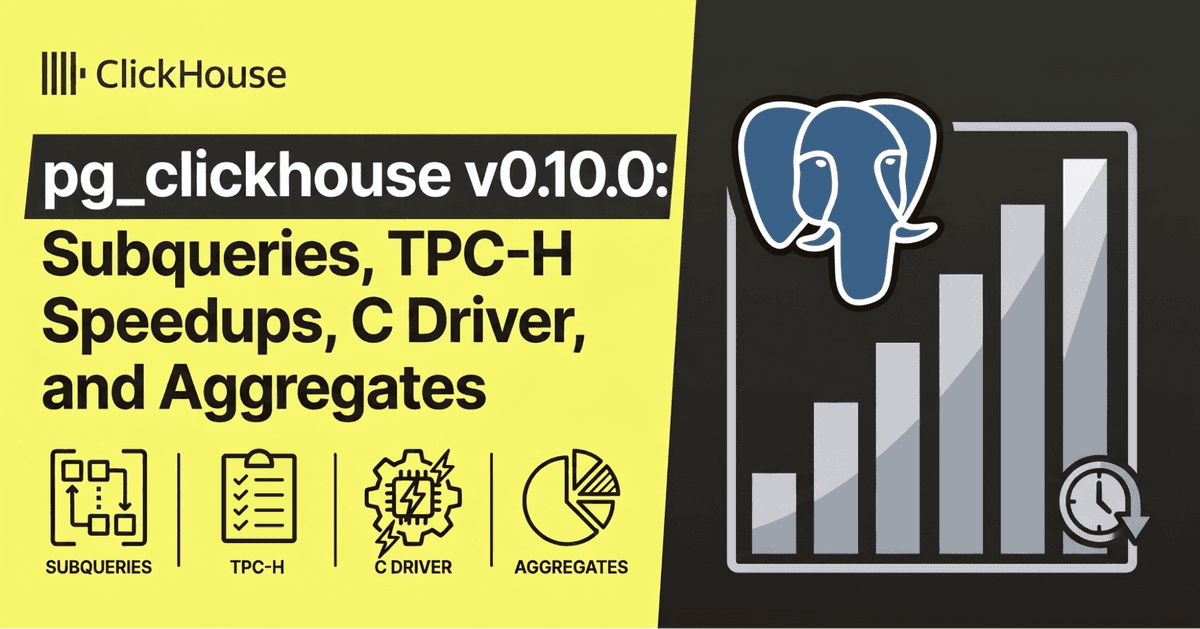
Databases ClickHouse

What's new in pg_clickhouse v0.10.0: Subqueries, TPC-H Speedups, C Driver, and Aggregates

Why it matters — Engineers using PostgreSQL-to-ClickHouse federation can now run more analytical queries entirely inside ClickHouse, cutting latency by orders of magnitude for workloads that previously required row-by-row evaluation. The updated C driver reduces maintenance overhead and fixes concurrency bugs that could cause intermittent failures under load. Knowing the remaining unsupported TPC-H shapes helps teams plan further query rewrites or await future pg_clickhouse enhancements.

2 feeds Compare ↗
11 min
12 496 new

Infra Phoronix

NetBSD 11.0

Why it matters — Engineers targeting embedded or heterogeneous systems now have an officially supported RISC-V target within NetBSD, which can simplify cross-platform toolchains. The upgraded Linux compatibility layer reduces friction when running Linux binaries on NetBSD, useful for legacy software or container-like workloads. Firewall improvements in NPF affect anyone who relies on NetBSD for routing or security appliances.

4 feeds Compare ↗
1 min
13 489 -4

AI llama.app

Open-source tool runs frontier AI models locally without API keys or telemetry

Why it matters — Engineers can now deploy AI models entirely on-premises, eliminating reliance on external APIs and ensuring data sovereignty. This reduces operational costs and compliance risks for applications handling sensitive data. However, performance and model selection may still be constrained by local hardware limits.

1 feed
2 min
14 488 -1

Infra Cloudflare

Introducing: Cloudflare Agents

Why it matters — For engineers running agentic workloads on Workers, the new view fills a real observability gap: prior traces covered fetch, KV, and D1 operations but stopped at the agent boundary, leaving you unable to tell whether a slow turn was the model, a tool, or the network. First-day support is limited to three OpenTelemetry-compatible harnesses, so adoption cost depends on whether your stack already uses one of them. Replay is recorded rather than re-executed, and payload capture is opt-in for sensitive data, so teams will need to make explicit choices about what gets stored.

6 feeds Compare ↗
7 min
15 484 -2

Infra Techmeme

Nvidia releases Nemotron 3.5 Lightning, an open 30B-parameter MoE model that it says delivers up to 4x faster output speeds, and an agentic AI model router (Kyt Dotson/SiliconANGLE)

Why it matters — For engineers building AI applications, an open MoE model with faster inference could lower latency and cost, while the agentic router hints at simpler orchestration across models. However, the speed claim is unverified and details on the router are minimal, so adoption should follow benchmarking.

3 feeds Compare ↗
85 min
16 481 -4

Infra github.com

CVE-2026-53361 AF_Unix GC vs. MSG_PEEK use-after-free container escape

Why it matters — The bug allows code running inside an unprivileged container to break out of its isolation, compromising host security. Engineers must update affected kernels or apply the fix to prevent this escape path. The issue also highlights subtle race conditions in kernel memory management that can be overlooked in container hardening.

1 feed
2 min
17 480 new

Tech OpenAI

Ten advances in mathematics and theoretical computer science

Why it matters — These breakthroughs resolve problems that have been open for a long time, potentially reshaping algorithmic design and security assumptions used by engineers. One of the cryptographic results was uncovered with the help of an AI model, showing that large-scale language-model prompting can contribute to security research, albeit at a significant token cost. The mix of new theory and AI-driven discovery suggests both new technical constraints and new research tools for software builders.

4 feeds Compare ↗
4 min
20 476 -3

Infra Linuxiac

NVIDIA’s Nemotron 3.5 Lightning AI Model Lands on Ubuntu via Snap

Why it matters — Engineers building or operating AI-driven systems on Ubuntu can now deploy a high-efficiency, customizable model without manual runtime setup. This reduces friction for local or edge AI workloads but ties users to Canonical’s Snap ecosystem and NVIDIA hardware. The trade-off is convenience versus flexibility in runtime choices.

2 feeds Compare ↗
2 min

HOW RANKING WORKS

Nothing here is paid, boosted, or weighted by time on page.

Every story carries a signal score, and every score decomposes into named parts you can inspect on the story page. If you disagree with a ranking, you can see exactly which component put it there.

Read the full method →

01 · RECENCY

How recently it was published, decaying on a fixed half-life rather than falling off a cliff.

02 · CROSS-FEED AGREEMENT

How many independent feeds carried the same story. Agreement reached separately is the strongest signal we have.

03 · SOURCE AUTHORITY

Editorial trust in the feed that carried it, which is not always the publisher shown. Primary engineering write-ups outrank rewrite desks.

04 · EARLY VELOCITY

Discussion the story drew in the feed that surfaced it, not on elseif. We never rank on our own click data.

05 · TOPIC CLARITY

How confidently the story classified. A story we cannot place is unlikely to be what you came for.