TECH Signal 430
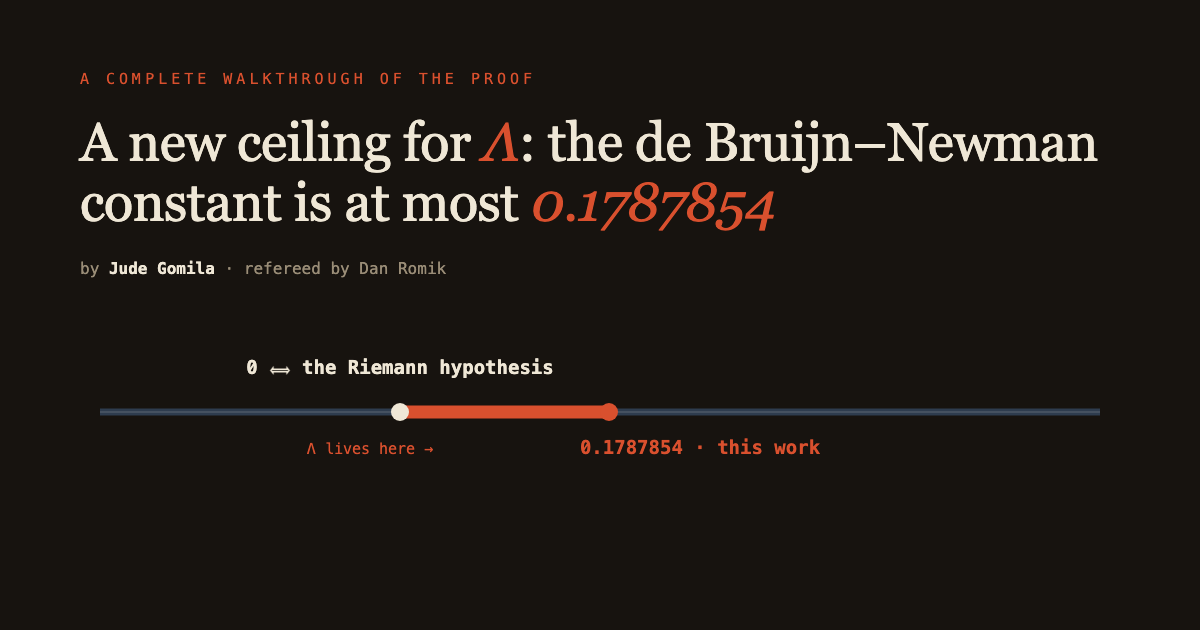
New upper bound proven for de Bruijn, Newman constant Λ at 0.1787854
 ↗
↗
Mathematicians have tightened the upper limit on the de Bruijn, Newman constant Λ, a proxy for the Riemann hypothesis, to 0.1787854.
The de Bruijn, Newman constant Λ directly encodes the Riemann hypothesis (RH): RH is true if and only if Λ ≤ 0. This new bound is the closest yet to zero, marking measurable progress toward resolving one of mathematics' most consequential open problems. For engineers, this affects the theoretical underpinnings of cryptographic systems and algorithms that rely on prime distribution assumptions.
Written by elseif from the cluster below · every claim links back to a sourceThe three things worth knowing
The Riemann hypothesis governs the error term in prime number distribution, impacting number-theoretic algorithms.
A new unconditional upper bound of 0.1787854 on Λ reduces the interval where the constant could lie.
The proof combines machine-verified checks, zero-free windows, and a lemma extending to infinity.
THE READ
What the cluster adds up to.
The de Bruijn, Newman constant Λ is a real number that reformulates the Riemann hypothesis (RH) into a quantitative statement: RH holds if and only if Λ ≤ 0. This new result proves Λ ≤ 0.1787854, shrinking the previous best upper bound. The significance lies in the unconditional nature of the proof, it does not assume RH is true or false, but instead provides a concrete, measurable step toward resolving it. For engineers, this matters because the error term in prime counting, governed by RH, influences the efficiency and security of algorithms that depend on prime distribution, such as those in cryptography.
The proof relies on three finite checks that collectively rule out zeros of the Riemann zeta function outside the critical line for Λ values above the new bound. The first check leverages existing machine-verified results for RH below a certain threshold. The second check certifies 3.1 million zero-free windows, while a lemma extends this certification to infinity. The third check establishes a barrier that no zero can cross under the new bound. These checks are combined to yield the upper limit on Λ. The method’s limitation is explicitly noted: it cannot reach Λ ≤ 0, meaning RH itself remains unproven.
The approach taken here is notable for its rigor and layering. The proof was verified four layers deep, ensuring robustness. However, the techniques used are tailored to bounding Λ from above and do not generalize to proving Λ = 0. This highlights a fundamental challenge: while progress on Λ is measurable, the tools required to close the gap to zero may differ entirely. For engineers, this underscores the distinction between incremental improvements and breakthroughs, while the new bound is a step forward, it does not yet alter the landscape of practical applications reliant on RH.
The Riemann hypothesis has implications far beyond pure mathematics. Its resolution would sharpen error bounds in prime-related algorithms, which are foundational to fields like cryptography and computational number theory. The new bound on Λ does not change the status of these applications, but it provides a clearer picture of how close mathematics is to resolving RH. The proof’s reliance on finite checks and computational verification also reflects a broader trend in modern mathematics, where large-scale computation plays a critical role in advancing theoretical results. This interplay between theory and computation is increasingly relevant to engineers working on algorithmic optimizations.
Written by elseif from the cluster below · checked for specifics the sources never containedTHE CLUSTER