DATABASES Signal 149
A new getting started experience for ClickHouse Managed Postgres
 ↗
↗
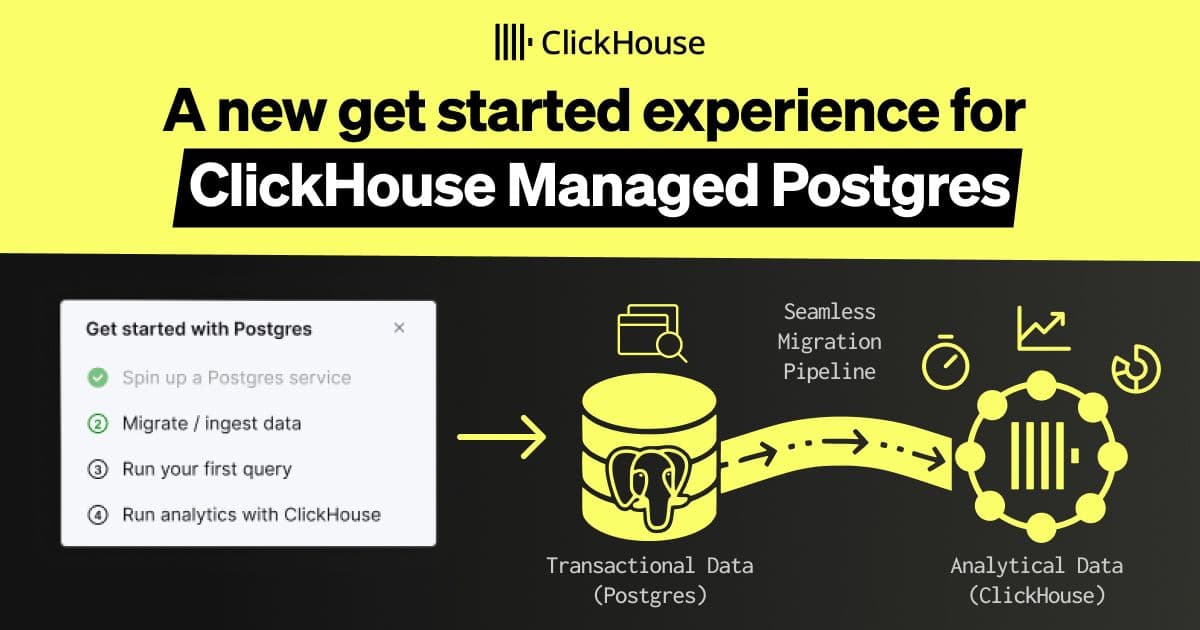
A four-step onboarding flow inside ClickHouse Cloud walks new Managed Postgres users from provisioning through data ingestion, a first SQL Console query, and analytics on the replicated data in ClickHouse.
For engineers evaluating ClickHouse Managed Postgres, the flow determines how quickly they can validate the unified Postgres-plus-ClickHouse pitch on their own data rather than on empty dashboards. The article excerpt cuts off before step four is fully described, and only one feed carried the announcement, so the substance here is what ClickHouse chose to publish about its own onboarding rather than independent reporting on it.
Written by elseif from the cluster below · every claim links back to a sourceThe three things worth knowing
The new flow replaces an Overview page that ClickHouse says was empty and gave new users no signal on what to do next.
Step two, ingesting or migrating data via ClickPipes, is positioned as the step every new user should complete, with sample datasets and language clients offered as fallbacks.
The path ends with CDC replication into ClickHouse and pg_clickhouse acting as a single query layer across both stores, exposing the combined stack rather than Postgres alone.
THE READ
What the cluster adds up to.
ClickHouse introduced a new getting-started flow for ClickHouse Managed Postgres inside ClickHouse Cloud. The previous experience dropped new users onto an Overview page that surfaced operational metrics and activity, which sat empty until a user loaded data and generated traffic. The replacement is a four-step path: provision a Postgres service, ingest or migrate data, run a first query in the SQL Console, and exercise ClickHouse for analytics against the replicated tables. The flow is stateful inside the product, meaning it tracks which steps a user has completed rather than relying on the existing CLI quickstart that lived in a separate documentation tab.
The onboarding is shaped around ClickHouse's positioning of Managed Postgres as half of a unified data stack: NVMe-backed Postgres for transactions, ClickHouse for real-time analytics, and managed replication keeping the two in sync. ClickPipes, already offered for ingestion, is now also the engine behind the Postgres-to-Postgres migration in step two, handling the snapshot, publication, replication slot, and ongoing sync. Steps three and four lean on the SQL Console and pg_clickhouse, with the latter positioned as a single query layer across both stores. The framing throughout is that value comes from working with data on both engines rather than from viewing dashboards about an idle database.
Three choices in the flow are worth flagging for someone building or operating on top of it. First, data ingestion is step two, not an afterthought, and migrating from an existing Postgres is treated as the canonical path, with sample datasets, language clients, and a blank-table creator as fallbacks for users not ready to connect a source database on day one. Second, the SQL Console is the destination for the first query rather than something the user has to discover. Third, an AI Assistant is offered inside the SQL Console to generate SQL against an unfamiliar schema, which is directly relevant after a migration when the user may not yet know the destination table layout.
The article excerpt cuts off mid-step-four, so the precise mechanics of the final analytics step are only summarised in the article's step table rather than described in prose. Only one feed carried this story, which is consistent with a vendor product announcement rather than independent industry coverage. Engineers evaluating the flow should treat the framing as ClickHouse's own narrative about what the onboarding does, not as a benchmark against competing managed Postgres offerings, and should expect to validate the unified-stack claim with their own data rather than relying on the configured sample datasets.
Written by elseif from the cluster below · checked for specifics the sources never containedTHE CLUSTER