LANGUAGES Signal 130
TypeSafe AI tests Jev, a non-generative model for trusted monitoring of backdoored code
 ↗
↗
TypeSafe AI has introduced Jev, a model designed to make structured decisions, providing suspicion scores for code submissions.
Jev represents a shift from traditional generative models to a non-generative approach for AI control, which could lead to more reliable monitoring processes. By providing structured outputs and lower operational costs, it may enhance the safety and efficiency of AI systems. The effectiveness of Jev in identifying backdoored code could significantly improve trust in AI decision-making.
Written by elseif from the cluster below · every claim links back to a sourceThe three things worth knowing
Jev is trained to provide fast, structured decisions instead of generating free-form text.
It achieves a high true-positive rate for detecting backdoors while maintaining a low false-positive rate.
The operational cost of using Jev is significantly lower than traditional models, priced at $0.042 per million tokens.
THE READ
What the cluster adds up to.
TypeSafe AI's Jev model represents a novel approach to monitoring AI outputs by focusing on structured decision-making rather than generative text creation. This shift allows Jev to analyze code submissions and provide suspicion scores effectively, identifying backdoored code with a high degree of accuracy.
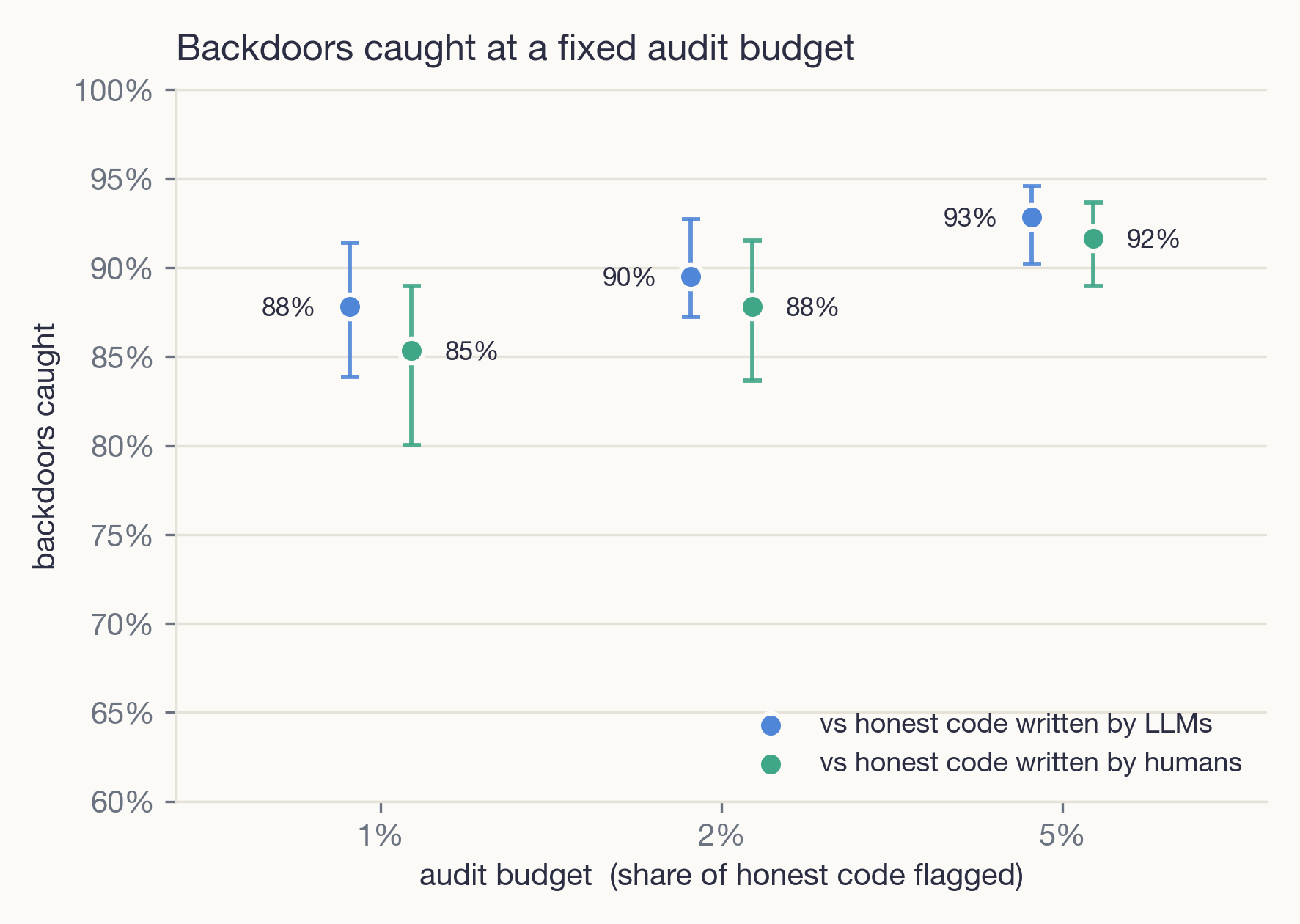
The model's performance is notable, achieving a true-positive rate of approximately 90% for detecting malicious code while maintaining a false-positive rate of only 2%. This reliability is crucial for AI control systems, which require consistent monitoring to ensure safety and trustworthiness.
Operating costs are a significant advantage of using Jev. At approximately $0.042 per million input tokens, it offers a cost-effective solution compared to existing models that utilize generative techniques. This affordability allows for broader implementation across various applications, enhancing overall system robustness against security threats.
Despite its strengths, Jev's monitoring capabilities may be limited to specific contexts, such as the APPS backdoor task. Its effectiveness in other scenarios or with different types of code submissions remains to be fully validated.
The use of reinforcement learning for calibrated decisions (RLCD) distinguishes Jev from traditional reinforcement learning with human feedback (RLHF) models. This difference could lead to more stable and reliable outputs, minimizing the risks associated with model drift commonly seen in generative models.
Written by elseif from the cluster below · checked for specifics the sources never containedTHE CLUSTER