AI Signal 431
A recurrent llm is reportedly easy to interpret but hard to steer
 ↗
↗
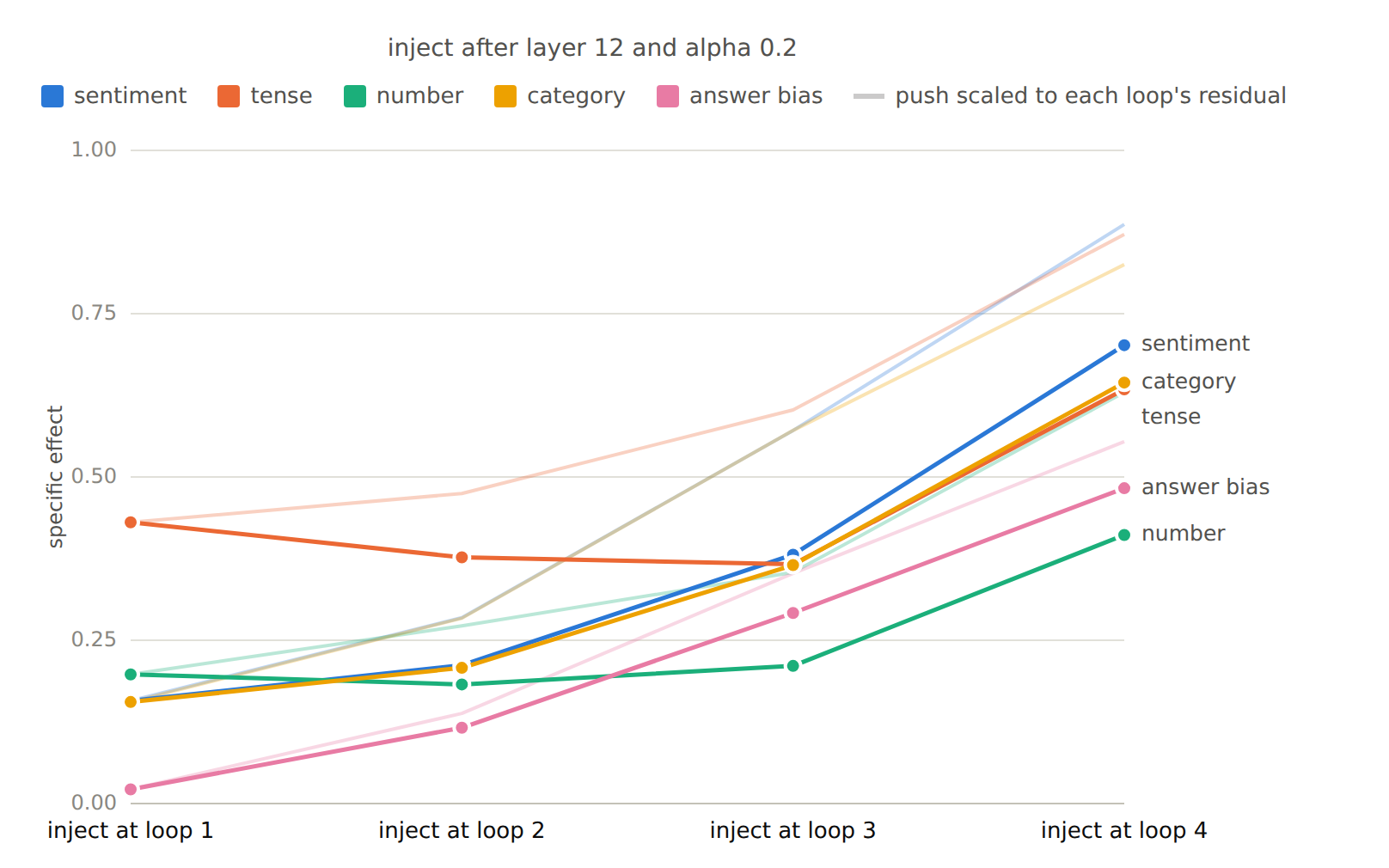
Ouro-1.4b-thinking is interpretable with logit lenses and linear probes but struggles with steering foreign concepts injected prior to the last loop.
Understanding the interpretability and steering capabilities of recurrent LLMs is crucial for their safe implementation in AI applications. The findings suggest potential risks in steering these models, particularly if they become misaligned. This raises concerns about safety in applications where alignment with user intent is critical.
Written by elseif from the cluster below · every claim links back to a sourceThe three things worth knowing
Ouro-1.4b-thinking can be interpreted effectively using logit lenses and linear probes.
Steering the model works best when applied during the last loop, with earlier injections being less effective.
The model tends to 'clean' foreign concepts from its residual stream, which can lead to safety implications.
THE READ
What the cluster adds up to.
The Ouro-1.4b-thinking model demonstrates a high level of interpretability, as evidenced by successful application of logit lenses and linear probes. This means engineers can analyze the model's decision-making processes effectively, which is beneficial for debugging and understanding model behavior.
However, the steering of the model presents challenges, especially when attempts are made to inject new concepts into the residual stream before the final loop. This cleaning effect suggests that the model prioritizes its inherent structure over external modifications, which could limit its adaptability in practical applications.
The findings highlight a critical point: steering is significantly more effective when applied at the last loop. This could force developers to rethink strategies for influencing model outputs, particularly in scenarios where real-time adjustments are necessary.
The implications for safety are noteworthy, as a misaligned model could plan around steering attempts, potentially leading to unintended consequences. Engineers must consider these risks when designing systems that rely on recurrent LLMs for decision-making tasks.
Overall, while the interpretability of Ouro-1.4b-thinking is a positive aspect, the difficulties in steering raise important questions about the reliability of these models in sensitive applications, necessitating further research and possibly new steering methodologies.
Written by elseif from the cluster below · checked for specifics the sources never containedTHE CLUSTER