TECH Signal 473
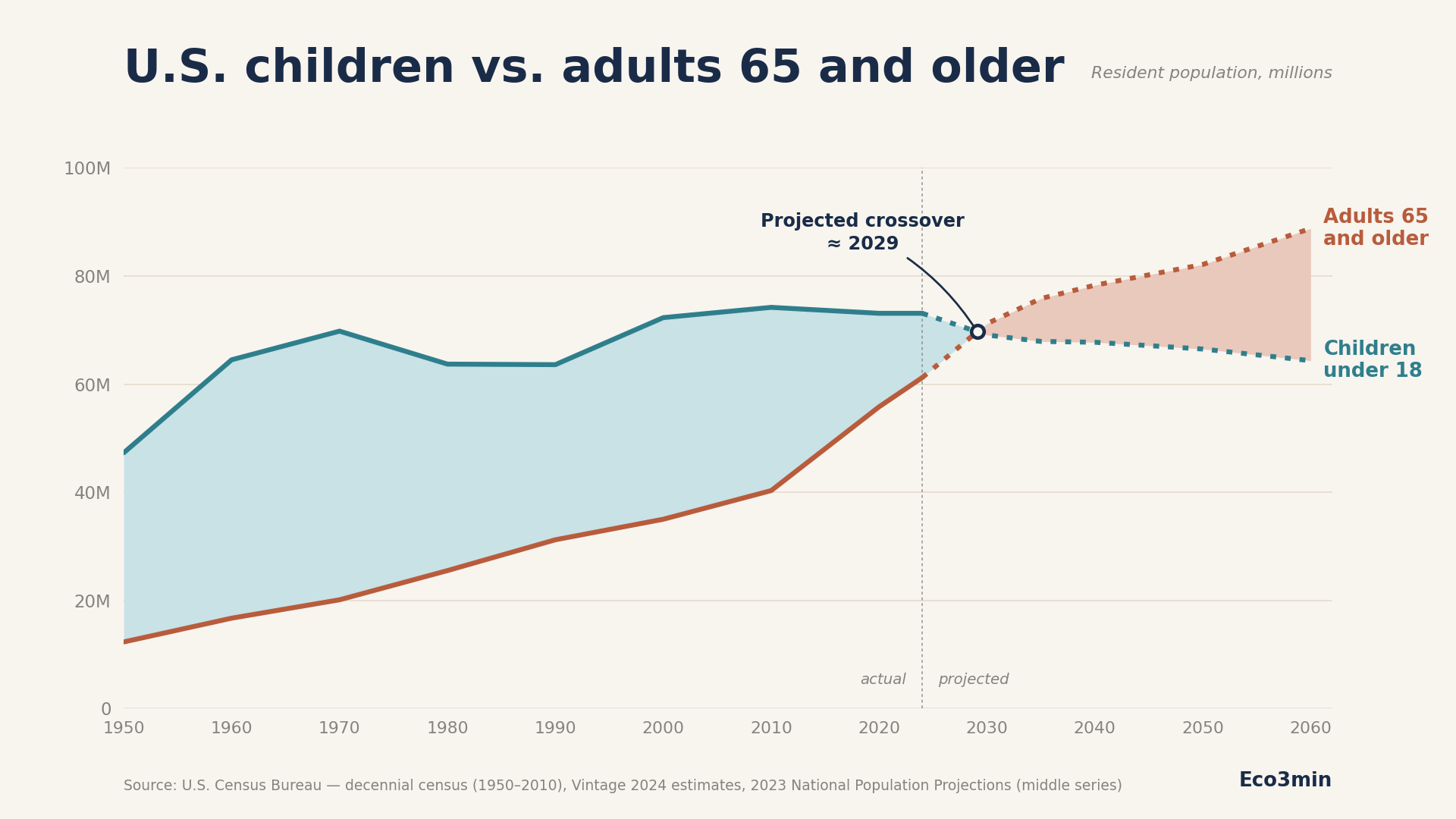
Adults over 65 will outnumber children by 2029
 ↗
↗
U.S. Census projections show adults over 65 will outnumber children under 18 by 2029, a demographic shift not seen before in U.S. history.
This crossover alters the user base for software and services, increasing demand for accessibility, health monitoring, and elder-focused interfaces. Engineers must design for a population that skews older, with implications for usability, support, and long-term product viability. The shift also pressures systems reliant on working-age labor, including tech workforce demographics.
Written by elseif from the cluster below · every claim links back to a sourceThe three things worth knowing
The crossover is projected for 2029, five years earlier than previously estimated due to revised fertility and mortality data.
The number of adults 65+ has grown five-fold since 1950, while the child population has remained relatively stable near 73 million.
Eleven states and nearly half of U.S. counties have already reached this demographic milestone as of 2024.
THE READ
What the cluster adds up to.
The demographic shift is driven by two distinct trends: a rapid increase in the 65+ population and a stagnant child population. The older cohort has grown steadily, accelerated by the aging baby-boom generation, while the number of children has plateaued despite overall population growth. This convergence is not a temporary anomaly but a structural change, with the gap closing entirely within the next five years. For engineers, this means the median user of many products will soon be over 65, requiring adjustments in design assumptions and testing protocols.
The crossover has immediate consequences for software that targets broad audiences. Accessibility features, such as larger text, voice control, and simplified navigation, will no longer be optional but essential for market viability. Health-related applications, from medication reminders to fall detection, will see increased demand, while platforms reliant on younger demographics may need to pivot or risk obsolescence. The shift also affects workforce planning, as the ratio of working-age adults to older adults declines, potentially tightening labor markets in tech and related fields.
The projection’s earlier timeline reflects updated data, particularly lower fertility rates post-pandemic. This revision underscores the unpredictability of demographic trends and the need for engineers to build flexibility into systems. For example, elder-care platforms must scale quickly, while consumer products may need modular designs to accommodate shifting user needs. The crossover also highlights regional disparities, with some areas already past the tipping point, requiring localized strategies for product deployment and support.
The long-term trajectory suggests this is not a one-time event but the beginning of a sustained trend. By 2060, nearly a quarter of the U.S. population will be 65+, with the ratio of working-age adults to older adults dropping from 3.4 today to 2.4. This demographic pressure will strain systems reliant on younger users or workers, from social media to enterprise software. Engineers must account for slower adoption curves, higher support costs, and the need for backward compatibility in products designed for longevity.
Written by elseif from the cluster below · checked for specifics the sources never containedTHE CLUSTER