TECH Signal 221
An opinionated primer on Causal Decision Theory (CDT) and Evidential Decision Theory (EDT)
 ↗
↗
A LessWrong article by Chi Nguyen provides a neutral overview of Causal and Evidential Decision Theory before arguing that EDT is superior for agents with correlated actions.
The post highlights a specific failure mode for Causal Decision Theory when agents are copies or functionally identical, suggesting that standard causal reasoning may lead to suboptimal outcomes in multi-agent AI systems. It provides a concrete framework for evaluating decision-making algorithms in scenarios where actions are evidentially linked rather than causally independent.
Written by elseif from the cluster below · every claim links back to a sourceThe three things worth knowing
The article uses a Prisoners' Dilemma variant with a copied opponent to demonstrate that CDT recommends defection while EDT recommends cooperation.
The author argues that EDT correctly handles the 'Smoking Lesion' scenario and can extract money from CDT agents via 'Adversarial Offers'.
The post recommends Arif Ahmed's 2014 book for a rigorous academic treatment of Evidential Decision Theory.
THE READ
What the cluster adds up to.
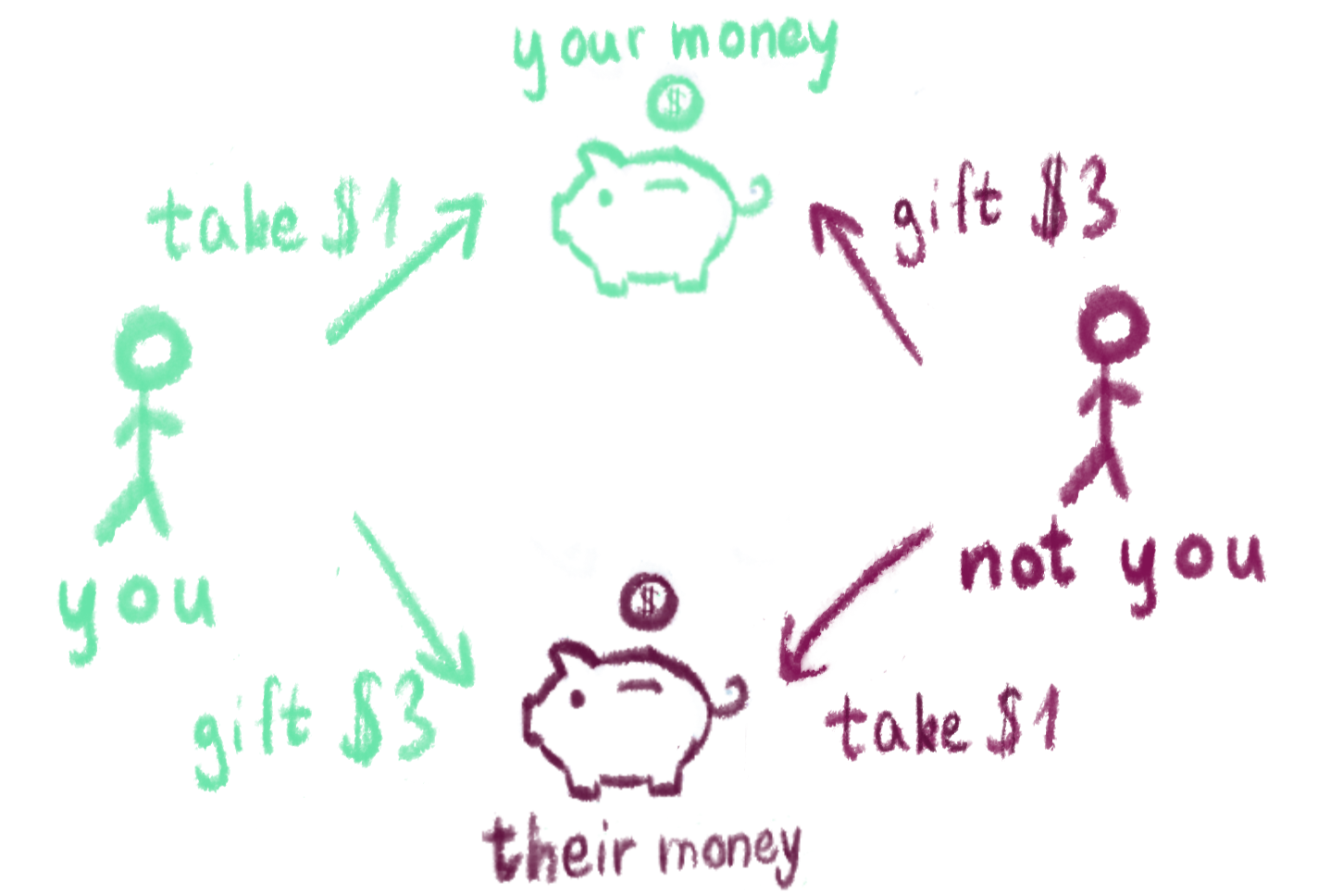
The core distinction between the two theories lies in how they form probability distributions over outcomes. Causal Decision Theory restricts this to physical consequences, ignoring correlations that do not involve direct causation. Evidential Decision Theory conditions on the action itself, treating the action as evidence about the state of the world, including correlated events. This difference becomes critical when the decision-maker's action is correlated with another agent's action without a causal link.
In the motivating example, where an agent faces a copy of themselves, CDT leads to defection because the agent cannot causally influence the copy's prior decision. EDT leads to cooperation because choosing to cooperate serves as strong evidence that the copy also chose to cooperate. The author argues that this evidential reasoning yields a higher expected utility in this specific setup, challenging the default assumption that causal reasoning is always optimal.
The article extends this argument to the 'Smoking Lesion' scenario, claiming EDT solves it correctly by recognizing the correlation between smoking and cancer risk without assuming causation. It also introduces the 'Adversarial Offer' concept, suggesting that a sophisticated agent can exploit CDT agents by making offers that are only beneficial if the agent defects, thereby extracting value from their causal reasoning limitations.
For software engineers building multi-agent systems, this distinction matters when agents share code, weights, or training data. If two AI instances are functionally identical, their decisions are correlated. Applying CDT in such environments may result in both agents defecting in cooperative scenarios, whereas EDT would align their incentives to cooperate. The post suggests that decision-making modules in such systems might need to account for these evidential links to maximize collective utility.
Written by elseif from the cluster below · checked for specifics the sources never containedTHE CLUSTER