INFRA Signal 149
Analyzing rising fraud attempts among travel and leisure businesses on Stripe
 ↗
↗
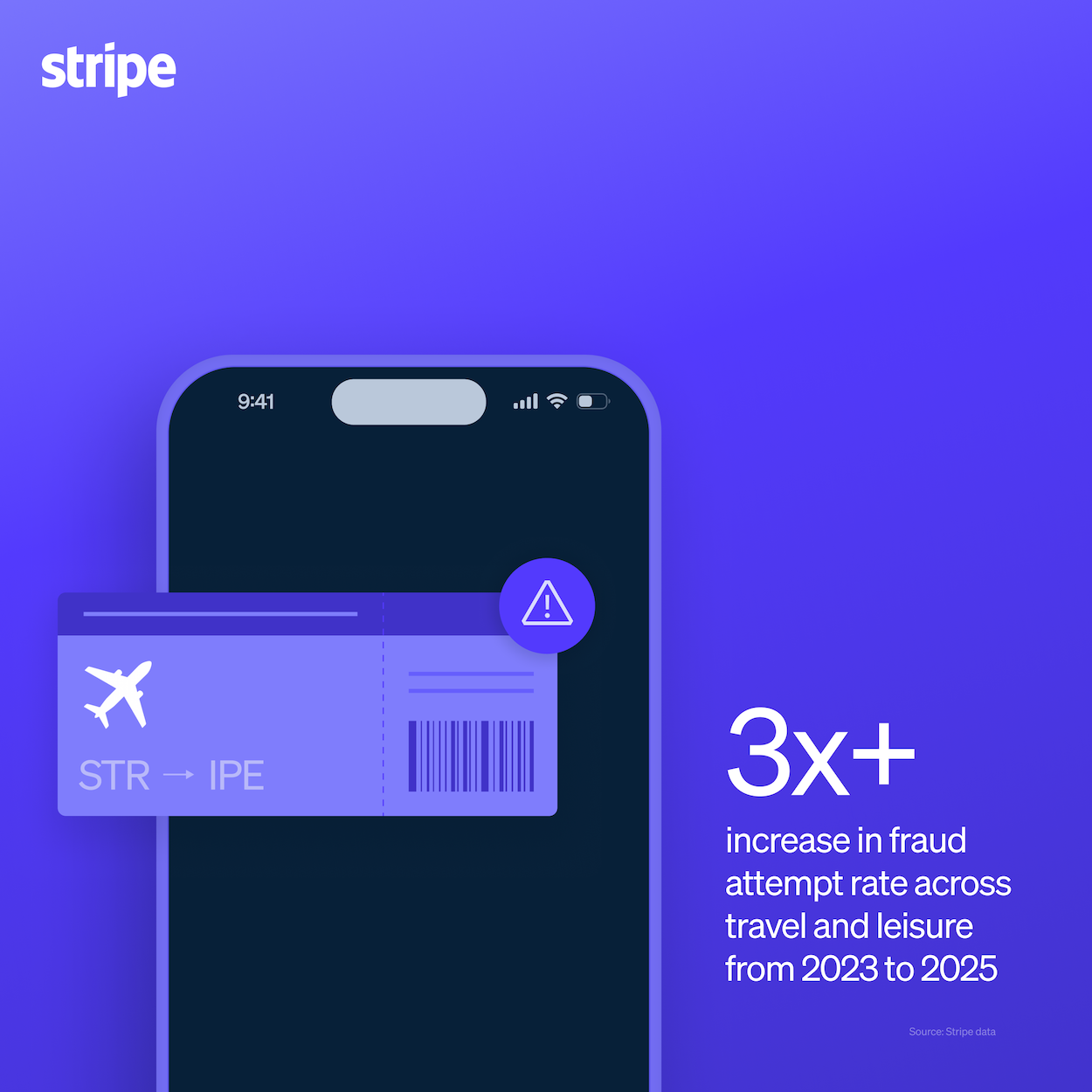
Stripe data from over 200,000 travel and leisure businesses indicates a sharp rise in fraud attempts, particularly in APAC and EMEA.
Travel businesses face a conflict between the need for second-speed booking approvals and the risk of high-value fraudulent transactions. This makes them vulnerable to synthetic identities and phishing kits sold as a service.
Written by elseif from the cluster below · every claim links back to a sourceThe three things worth knowing
Fraud attempt rates in APAC and EMEA increased more than fivefold from 2024.
Stripe Radar blocked over $3 billion in suspected fraudulent payment volume for these merchants last year.
The share of attempted fraud reaching payment decreased by more than two-thirds between 2023 and 2025.
THE READ
What the cluster adds up to.
Fraud attempts are increasing due to the time-sensitive nature of travel bookings and the use of AI to create synthetic identities. Bad actors target high-value reservations and smaller add-ons like lounge access or seat upgrades. These losses are difficult to recover because services are often consumed before the fraud is detected.
The cost of mitigation involves a trade-off between security and customer friction. Adding verification steps can lead to lost customers who prioritize speed for last-minute bookings. Some businesses mitigate this by applying targeted authentication, such as checking if the reservation name matches the cardholder name.
Effectiveness varies by region, with North American businesses seeing a decline in fraud attempt rates while other regions rose. This divergence suggests that global fraud controls may not be universally effective. Operators must analyze disputes and acceptance rates by region and payment method to identify specific risks like card testing or account takeovers.
Written by elseif from the cluster below · checked for specifics the sources never containedTHE CLUSTER