TECH Signal 427
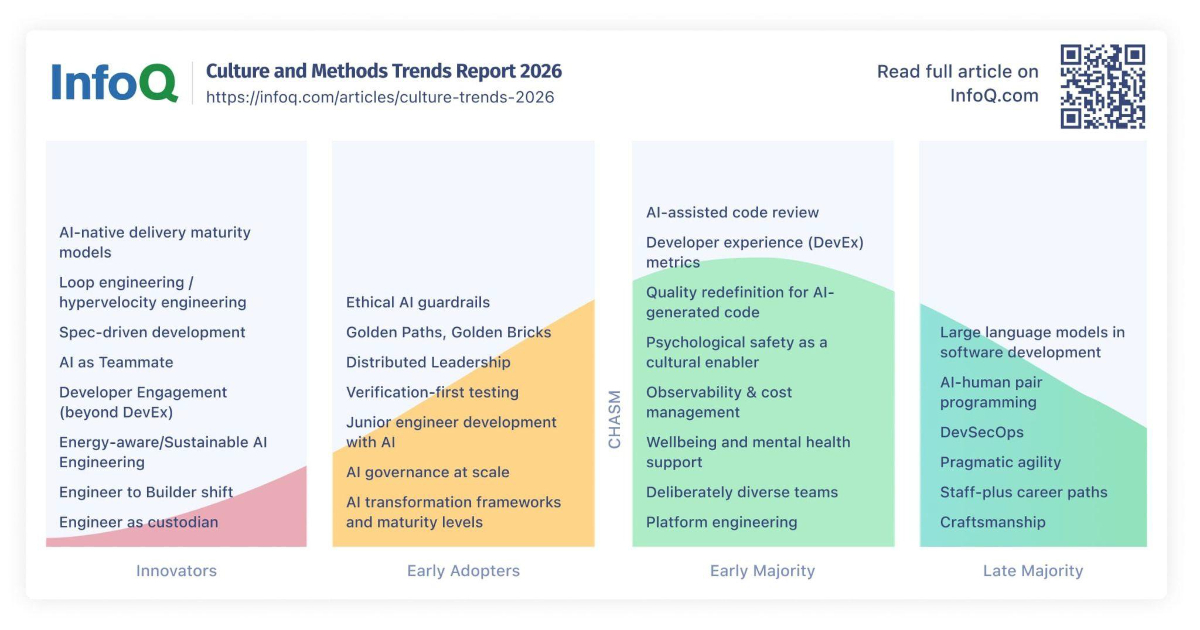
Article: InfoQ Culture and Methods Trends Report - 2026
 ↗
↗
The InfoQ Culture and Methods Trends Report 2026 summarizes ongoing and emergent trends in software culture and methods as seen by its editorial team.
Engineers must adopt risk-based AI maturity frameworks that match automation levels to the criticality of systems. They also need to adapt to shrinking, role-blurred teams, implement new quality and accountability processes for AI-generated code, and shift from writing code to directing, validating, and building guardrails around AI agents while upholding agile fundamentals.
Written by elseif from the cluster below · every claim links back to a sourceThe three things worth knowing
AI adoption requires maturity frameworks that assess risk, impact, and specific context before deciding on automation levels.
Collaboration patterns are changing as teams shrink and roles blur, making effectiveness more important than fixed team structures.
The surge in AI-generated code demands new processes for quality assurance, cognitive load management, and clear accountability.
THE READ
What the cluster adds up to.
The report notes that many organizations treat AI adoption as an all-or-nothing decision, either applying it everywhere or holding back completely. A more effective approach is to use risk-based reasoning: evaluate the specific risk, impact, and circumstances of the software, the company, and the people involved. This leads to maturity frameworks that differentiate between low-risk internal tools and business-critical systems, determining appropriate levels of automation and human oversight.
Adopting such frameworks carries costs in the form of time spent assessing risk, defining maturity levels, and establishing governance processes. Teams may need new tooling for monitoring AI behavior and training staff to interpret risk assessments. If organizations skip this step and apply AI indiscriminately, they increase the chance of unintended consequences, especially in high-impact areas where errors could be costly.
Collaboration is described as shifting from predefined team structures to fluid arrangements where members take on overlapping responsibilities. This change requires investment in communication practices, shared understanding of goals, and mechanisms to maintain effectiveness despite blurred role boundaries. Without deliberate effort to improve collaboration, the potential benefits of AI-augmented work may be lost due to misalignment or duplicated effort.
The explosion of AI-generated code introduces additional work: establishing quality checks, managing the cognitive load of reviewing AI output, and clarifying who is accountable when issues arise. Engineers must spend time building guardrails, validating AI suggestions, and observing system behavior in production. If these processes are not put in place, the speed gains from AI can be undermined by defects, technical debt, or unclear responsibility, ultimately slowing delivery and increasing risk.
The report warns that organizations lacking solid agile fundamentals, fast feedback loops, reflective learning, observability, and a focus on shipping the right value to users, face catastrophic risk when they adopt AI. Additionally, the industry must confront the environmental costs of AI workloads, the potential loss of diverse thinking from homogenized model outputs, and the accountability gap when no individual owns AI-generated systems. Ignoring these factors limits where AI adoption can succeed and may lead to negative outcomes that outweigh any short-term gains.
Written by elseif from the cluster below · checked for specifics the sources never containedTHE CLUSTER