TECH Signal 400
ASRock X870E Taichi White Motherboard Review: A Taichi washed in white, now with 10 GbE
 ↗
↗
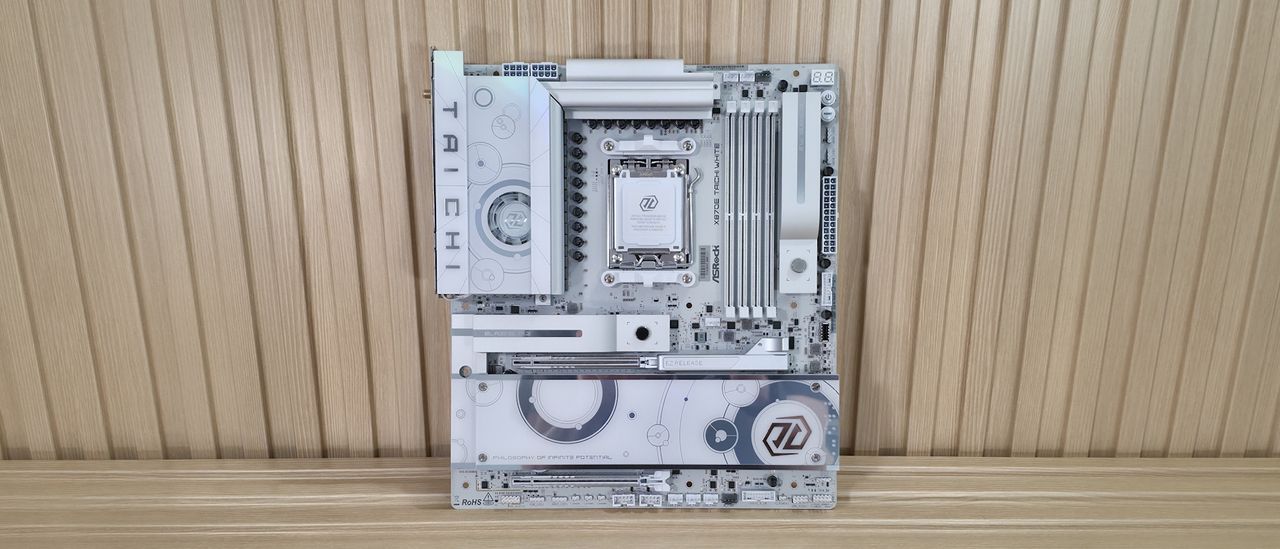
The ASRock X870E Taichi White motherboard adds an all-white aesthetic and 10 GbE networking to the existing Taichi platform.
Engineers building high-end white-themed systems gain a motherboard that matches the aesthetic without custom painting. The addition of 10 GbE provides faster wired networking for data-intensive workloads. However, the higher price may limit adoption compared to other white options.
Written by elseif from the cluster below · every claim links back to a sourceThe three things worth knowing
The motherboard features an all-white color scheme and is ASRock's first board with all-white components.
It includes a 10 GbE Ethernet controller (Marvell AQC113) upgrading from previous 5 GbE.
It retains the original Taichi's feature set such as 27-phase VRM with active cooling, multiple USB4 ports, and four DDR5 slots, while reducing SATA ports from six to three.
THE READ
What the cluster adds up to.
The ASRock X870E Taichi White motherboard introduces an all-white color scheme, marking the first ASRock board to feature all-white components. This addresses builders seeking a clean aesthetic without the need for custom paint or aftermarket parts. The visual change does not alter the underlying socket or chipset compatibility.
Networking is upgraded to a 10 GbE Ethernet controller (Marvell AQC113), increasing bandwidth from the previous 5 GbE offering. This provides faster data transfer for workloads such as virtualization, storage arrays, or high-resolution video editing. The rest of the I/O layout remains similar to the original Taichi, preserving the abundant USB ports.
Core hardware retains the 27-phase VRM with active cooling, supporting high-end AMD processors on the AM5 socket. The board continues to offer two USB4 (40 Gbps) Type-C ports, multiple USB 3.2 Gen 2 ports, and four DDR5 DIMM slots capable of overclocked memory. PCIe expansion includes two x16 slots (x8/x8 mode) and four M.2 sockets, though only one operates at PCIe 5.0 speeds.
Trade-offs include a reduced SATA count of three ports down from six on the prior model and a single PCIe 5.0 M.2 slot, which may limit storage configurations. The BIOS is noted as still needing a refresh, and the Wi-Fi 7 module operates at a narrower 160 MHz channel, resulting in lower wireless throughput. Additionally, the VRM fan requires software-based control for full speed adjustment, and the higher price may deter cost-sensitive builders.
Written by elseif from the cluster below · checked for specifics the sources never containedTHE CLUSTER