AI Signal 372
Astra reportedly solves complex Boolean logic problems without chain-of-thought prompting
 ↗
↗
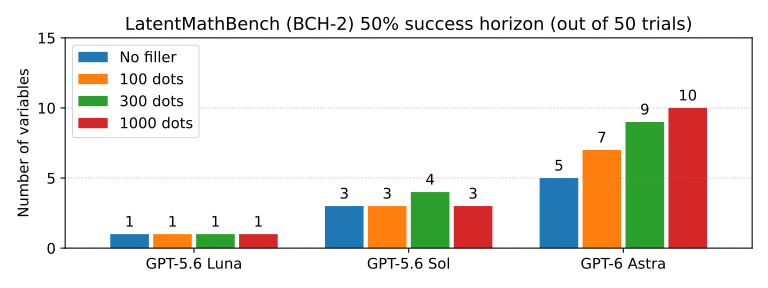
Testing on randomized Boolean logic problems shows Astra performing belief-propagation-like inference without explicit step-by-step reasoning
If confirmed, this suggests some large language models may internally approximate probabilistic reasoning without explicit intermediate steps. This could reduce the need for engineered prompts in certain logic tasks but may also obscure how solutions are derived. The finding is preliminary and based on limited testing.
Written by elseif from the cluster below · every claim links back to a sourceThe three things worth knowing
Astra demonstrates ability to solve complex Boolean logic problems without chain-of-thought prompting
Performance improves with additional filler tokens, suggesting token count influences inference capability
Model appears to combine prior probabilities with constraints to find most likely solutions
THE READ
What the cluster adds up to.
The reported behavior indicates Astra may perform some form of belief propagation during inference, a technique used in probabilistic graphical models. This would represent a departure from the typical step-by-step reasoning seen in chain-of-thought approaches. The model's ability to handle randomized Boolean logic problems without explicit intermediate steps suggests an internal mechanism that approximates probabilistic reasoning.
The observation that performance improves with more filler tokens introduces an interesting variable in model behavior. This suggests that token count, rather than just content, may influence the model's ability to perform complex logical inference. Such behavior could complicate prompt engineering, as optimal performance might require balancing meaningful content with seemingly irrelevant tokens.
The claim that Astra combines prior probabilities with constraints to find solutions points to a more sophisticated inference process than simple pattern matching. This capability, if verified, would indicate the model can perform a form of probabilistic reasoning that integrates multiple sources of information. However, the lack of chain-of-thought output means the internal reasoning process remains opaque to users.
The findings are based on a single test case with randomized Boolean logic problems, limiting their generalizability. While intriguing, the results require replication across different problem types and model configurations before drawing broader conclusions. The absence of chain-of-thought output also makes it difficult to verify whether the model is truly performing belief propagation or some other form of inference.
Written by elseif from the cluster below · checked for specifics the sources never containedTHE CLUSTER