TECH Signal 509
Astronomers capture highest-resolution image ever of the Sun's surface
 ↗
↗
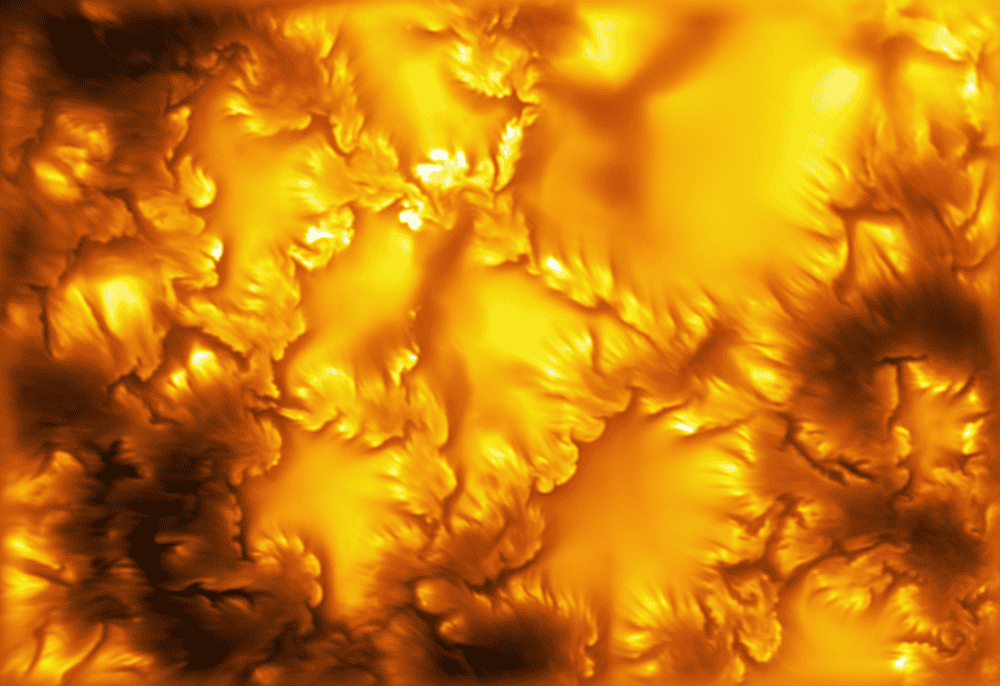
Astronomers have obtained the highest-resolution image of the Sun's visible surface, revealing plasma vortices as small as 20 km linked to Kelvin-Helmholtz instabilities.
The new resolution lets engineers see fluid-dynamic processes that were previously invisible, improving the fidelity of solar-plasma models used for space-weather forecasting. It also demonstrates the capability of the Daniel K Inouye Solar Telescope to probe sub-granular scales, informing the design of future solar observatories and diagnostic tools.
Written by elseif from the cluster below · every claim links back to a sourceThe three things worth knowing
The image shows vortex-like structures at the edges of granules, with some features as narrow as 20 km.
These vortices are interpreted as Kelvin-Helmholtz instabilities arising where plasma flows slide past each other at different speeds.
Observing such small-scale motions provides the first direct confirmation of the instability on the Sun and may help explain coronal heating and magnetic-energy transport.
THE READ
What the cluster adds up to.
The achievement represents a change in observable scale: structures down to about 20 km on the solar photosphere are now resolvable, whereas earlier images could only show larger granules (500 to 2000 km). This pushes the imaging limit into the regime where plasma whirlpools and vortex-like patterns become visible. The change enables direct study of shear-driven instabilities that were previously inferred only indirectly. Engineers working on solar-instrumentation now have a benchmark for the smallest features that can be captured with current technology.
Adopting this level of detail requires access to the Daniel K Inouye Solar Telescope, which is a specialized facility located in Hawaii, and sophisticated data-processing pipelines to extract the faint vortex signals from the raw data. The cost is therefore limited to institutions that can secure telescope time and allocate computational resources for high-dynamic-range image reconstruction. Only a handful of solar observatories worldwide possess comparable aperture and adaptive-optics capabilities, so widespread replication is not immediate.
The technique stops working when attempting to resolve features smaller than the ~20 km scale set by the telescope’s diffraction limit and residual atmospheric distortions, even after post-processing. Additionally, the observed vortices appear most prominently in magnetically active regions near sunspots; quieter areas of the photosphere may not exhibit sufficient contrast or flow shear to make the instabilities detectable. Consequently, the method is presently most useful for studying active-region dynamics rather than the global quiet Sun.
Linking the observed structures to Kelvin-Helmholtz instabilities provides engineers with a concrete fluid-dynamics mechanism to include in solar-plasma simulations and space-weather prediction codes. By validating the instability at the observed scale, models can better capture how magnetic energy is transferred and dissipated near the surface, which influences coronal heating and solar-wind acceleration. This observational feedback loop helps refine the parameters used in engineering-grade simulations of solar-magnetospheric interactions.
Written by elseif from the cluster below · checked for specifics the sources never containedTHE CLUSTER