DATABASES Signal 348
August 2026 newsletter
 ↗
↗
The August 2026 ClickHouse newsletter highlights the 26.7 release with new token-position text indexes, an EXPLAIN ANALYZE clause, and join optimizations, plus a new research lab and a multi-city Open House roadshow.
Token-position indexes enable efficient phrase searches, cutting latency dramatically for text-heavy analytical queries. EXPLAIN ANALYZE supplies detailed per-phase execution metrics, allowing engineers to pinpoint bottlenecks and tune queries. The join algorithm improvements lower CPU and memory pressure, reducing operational cost for large-scale workloads.
Written by elseif from the cluster below · every claim links back to a sourceThe three things worth knowing
Token-position text indexes make phrase search up to 40× faster on real-world datasets.
EXPLAIN ANALYZE runs each query-processing phase and annotates the plan with actual measurements.
Join optimizations shrink probe input and build-side hash tables while auto-arranging multi-table joins.
THE READ
What the cluster adds up to.
The August newsletter announces ClickHouse version 26.7, the longest release post to date, introducing several performance-focused features. Among them are token-position text indexes that store token locations, a new EXPLAIN ANALYZE clause, and join algorithm refinements that reduce probe-side input and shrink hash tables. The release also adds automatic join ordering for multi-table queries, expanding the optimizer's capabilities.
Token-position indexes are designed for efficient phrase search; a test on a Hacker News dataset showed a 40-fold speedup for a phrase query. Enabling these indexes may increase index storage size because token positions must be persisted, but the trade-off is substantially lower query latency for text-heavy workloads. Engineers should evaluate index overhead against expected search patterns before deployment.
EXPLAIN ANALYZE executes every phase of a query, discarding result rows while collecting timing data that is attached to the logical plan tree. This provides precise runtime insight without altering query semantics, but the extra execution step adds overhead, so it is best used during debugging or performance tuning rather than in production pipelines. The feature complements existing EXPLAIN output by turning abstract cost estimates into measured values.
Join optimizations reduce the amount of data probed on the build side and compress hash tables, which can lower memory consumption and improve CPU cache utilization. The system now automatically decides how to arrange joins in multi-table queries, simplifying query authoring. These changes are transparent to existing queries but may require re-evaluation of custom join hints if they were previously used.
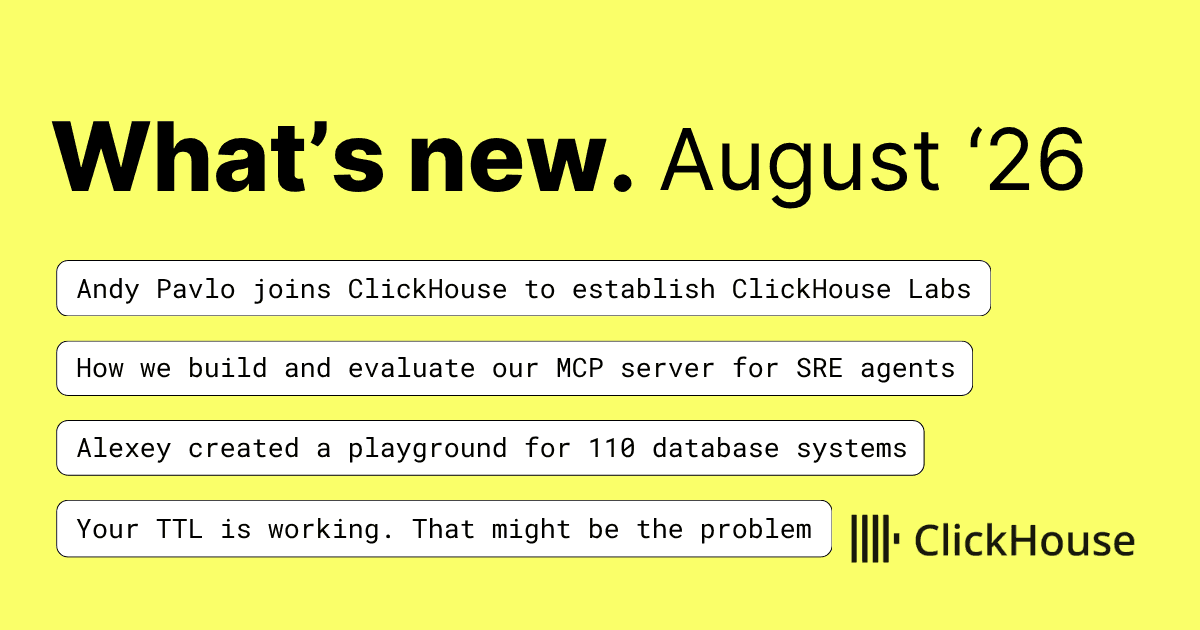
Beyond the release, ClickHouse announced the formation of ClickHouse Labs, led by Andy Pavlo, to conduct applied research and boost the managed PostgreSQL offering. The Open House Roadshow will visit six cities, providing talks and optional training workshops, signaling a push for community engagement. Additionally, an interactive playground now supports ad-hoc queries against over 100 database systems using Firecracker microVMs on AWS, offering strong isolation and fast startup for benchmarking, though it incurs AWS compute costs.
Written by elseif from the cluster below · checked for specifics the sources never containedTHE CLUSTER