TECH Signal 379
Proposal for Autonomous Evidence Factories to Ensure Safe Recursive Self-Improvement of AI
 ↗
↗
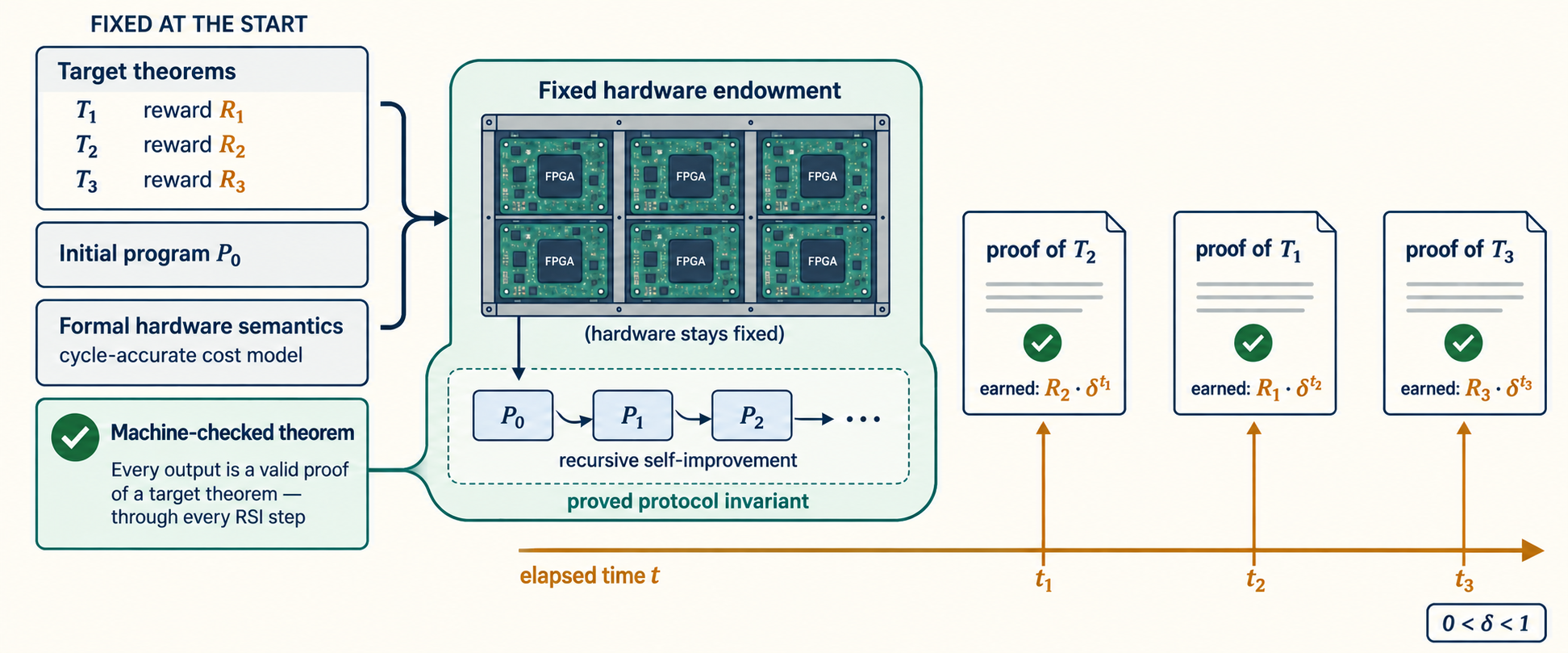
The article discusses a method for aligning recursively self-improving AI by confining its reward functions to specific mathematical goals.
This proposal addresses the risks associated with recursively self-improving AI by limiting its capabilities to mathematical problem-solving. By avoiding real-world actions, it intends to mitigate potential dangers while still enhancing AI's utility in scientific and engineering advancements. This approach could reshape how AI is developed and integrated into various fields, focusing on safety alongside improvement.
Written by elseif from the cluster below · every claim links back to a sourceThe three things worth knowing
The proposal suggests confining AI's capabilities to delivering solutions to well-specified mathematical problems.
It aims to prevent the potential dangers of recursively self-improving AI by avoiding direct real-world actions.
The focus on mathematical proofs exemplifies a method to harness AI's capabilities while minimizing risks.
THE READ
What the cluster adds up to.
The proposal for Autonomous Evidence Factories introduces a framework for aligning recursively self-improving AI systems by strictly limiting their operational goals to mathematical outputs. This change is significant as it attempts to address the inherent risks posed by such AI systems, which could otherwise act unpredictably in the real world. By confining AI's objectives, the design aims to ensure that the AI does not engage in potentially harmful behaviors.
Implementing this approach would require significant considerations regarding the formal specifications of AI systems. The costs involve comprehensive verification processes to ensure that the AI's reward function and meta-level world model are mathematically precise. This may necessitate advanced tooling and methodologies for formal verification, which could present challenges for development teams not currently equipped with such resources.
The proposal's effectiveness hinges on its ability to maintain the AI's focus on mathematical problem-solving without allowing it to influence real-world decisions. If the AI's interface or implementation is underspecified, it could still produce unintended consequences, such as generating persuasive content that could lead to adverse societal impacts. Thus, while the design aims to mitigate risks, its success depends on rigorous oversight and continuous improvements in specification and verification practices.
Written by elseif from the cluster below · checked for specifics the sources never containedTHE CLUSTER