PLATFORMS Signal 75
AWS Outlines Specification-Driven Composition Pattern for Data Transformation Workflows
 ↗
↗
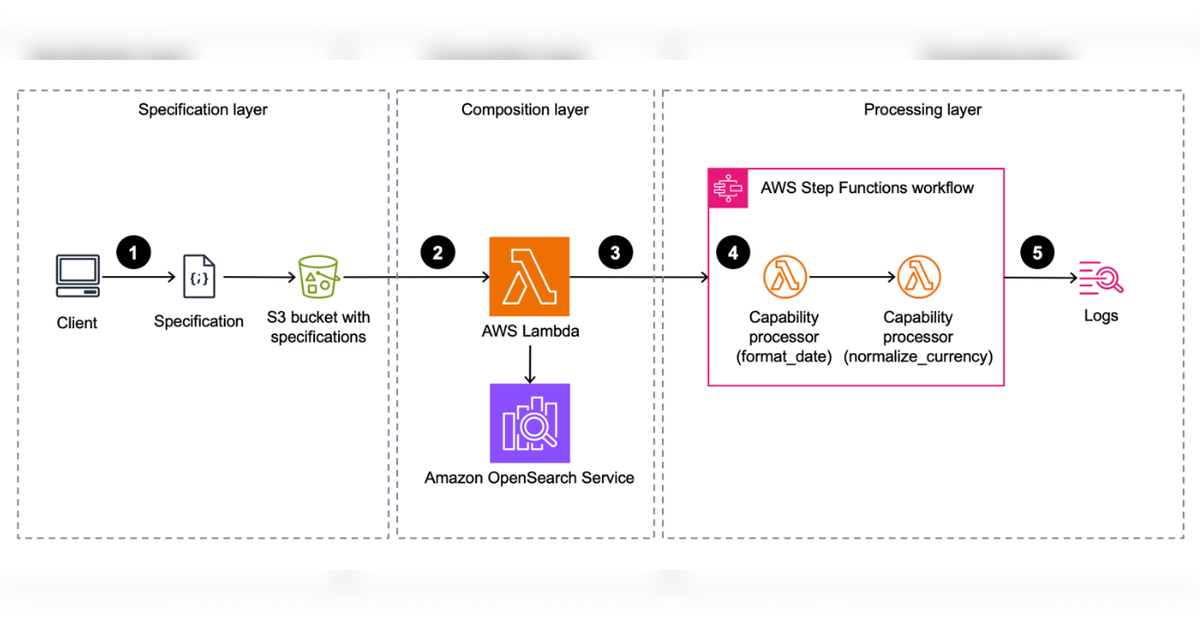
AWS describes a specification-driven approach that separates workflow intent from processing logic using declarative specifications to dynamically assemble reusable capabilities, with a serverless reference implementation on Lambda, Step Functions, S3, and OpenSearch Service.
This pattern targets data pipelines that become unmaintainable as datasets and workflow variants multiply, offering pre-execution validation, traceability, and versioned capability references for regulated environments. AWS itself cautions that the approach adds unnecessary complexity for simple transformations or environments with only a few workflows, so adoption should be scoped to cases where governance requirements and workflow variation are already high.
Written by elseif from the cluster below · every claim links back to a sourceThe three things worth knowing
The architecture separates workflow into three layers: an intent layer holding the specification, a composition layer that validates and assembles the pipeline, and a processing layer that executes transformations.
A capability registry stores metadata for reusable transformation functions including identifiers, schemas, permissions, and versions, enabling discovery by intent and reproducible workflow execution.
AWS cautions that specification-driven composition introduces unnecessary complexity for simple transformations or environments with only a few workflows, making it more applicable as variation and governance demands increase.
THE CLUSTER