INFRA Signal 142
Open-source CUDA implementation achieves 94.4% of FlashAttention-4 performance on B200 hardware
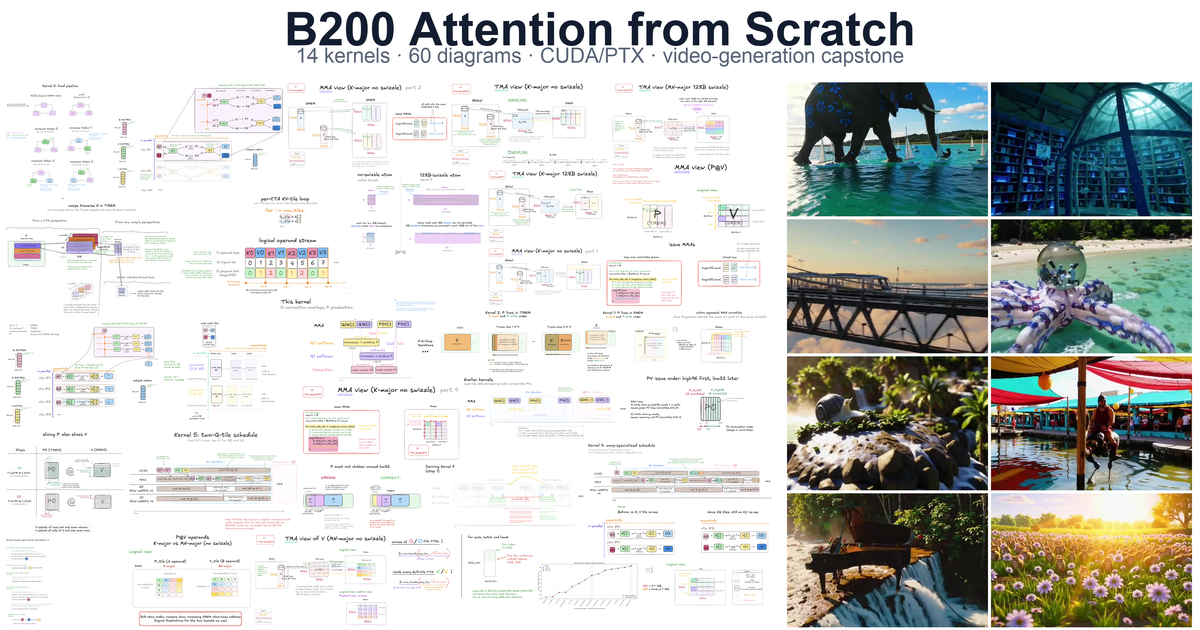 ↗
↗
A detailed guide and codebase demonstrate building a Blackwell B200 attention kernel from scratch to near state-of-the-art performance using 60 diagrams and incremental optimizations
This work lowers the barrier for engineers to understand and optimize GPU kernels for modern AI hardware. The visual progression and incremental code changes provide a rare hands-on resource for learning how to implement high-performance attention mechanisms without relying on domain-specific languages. It also highlights the trade-offs between abstraction layers and raw performance in kernel development
Written by elseif from the cluster below · every claim links back to a sourceThe three things worth knowing
The kernel targets Blackwell B200 hardware and achieves 94.4% of FlashAttention-4 performance on 4K, 8K, and 16K sequence lengths
The implementation uses CUDA and PTX rather than domain-specific languages like CuTe to simplify understanding of low-level optimizations
The guide includes 60 diagrams and incremental code changes to explain each optimization step from baseline to near-SOTA performance
THE READ
What the cluster adds up to.
This implementation demonstrates that near state-of-the-art attention kernel performance can be achieved without using domain-specific languages like CuTe. The choice to use raw CUDA and PTX reduces abstraction layers, making it easier for engineers to understand the low-level optimizations that drive performance. However, this approach requires deeper hardware knowledge and more manual optimization work compared to using higher-level DSLs. The trade-off between abstraction and control is particularly relevant for teams deciding between productivity and performance in kernel development.
The visual guide and incremental code changes provide a rare educational resource for learning how to optimize GPU kernels. Each optimization step is explained with diagrams and code diffs, allowing engineers to see the impact of individual changes. This approach is valuable for both beginners and experienced developers, as it breaks down complex optimizations into understandable components. The focus on Blackwell-specific features also helps engineers understand how to leverage new hardware capabilities in their own kernel implementations.
The performance comparison to FlashAttention-4 provides a concrete benchmark for evaluating the implementation's effectiveness. Achieving 94.4% of FA4's performance on 4K, 8K, and 16K sequence lengths suggests that the kernel is competitive with state-of-the-art implementations. However, the material does not specify whether this performance is consistent across different batch sizes or head dimensions, which could limit its applicability in some scenarios. The focus on dense, non-causal attention with head dimension 128 also narrows the scope of the kernel's use cases.
The capstone project integrating the kernel into a video-generation model demonstrates a practical application of the optimized attention mechanism. This provides a tangible example of how the kernel can be used in real-world scenarios, beyond synthetic benchmarks. However, the material does not specify the performance impact of using this kernel in a full model, which could differ from the isolated kernel benchmarks. The educational focus of the project also means that it may not represent a production-ready implementation, as the author notes that further performance tuning is planned for future work.
Written by elseif from the cluster below · checked for specifics the sources never containedTHE CLUSTER