TECH Signal 250 2 feeds carried it
Bespoke language enforces verbose polite syntax with formal letter-style code and British spelling
 ↗
↗
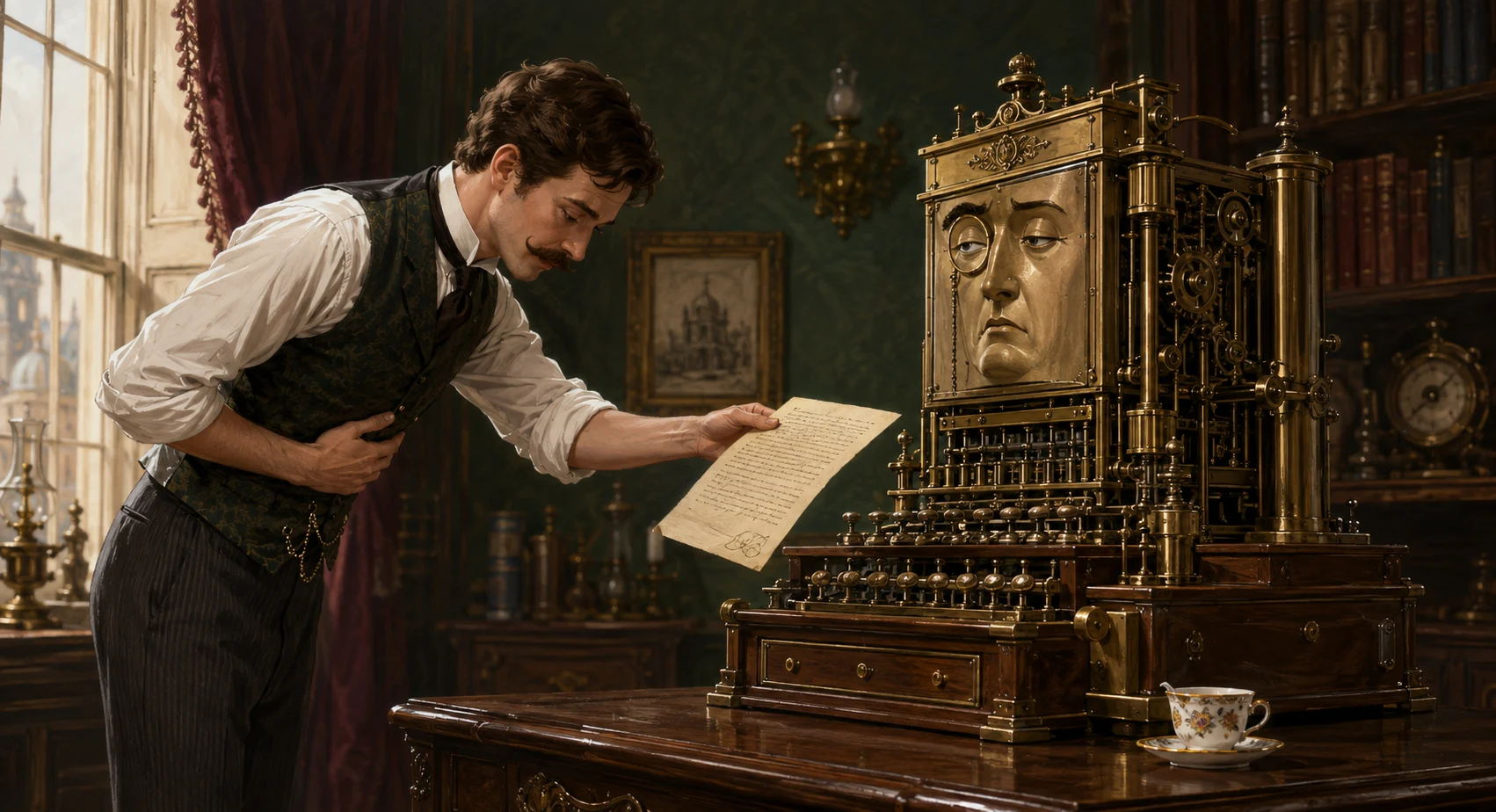
Bespoke is a statically typed, nominally typed programming language where source code is written as formal correspondence to the compiler, requiring salutations, courteous phrasing, and approved sign-offs for every statement.
Bespoke is a satirical language that pushes verbosity and etiquette to absurd lengths, but its design choices, rejecting terse type names, enforcing mutation acknowledgements, and making the compiler a gatekeeper of phrasing, highlight how syntax conventions encode assumptions about programmer-machine relationships. The implementation currently lags behind the specification, so it is not usable for real work.
Written by elseif from the cluster below · every claim links back to a sourceThe three things worth knowing
Source files use the .charming extension and every statement must be phrased as a formal request to the Compiler, Output Console, or Host Environment.
Types use full names like An Integer Number and A Truth Value, with truth literals Quite True and Patently False, and British orthography is enforced during lexical analysis.
Mutation requires an apology phrased as a polite request; a blunt assignment like carriageCount = 42 triggers diagnostic B-101 and suspends compilation.
THE READ
What the cluster adds up to.
Bespoke is a statically typed, nominally typed language where every program is structured as formal correspondence. Variable declarations, mutations, and I/O are written as letters addressed to specific recipients: the Compiler for allocations and updates, the Output Console for terminal output, and the Host Environment for filesystem and runtime services. Source files carry the .charming extension, and the language enforces British orthography during lexical analysis, Colour is valid, Color is not.
The type system rejects abbreviated names. Instead of int, char, or bool, Bespoke uses An Integer Number, An Individual Character, and A Truth Value. There are exactly two truth literals: Quite True and Patently False. A third state called Perhaps, Though I Should Not Like to Presume was considered for database work but rejected as insufficiently deterministic. The language also includes A Rational Fraction for exact arbitrary-precision ratios and A Distinguished Colour as a first-class type.
Mutation is permitted but requires the programmer to acknowledge the inconvenience with polite phrasing. A direct assignment such as carriageCount = 42 produces diagnostic B-101, Blunt Imperative, and compilation is suspended. Semicolons are rejected outright. Memory management is not automatic by default; the programmer must formally request the Host Environment to engage or release resources.
The specification is more developed than the implementation. The article states the implementation is somewhat less advanced than the etiquette manual and frames this as deliberate: one does not rush a formal introduction. The language is unrelated to Josiah Winslow's Bespoke, a separate esolang that encodes instructions through word lengths.
Only two feeds carried this story, both pointing to the same source with comment threads and no additional reporting. There is no corroboration of adoption, benchmarks, or real-world usage beyond the author's proposal. The language reads as a design exercise or satire rather than a production tool, and the material provides no evidence it is intended for practical use.
Written by elseif from the cluster below · checked for specifics the sources never containedTHE CLUSTER