PLATFORMS Signal 240
Building a software factory for AI SDK
 ↗
↗
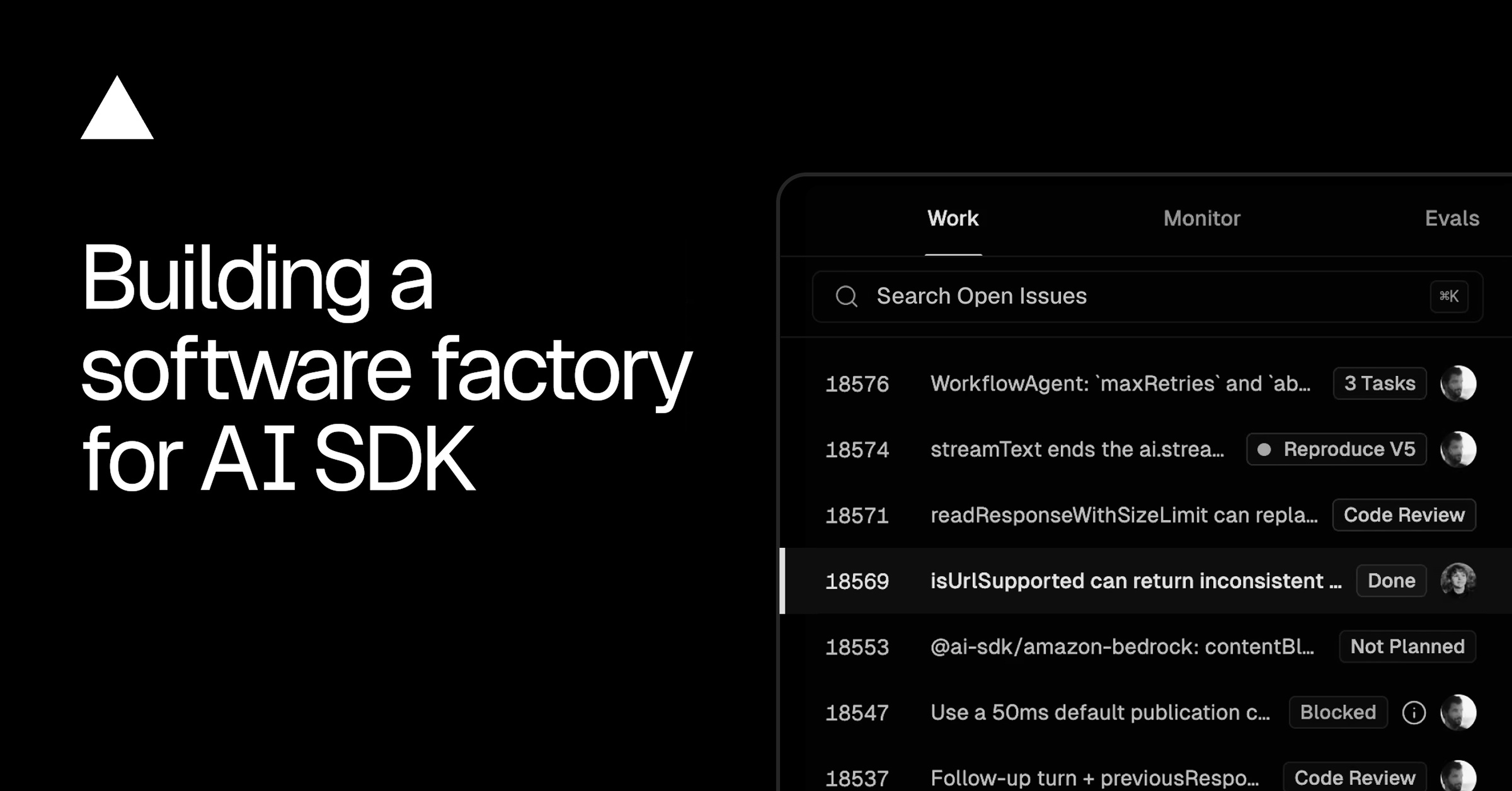
Vercel implemented a software factory to handle the growing backlog of issues and pull requests in its AI SDK open-source project.
Maintaining large open-source projects at scale requires more than manual effort, especially when contributions and issues grow exponentially. This approach demonstrates how automation can augment human review without removing accountability, a model that may apply to other high-velocity codebases. The trade-off between automation and risk remains critical for foundational infrastructure.
Written by elseif from the cluster below · every claim links back to a sourceThe three things worth knowing
The AI SDK factory now authors 25-35% of merged PRs and closes 70-80% of issues autonomously.
Automation is designed to preserve human oversight, with reviewers maintaining control over merges and risk assessment.
The factory classifies issues, reproduces bugs, and implements features, but high-risk changes still require deep human review.
THE READ
What the cluster adds up to.
Vercel’s AI SDK faced an unsustainable backlog of over 1,000 open issues and nearly 800 pull requests, driven by rapid growth in model providers, UI frameworks, and community contributions. Manual review processes couldn’t scale, as even the most efficient maintainers hit limits on human attention. The software factory was built to address this by automating repetitive tasks while keeping humans in the loop for accountability.
The factory operates on a spectrum of automation, avoiding full autonomy due to the SDK’s role as foundational AI infrastructure. Instead, it focuses on augmenting human reviewers by generating comprehensive assessments of changes, including evidence chains for risk evaluation. This allows reviewers to allocate effort proportionally, quick glances for docs fixes, focused validation for provider changes, and deep review for new APIs.
Implementation was incremental, starting with issue classification to improve visibility into the backlog. Agents were then added to handle specific tasks like bug reproduction and feature implementation, with each step prototyped and refined. The goal was to optimize for reviewer efficiency, ensuring automation handled the volume while humans retained control over what ships.
The approach balances automation with risk management, a critical consideration for projects with millions of downstream dependencies. While agents can generate code and validate changes, the factory’s design ensures that high-risk modifications still undergo rigorous human review. This model may be adaptable to other open-source projects struggling with similar scaling challenges.
Written by elseif from the cluster below · checked for specifics the sources never containedTHE CLUSTER