TECH Signal 358
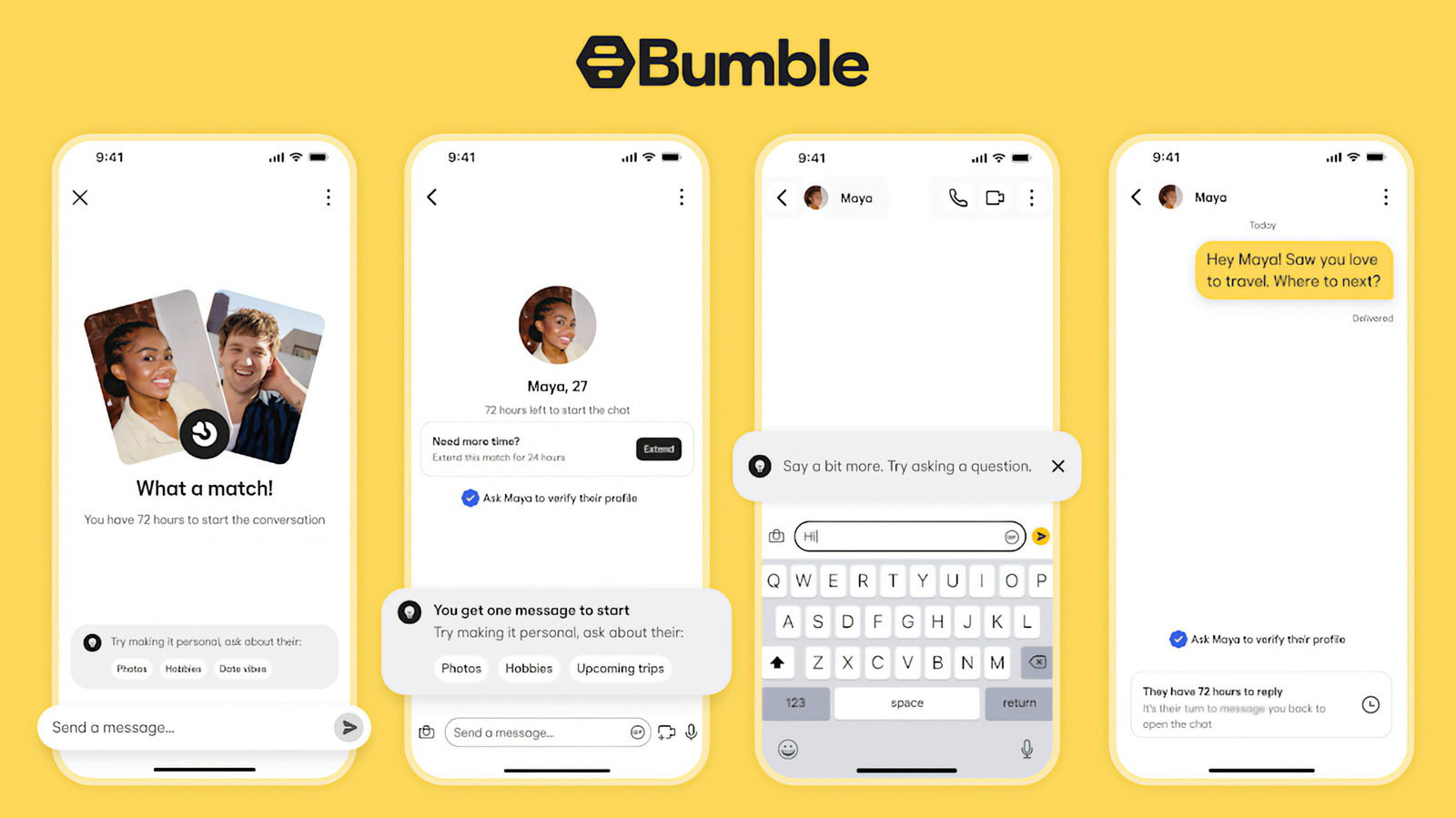
Bumble now lets either person send the first message after matching
 ↗
↗
Bumble has removed its gendered first-message requirement, allowing either match to initiate conversation after pairing.
Engineers maintaining dating platforms or social apps may need to audit their matching and messaging logic to support symmetric initiation. The change also introduces a new content-moderation layer that flags short, low-effort openers, which could require additional NLP integration or rule-based filtering. Existing user flows that assume a single initiator will break unless updated.
Written by elseif from the cluster below · every claim links back to a sourceThe three things worth knowing
Either person in any gender pairing can now send the first message, but the chat only opens if the recipient replies.
Bumble added a real-time prompt that discourages one-word openers, implying new server-side message analysis.
The 72-hour reply window remains, so backend timers and notification logic are unaffected.
THE READ
What the cluster adds up to.
Bumble’s policy shift removes a long-standing asymmetry in its matching system. Previously, the app enforced a gender-specific rule where one side had to message first; now the constraint is purely temporal, either user can send the first message, but the conversation only materializes if the other side engages. This change forces engineers to decouple the “first message” flag from any gender field in the database and instead track it as a simple timestamped event. Any downstream logic that assumed a single initiator, such as badges, analytics dashboards, or referral incentives, must be rewritten to handle multiple potential initiators per match.
The new nudges against one-word openers introduce a lightweight content-moderation layer. Bumble’s implementation appears to use a rule-based filter (length threshold) rather than a full NLP model, but the prompt itself is served in real time. Engineers will need to add a pre-send hook that checks message length and conditionally injects the warning, which adds latency to the send path. If the filter scales poorly or false positives annoy users, the feature could be rolled back, so the code should be modular enough to disable without affecting core messaging.
Despite the headline change, the 72-hour reply window remains unchanged. This means the existing timer infrastructure, database columns, cron jobs, push notifications, can stay in place. However, the new symmetric initiation rule may increase the total number of unanswered first messages in the system, which could inflate storage costs and complicate metrics like “match success rate.” Engineers should monitor database growth and adjust retention policies if the volume of stale half-conversations spikes.
Bumble’s broader strategy includes AI-driven matchmaking and in-person events, but the immediate engineering impact is confined to the messaging layer. The change does not alter the matching algorithm itself, so recommendation engines and user profiles remain untouched. However, any future AI features that rely on conversation initiation patterns will now have to account for two potential initiators instead of one, which may require retraining models or revising feature importance in ranking formulas.
Written by elseif from the cluster below · checked for specifics the sources never containedTHE CLUSTER