LANGUAGES Signal 592 2 feeds carried it
C++26 standard library hardening replaces undefined behavior with contract violations in hardened mode
 ↗
↗
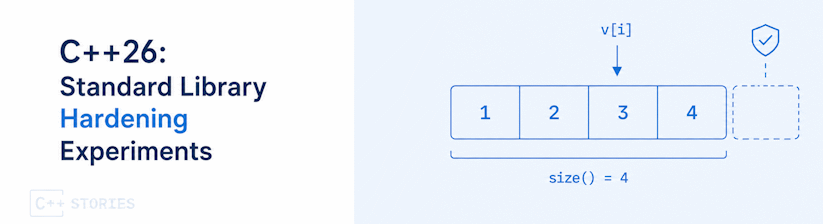
C++26 introduces hardened implementations of the standard library where out-of-bounds access triggers contract violations instead of undefined behavior
This change gives engineers a standardized way to catch memory safety errors at runtime without relying on vendor-specific debug modes. The hardened mode trades undefined behavior for predictable termination, making debugging easier but requiring explicit opt-in. It does not eliminate all safety issues but provides a consistent baseline across compilers.
Written by elseif from the cluster below · every claim links back to a sourceThe three things worth knowing
Hardened mode converts undefined behavior in standard library operations like `std::vector::operator[]` into contract violations with terminating semantics
Implementation is compiler-specific: GCC uses `-fhardened`, Clang uses `_LIBCPP_HARDENING_MODE`, and MSVC uses `_MSVC_STL_HARDENING` macros
Hardening does not replace `.at()` or exceptions but provides an alternative error-handling mechanism with predictable failure modes
THE READ
What the cluster adds up to.
C++26 standardizes a hardening mechanism for the standard library that replaces undefined behavior with contract violations when enabled. This affects operations like `std::vector::operator[]` where out-of-bounds access previously led to unpredictable crashes or corruption. The change is opt-in and implementation-defined, meaning engineers must explicitly enable it through compiler-specific flags or macros. The hardened mode does not introduce new functionality but instead formalizes a safer failure mode for existing operations.
The hardening feature leverages C++26's new contracts model but uses a stricter terminating semantic. Unlike regular contracts that can be configured to ignore, observe, or enforce violations, hardened preconditions always terminate execution. This ensures that memory safety errors cannot be silently ignored or observed, which was a limitation of previous debug modes. However, the terminating behavior means hardened mode is not suitable for production environments where graceful degradation is required. Engineers must weigh the debugging benefits against the cost of abrupt termination.
Compiler support for hardening varies in maturity and configuration. GCC's `-fhardened` flag enables hardening alongside other security options, while Clang offers granular control through `_LIBCPP_HARDENING_MODE` with multiple levels. MSVC provides both global and per-type hardening macros. These differences mean engineers must adapt their build systems to each compiler's hardening mechanism. The feature also does not cover all standard library operations, so some undefined behavior may persist even in hardened mode. The incomplete implementation status as of August 2026 suggests further refinements are likely.
Hardening does not replace existing safety mechanisms like `.at()` or vendor-specific debug modes but complements them. The key advantage is standardization: engineers no longer need to rely on compiler-specific flags like `_GLIBCXX_ASSERTIONS` or `_ITERATOR_DEBUG_LEVEL` to catch memory safety errors. However, the feature stops working if the hardened mode is not enabled, and it does not address all sources of undefined behavior in C++. The terminating semantic also means engineers cannot recover from violations, limiting its use in long-running or mission-critical systems.
Written by elseif from the cluster below · checked for specifics the sources never containedTHE CLUSTER