LANGUAGES Signal 298
Can you reverse engineer an ASIC?
 ↗
↗
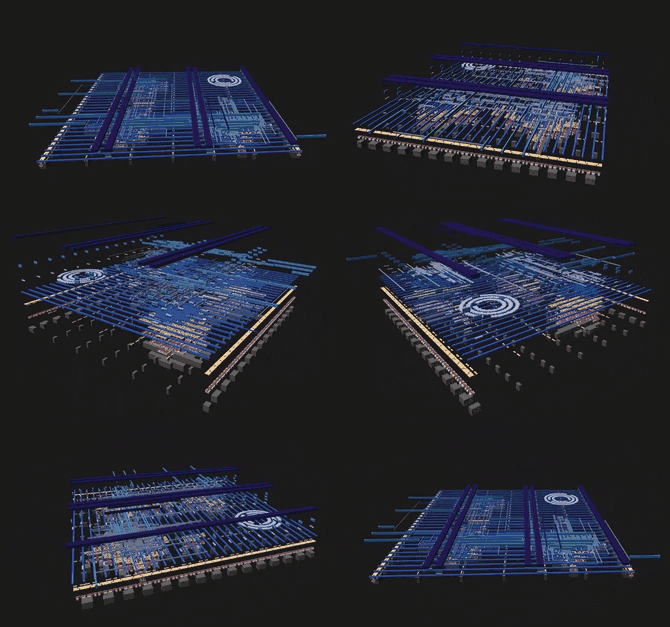
Jane Street published a puzzle that challenges engineers to reverse engineer an ASIC from its GDS layout, requiring recovery of a netlist and identification of the circuit's function to find a hidden output.
This puzzle gives engineers a rare, hands-on opportunity to practice hardware reverse engineering using real open-source tools and a fabricated chip layout. It highlights the growing accessibility of ASIC design and the importance of understanding the full stack from code to silicon. The competition also signals Jane Street's interest in finding talent comfortable with low-level hardware and digital logic.
Written by elseif from the cluster below · every claim links back to a sourceThe three things worth knowing
Participants receive only the GDS layout of a custom ASIC and must recover the netlist, then determine the circuit's purpose and a hidden output string.
The puzzle includes a warm-up example with a binary adder to help newcomers learn how to map layout to logic using open-source tools like KLayout.
Jane Street plans a follow-up competition where participants design their own ASIC, with the most interesting entries being fabricated.
THE READ
What elseif makes of it.
The puzzle presents a realistic but constrained reverse-engineering task: given a GDS file, the final geometric description of every polygon on every chip layer, participants must extract a gate-level netlist. This mirrors the work of hardware security engineers or anyone analyzing a chip without documentation. The challenge is that the layout contains no labels, so every transistor and wire must be identified from geometry alone.
To succeed, engineers need familiarity with digital design flows (Verilog, synthesis, place-and-route) and tools like KLayout or Magic VLSI. The warm-up adder provides a sandbox to practice mapping layout to logic. The puzzle also requires simulation to test the recovered circuit, meaning participants must build or adapt a simulator that can run the netlist against sample inputs and check the success signal.
The article emphasizes that the circuit is physically arranged to hint at its functionality, so spatial reasoning is part of the task. There is also a section that generates output but does not affect the success signal, a deliberate distraction. This mirrors real-world reverse engineering where not all logic is critical to the main function, and engineers must decide what to ignore.
Jane Street frames this as a warm-up for a larger competition where participants design their own ASIC for fabrication. This progression, from reverse engineering to design, shows the company's interest in hardware talent. For working engineers, the puzzle is a low-risk way to gain hands-on experience with the full hardware stack, from layout to simulation, using only free and open-source tools.
The puzzle explicitly discourages feeding the files into AI tools for the final answer but allows AI for scripting and code. This suggests the core challenge is human pattern recognition and logical deduction, not brute-force computation. The deadline and submission process (emailing a description) indicate that Jane Street values the approach and methodology as much as the correct answer.
Written by elseif from the cluster below · checked for specifics the sources never containedTHE CLUSTER