INFRA Signal 129
Cloudflare redesigns 1.1.1.1 DNS cache to cut 100 TB of memory
 ↗
↗
Cloudflare redesigned its Big Pineapple DNS cache representation in Rust, reducing per-entry memory by 56% and freeing roughly 100 TB of working-set memory across its fleet while increasing insertion throughput by 43% and lowering lookup latency by 19%.
The memory savings allow Cloudflare to expand cache capacity without adding hardware, directly improving DNS response times for end users. The optimization also demonstrates how low-level representation changes can yield measurable performance gains at massive scale.
Written by elseif from the cluster below · every claim links back to a sourceThe three things worth knowing
Per-entry cache footprint shrank from 953 to 420 bytes, freeing ~100 TB of working-set memory fleetwide.
Insertion throughput rose 43% and lookup latency dropped 19% after the redesign.
Resident memory per instance fell from 9.3 GB to 5.3 GB (p99) and from 6.5 GB to 3.8 GB (p90).
THE READ
What the cluster adds up to.
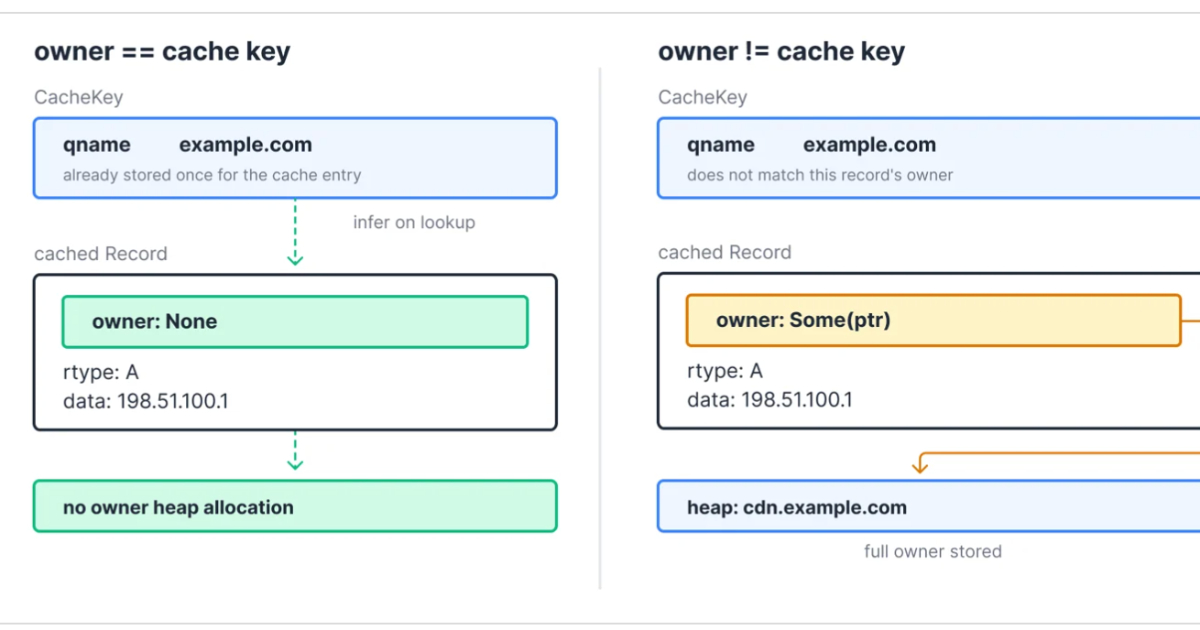
The redesign replaces Vec and String with Box<[T]> and Box<str>, and consolidates answer, authority, and additional records into a single list with compact offsets, eliminating per-record allocation overhead.
By storing record data in a contiguous byte buffer using DNS wire format, Cloudflare removes enum and allocation overhead, improving cache locality and enabling faster lookups.
The optimization was rolled out between May 18 and July 6, 2026, and the resulting memory savings are being reallocated to increase cache capacity without expanding overall memory consumption.
Written by elseif from the cluster below · checked for specifics the sources never containedTHE CLUSTER