DEV TOOLS Signal 178
Cloudflare reduces Astro GitHub issues by 85% using isolated AI agents in triage workflow
 ↗
↗
Cloudflare automated Astro’s issue triage with AI agents running in GitHub Actions, cutting open issues from over 200 to about 30.
This demonstrates a scalable way to offload repetitive triage work while keeping humans in the loop for validation. The approach could reduce maintainer burnout in open-source projects, but its effectiveness depends on codebase test coverage and agent sandboxing.
Written by elseif from the cluster below · every claim links back to a sourceThe three things worth knowing
AI agents reproduce, diagnose, and propose fixes for Astro issues before human review.
The workflow uses GitHub labels and preview releases to validate fixes with reporters.
Failed agent runs now signal gaps in tests or documentation rather than just triage failures.
THE READ
What the cluster adds up to.
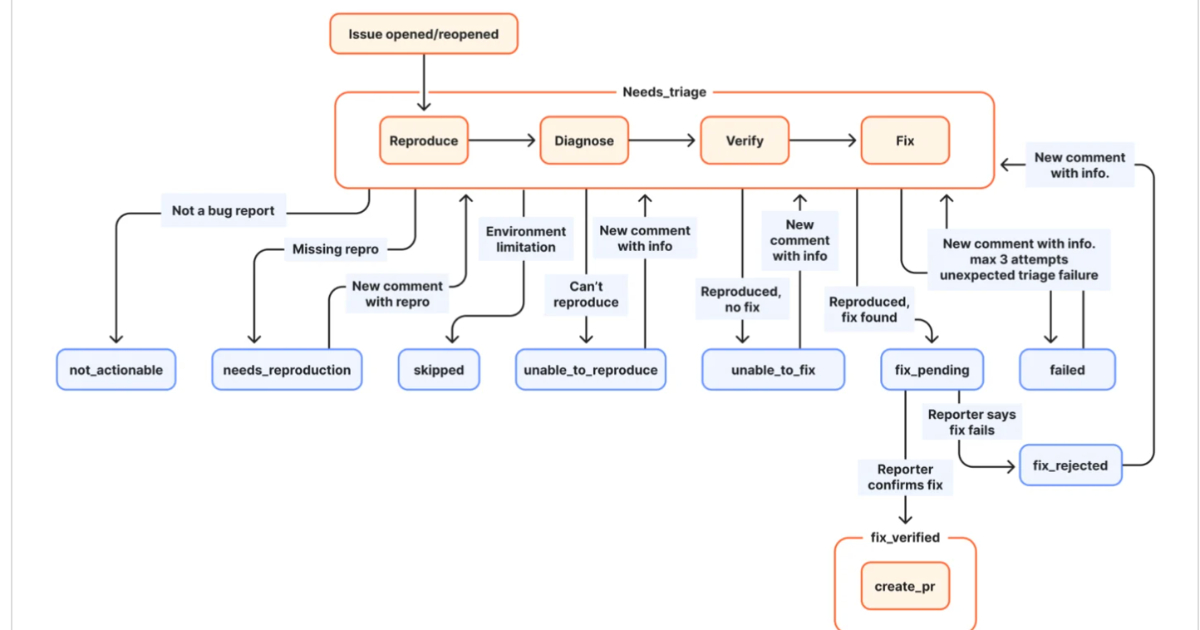
Cloudflare replaced manual issue triage for the Astro framework with a GitHub Actions workflow driven by isolated AI agents. Each agent handles a distinct step, reproduction, diagnosis, verification, or fix generation, without sharing execution context. This mirrors the stages human maintainers follow but scales to handle hundreds of issues without proportional human effort. The 85% reduction in open issues suggests the approach works for well-defined, reproducible bugs, though its limits aren’t yet clear for edge cases or ambiguous reports.
The workflow’s state machine uses GitHub issue labels to track progress, from triage needed to fix verified. When an agent proposes a fix, it generates a preview release and posts installation instructions to the issue thread. Reporters validate the patch before the automation opens a pull request, shifting the human role from initial triage to final approval. This keeps humans in the loop but reduces their workload to reviewing pre-vetted fixes rather than diagnosing every report from scratch.
Agent failures now serve as feedback for codebase maintainability. In one case, an agent repeatedly introduced regressions in Hot Module Replacement logic until a descriptive comment was added to clarify the behavior. This turns triage into a two-way process: agents resolve issues while also highlighting gaps in tests, documentation, or code clarity. The approach assumes sufficient test coverage to reproduce issues, which may not hold for all projects or bug types.
The Astro workflow evolved into triagebot-action, a standalone GitHub Action, and Flue, an open-source framework for durable agent workflows. Flue uses a declarative model where agents are defined by their context, model, skills, sandbox, and instructions, rather than an orchestration loop. Its persistent event log allows interrupted workflows to resume, and it supports integrations with GitHub, Slack, and other platforms. This suggests the model could extend beyond issue triage to other repetitive, structured tasks in software development.
Written by elseif from the cluster below · checked for specifics the sources never containedTHE CLUSTER