TECH Signal 206
CLT Features Support Manifold Steering, but Hold Only Partial Steering Signal
 ↗
↗
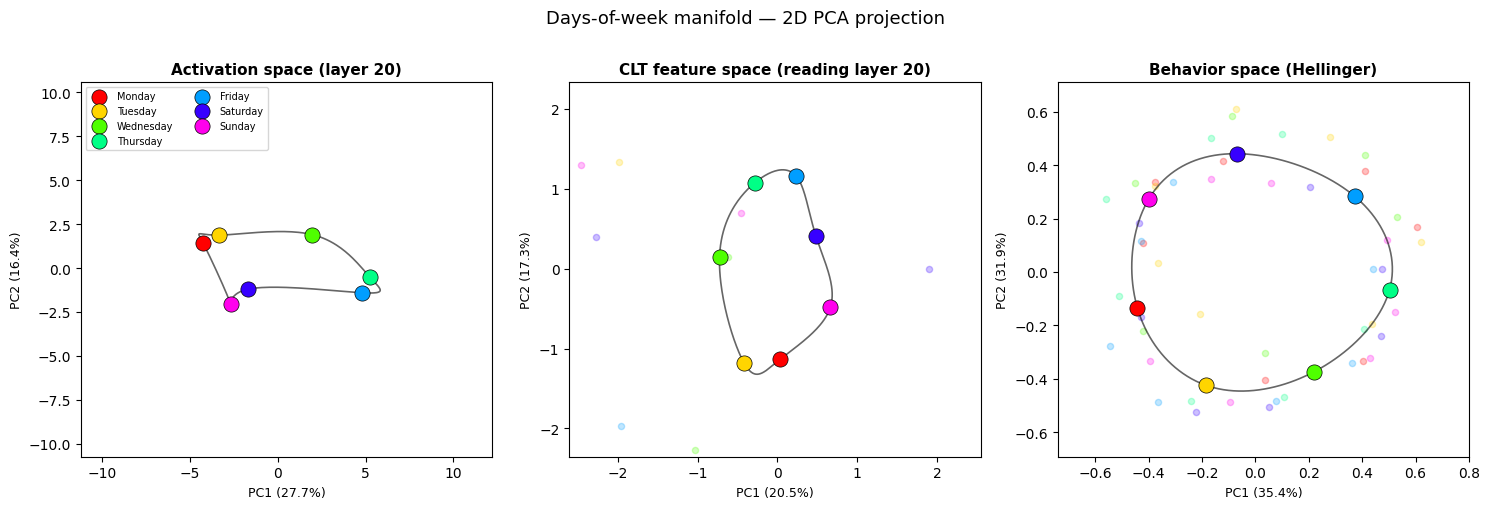
Manifold steering in CLT feature space shows weaker signals than in raw activation space.
This finding suggests limitations in the effectiveness of CLT features for steering tasks. Understanding the differences in signal strength between raw activation and CLT feature space can inform future model design and feature extraction methods. It highlights the importance of evaluating how well features perform in specific contexts.
Written by elseif from the cluster below · every claim links back to a sourceThe three things worth knowing
Manifold steering produces expected cyclical transitions in both activation and CLT feature spaces.
CLT features provide a weaker steering signal compared to raw activation space.
The study indicates that CLT features may only represent a portion of the full signal.
THE READ
What the cluster adds up to.
The event highlights the results of manifold steering experiments applied to both raw activation space and CLT feature space in the Gemma-2-2B model. While the steering method performed as expected in both contexts, the strength of the steering signal derived from CLT features was significantly weaker. This difference is crucial for engineers working on feature engineering and model fine-tuning.
The findings suggest that while CLT features can represent data effectively, they may not encapsulate all necessary information for robust steering. The partial signal in CLT features indicates limitations that could impact the performance of applications relying on these features for decision-making or generative tasks. Engineers may need to consider combining CLT features with raw activation data to achieve better results.
The study also underscores the importance of feature selection and evaluation in machine learning models. The approach taken with the cubic spline fitting and centroid calculations demonstrates a systematic method for analyzing the effectiveness of steering methods. Engineers can apply similar methodologies to assess the performance of features in their models, ensuring that they leverage the most effective representations available.
Written by elseif from the cluster below · checked for specifics the sources never containedTHE CLUSTER