TECH Signal 494
Databricks drove down AI coding spend 70%
 ↗
↗
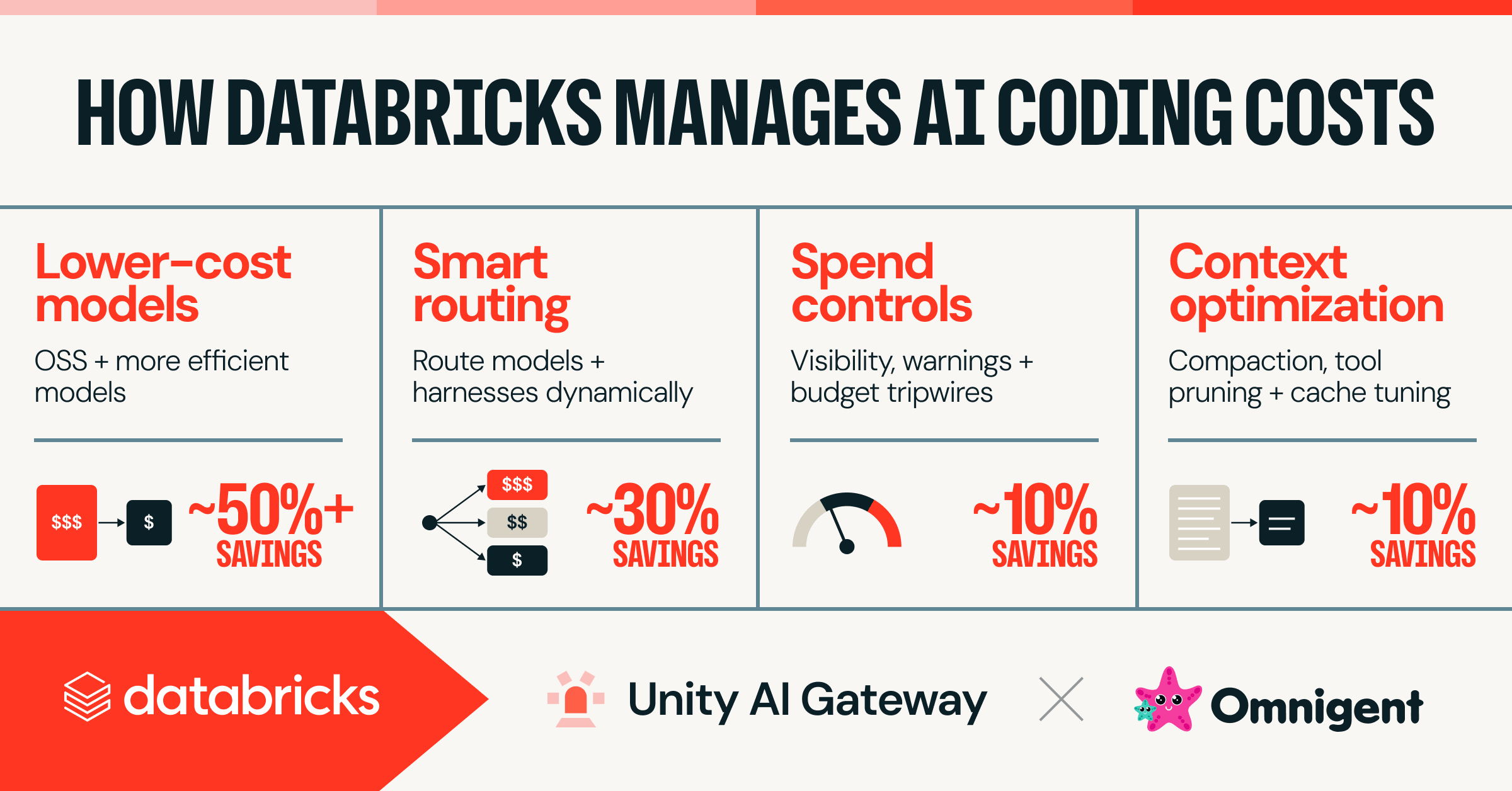
Databricks reports a 70% reduction in AI coding expenses by adopting cost-control practices that balance broad tool access with predictable spending.
The result shows that rising AI tool costs can be curbed without sacrificing the productivity gains that motivated their adoption. Other engineering teams can follow a similar pattern to keep AI spending within a fixed envelope while still giving developers powerful assistants.
Written by elseif from the cluster below · every claim links back to a sourceThe three things worth knowing
The primary savings come from shifting to newer models that offer better intelligence per dollar.
Teams use internal evaluations to pick models that meet their coding quality bar before rolling them out.
Providing developers with interchangeable harnesses lets organizations migrate workloads to cheaper models without locking them into a single tool.
THE READ
What the cluster adds up to.
AI coding assistants have raised engineering velocity across many teams at Databricks, sometimes delivering ten-fold output gains. Yet the same tools generate rapidly rising expenses that can outpace revenue if left unchecked. Companies face a paradox: they want to give engineers powerful AI help while keeping the total bill predictable. Solving this tension requires a deliberate cost-management strategy that preserves broad access.
The biggest lever for cutting spend is moving to models that provide more intelligence per dollar, a concept described as the efficiency frontier. To know whether a newer model actually beats the incumbent, teams run internal evaluations that reflect their real-world coding workload. These evaluations help avoid adopting models that are more expensive without delivering meaningful quality gains. By continuously shifting workloads to better-priced models, Databricks achieved a large portion of its 70% cost reduction.
Flexibility in the developer toolchain is essential for model switching; offering a choice of harnesses lets engineers stay in their preferred environment while the organization redirects traffic to cheaper models. Databricks has made its meta-harness and AI gateway components freely available, lowering the barrier for others to adopt similar flexibility. Other firms such as Stripe, Coinbase, Uber, and Ramp have reported using comparable techniques to keep AI coding costs within a fixed envelope per user. Sharing these components helps spread the practice across the industry.
Adopting these practices is not without cost; building or integrating evaluation pipelines and maintaining multiple harnesses requires engineering effort. Switching harnesses can impose a learning curve on developers, which may temporarily affect productivity. Moreover, not every newly released model improves the cost-quality trade-off, so reliance on evaluations is crucial to avoid regressions. Organizations that lack the infrastructure to run such assessments may find the expected savings harder to realize.
Written by elseif from the cluster below · checked for specifics the sources never containedTHE CLUSTER