TECH Signal 438
Deco Gear DG49OLED240 replaces dual 27-inch QHD monitors with single 49-inch 32:9 QD-OLED panel
 ↗
↗
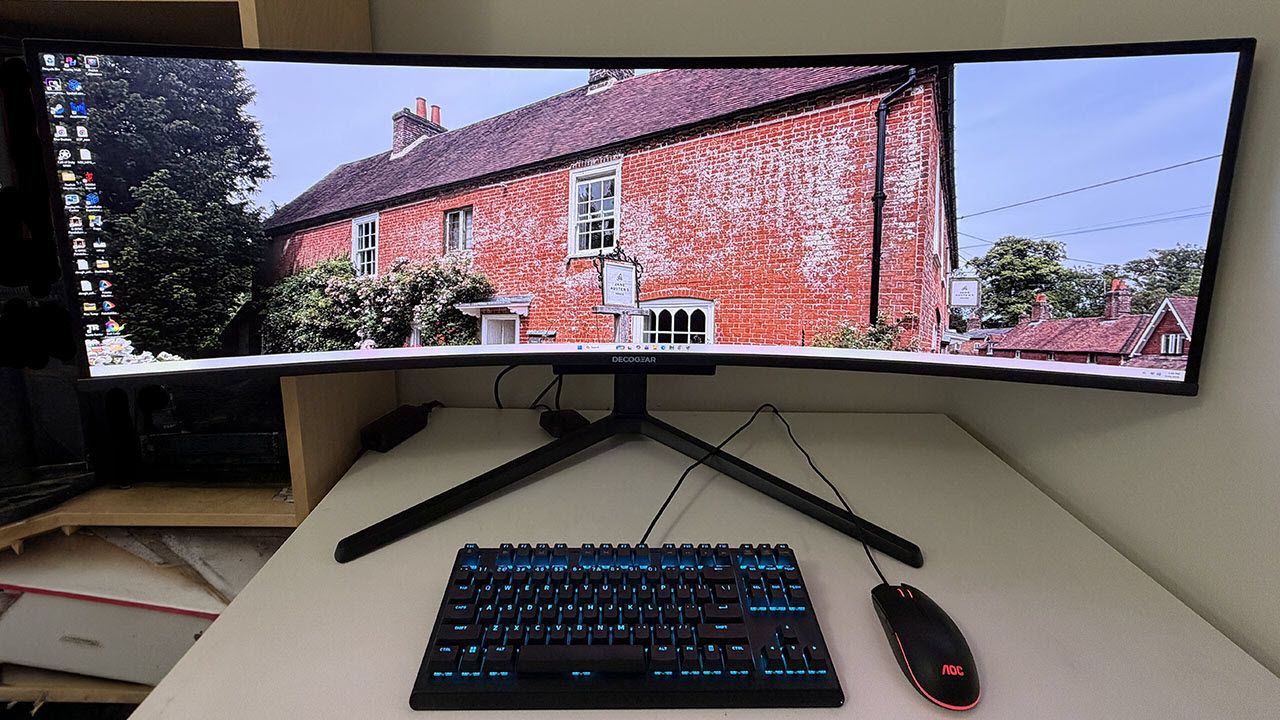
A 49-inch 32:9 QD-OLED gaming monitor eliminates the bezel gap of two 27-inch QHD displays while adding 240 Hz, HDR400, and wide gamut color.
Engineers and developers who rely on multi-monitor setups for productivity or simulation can now achieve seamless screen real estate without bezels. The trade-off is higher cost and a single point of failure for the entire workspace.
Written by elseif from the cluster below · every claim links back to a sourceThe three things worth knowing
Single 49-inch 32:9 QD-OLED panel matches the pixel count of two 27-inch QHD monitors without a dividing line
240 Hz refresh rate, Adaptive-Sync, HDR400, and 112% DCI-P3 coverage target gaming and color-critical workflows
Unintuitive OSD controls and slightly dark gamma may require manual calibration for optimal use
THE READ
What the cluster adds up to.
The Deco Gear DG49OLED240 consolidates two 27-inch QHD monitors into one 49-inch 32:9 QD-OLED panel. This eliminates the bezel gap that disrupts workflows in multi-monitor setups, particularly for gaming, simulation, or productivity tasks. The 5120x1440 resolution and 1800R curve maintain the same pixel density and viewing angles as two separate displays, but without the physical interruption. For engineers who need contiguous screen space, such as for CAD, data visualization, or debugging, this removes a persistent visual and ergonomic obstacle.
The panel’s specifications cater to high-performance use cases. A 240 Hz refresh rate and Adaptive-Sync support reduce motion blur and screen tearing, which is critical for fast-paced applications. The QD-OLED technology delivers 112% DCI-P3 coverage and HDR400 certification, providing accurate color and contrast for tasks like video editing or HDR content creation. However, the monitor’s 400-nit peak brightness may fall short in brightly lit environments, and the slightly dark gamma could require manual calibration to avoid washed-out shadows.
Adopting the DG49OLED240 involves trade-offs beyond its price. While it simplifies cable management and reduces desk clutter, it introduces a single point of failure for the entire workspace. The unintuitive OSD controls and unusual button layout may frustrate users who frequently adjust settings. Additionally, the 1800R curve, while beneficial for immersion, may not suit all users, particularly those accustomed to flat panels. The monitor’s size also demands significant desk depth, which could be a limitation in compact workspaces.
The built-in audio system, two 5W speakers and a 10W woofer, exceeds typical monitor standards, reducing the need for external speakers in casual use. Connectivity includes two DisplayPort 1.4 ports, one HDMI 2.1, and a USB-C port with 90W charging, accommodating most modern devices. However, the lack of USB hub functionality beyond basic input devices may limit its utility for users who rely on peripherals. The one-year warranty is shorter than some competitors, which could be a consideration for long-term reliability.
Written by elseif from the cluster below · checked for specifics the sources never containedTHE CLUSTER