TECH Signal 240
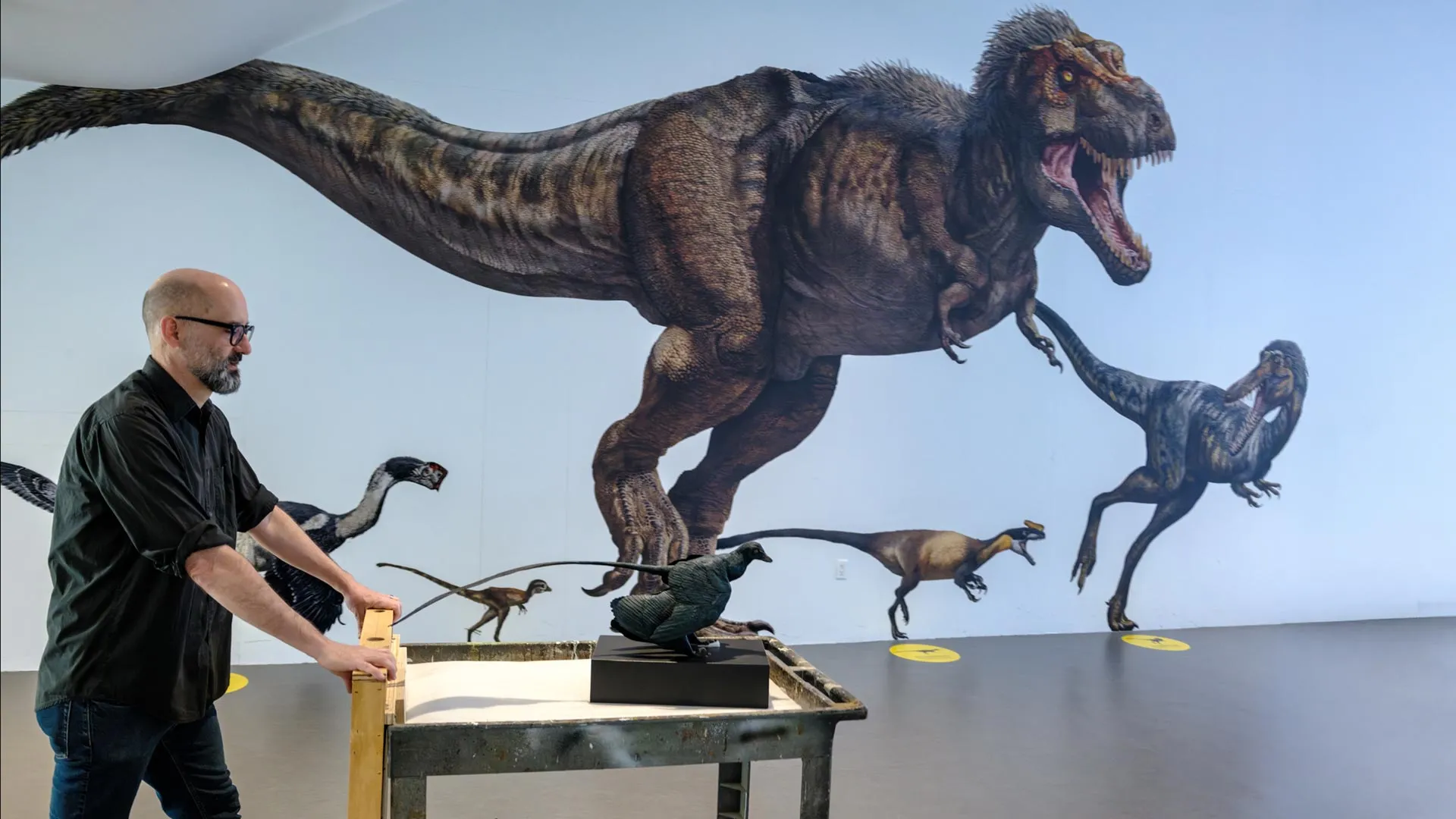
Dinosaurs became giants — so why did they never become tiny?
 ↗
↗
New research argues that early mammals kept dinosaurs from evolving into truly tiny forms, leaving a gap at the low-end of dinosaur body size.
Understanding that ecological competition, not just physiology, limited dinosaur size helps engineers who build evolutionary or ecological simulation tools to incorporate inter-taxon competition factors. Ignoring such constraints could produce unrealistic size distributions in models of past ecosystems or in bio-inspired optimization algorithms.
Written by elseif from the cluster below · every claim links back to a sourceThe three things worth knowing
Mathematical models show that energy-use and physiological constraints explain size ranges in mammals, birds, and turtles but fail to account for the absence of mouse-sized dinosaurs.
Fossil sites that preserve tiny mammals, lizards, and amphibians rarely contain equally tiny dinosaur remains, suggesting genuine scarcity rather than preservation bias.
The authors propose that early small mammals occupied ecological niches that would have supported tiny dinosaurs, effectively setting a lower size limit for non-avian dinosaurs.
THE READ
What the cluster adds up to.
The study adds a competitive ecological dimension to explanations of dinosaur body-size evolution, shifting focus from internal physiology to external niche occupation. Researchers built models that integrate energy intake and reproductive rates, then compared predicted size limits with the fossil record. The mismatch highlighted that dinosaurs did not exploit the smallest vertebrate niches despite having the physiological capacity to do so. This insight revises assumptions used in paleo-ecological reconstructions and any software that simulates ancient ecosystems.
For engineers maintaining simulation platforms, the finding means that simply scaling physiological parameters will not reproduce realistic dinosaur size spectra. Implementations must now include rules for inter-group competition, such as resource partitioning between early mammals and dinosaurs. Adding these rules incurs development effort: new interaction modules, calibration against fossil occurrence data, and validation of emergent size distributions. The benefit is a more faithful representation of ancient community structure, which can improve downstream analyses like climate impact modeling.
The physiological models remain valid for taxa where competition does not dominate size evolution, such as modern mammals, birds, and turtles. However, applying those same models to non-avian dinosaurs without a competition layer will produce inaccurate predictions, especially at the lower size extreme. Engineers should therefore limit the use of pure physiology-based size models to contexts where ecological overlap is minimal, and switch to hybrid models when simulating mixed clades from the Mesozoic era.
Written by elseif from the cluster below · checked for specifics the sources never containedTHE CLUSTER