TECH Signal 437
Statistical test finds no significant alignment between Sumerian King List reigns and paleoclimate events
 ↗
↗
An exploratory analysis tests whether the antediluvian Sumerian King List encodes real climate shifts but finds no statistically significant alignment with geological records.
This analysis demonstrates how speculative historical hypotheses can be rigorously tested using quantitative methods. For engineers, it highlights the importance of null models and statistical significance when evaluating pattern-matching claims, especially in interdisciplinary work where data may be sparse or ambiguous.
Written by elseif from the cluster below · every claim links back to a sourceThe three things worth knowing
The Sumerian King List’s antediluvian reign lengths were rescaled and anchored to a proposed flood date to test alignment with paleoclimate events.
No statistically significant alignment was found after adjusting for multiple comparisons, even when expanding the event catalog.
The analysis underscores the risk of false positives when testing speculative hypotheses without predefined anchors or controls.
THE READ
What the cluster adds up to.
The Sumerian King List describes eight pre-flood kings with reign lengths ranging from 18,600 to 43,200 years, all multiples of 600. These numbers have led to speculative interpretations that the list encodes real prehistoric events, such as climate shifts or catastrophes. The analysis here tests this hypothesis by rescaling the reign lengths to a fixed 241,200-year span and anchoring the sequence to an analyst-chosen date near the Younger Dryas termination (11.6 ka BP). This approach transforms the list into a timeline that can be compared against geological records of paleoclimate events.
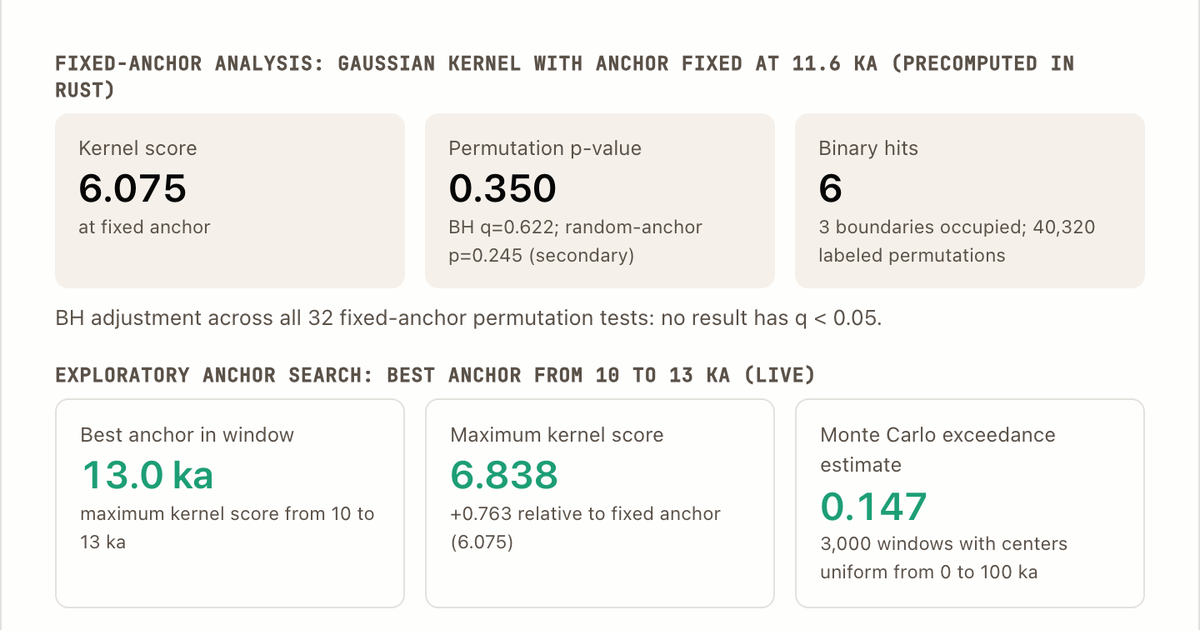
The primary test used a Gaussian kernel to measure alignment between the rescaled Sumerian sequence and a catalog of Quaternary paleoclimate events. At a fixed anchor and bandwidth, the permutation p-value was 0.350, with an adjusted q-value of 0.622, indicating no statistically significant alignment. Expanding the analysis to a wider catalog of 103 events increased apparent matches but did not improve significance, yielding a p-value of 0.148 and an adjusted q-value of 0.430. The best exploratory result, found in a catastrophic event catalog, had a raw p-value of 0.021, but this did not survive adjustment for multiple comparisons (q = 0.222).
The analysis also compared the Sumerian sequence to other ancient chronologies, such as Biblical patriarchal ages and Manethonian god reigns, to assess whether the Sumerian list produced unusually strong alignments. These comparisons showed that unrelated sequences could yield apparent matches under the same procedure, highlighting the risk of false positives when testing speculative hypotheses. The lack of predefined anchors or constraints in the Sumerian text further complicates the interpretation, as the choice of anchor date and bandwidth can heavily influence results.
For engineers, this study serves as a case study in the challenges of pattern-matching in sparse or ambiguous data. The use of null models and statistical adjustments is critical to avoid overinterpreting coincidental alignments. The analysis also demonstrates the value of transparency in exploratory work, as the interactive tool allows users to test different parameters and observe how results vary. While the Sumerian King List remains a fascinating historical artifact, this test suggests its reign lengths are unlikely to encode real paleoclimate events.
Written by elseif from the cluster below · checked for specifics the sources never containedTHE CLUSTER