TECH Signal 420
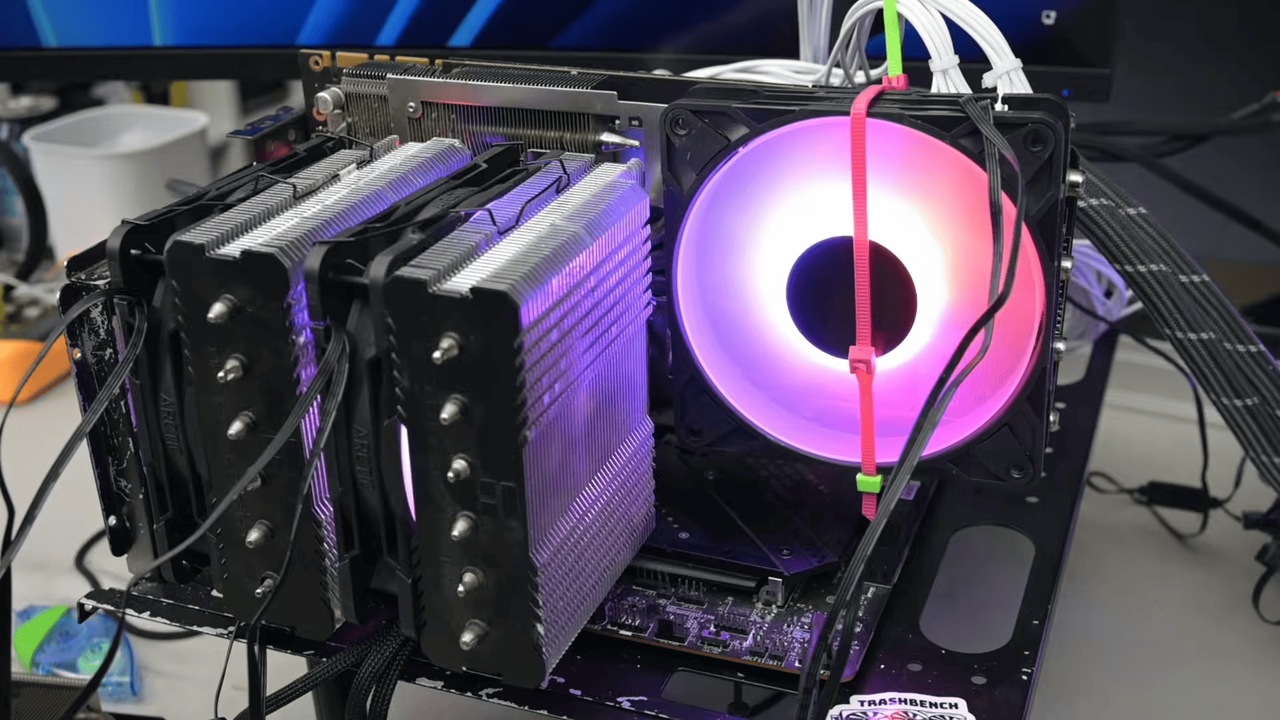
Enthusiast replaces GTX 1080 Ti stock cooler with dual-tower CPU cooler cutting temps by 32°C
 ↗
↗
A hardware modder swapped a GPU’s factory cooler for a high-end CPU cooler, reducing temperatures and power draw while boosting performance.
This experiment demonstrates the thermal and power efficiency limits of stock GPU coolers, particularly for high-TDP cards. For engineers, it highlights the potential gains from custom cooling solutions, though practical adoption is constrained by physical and compatibility challenges.
Written by elseif from the cluster below · every claim links back to a sourceThe three things worth knowing
Mod reduces GTX 1080 Ti load temperatures by up to 32°C compared to a transplanted stock cooler from a lower-TDP card.
Power consumption drops by 30W (12%) at equivalent clocks, with 9% higher FPS achievable after overclocking.
Method requires destructive modification of the GPU’s baseplate and is only viable in open test-bench setups.
THE READ
What the cluster adds up to.
The mod replaces the GTX 1080 Ti’s stock cooler with a dual-tower CPU cooler, a component designed for higher thermal dissipation than typical GPU heatsinks. The 32°C temperature reduction under load suggests stock coolers are optimized for cost and form factor rather than peak thermal performance. This gap becomes more pronounced with higher-TDP GPUs, where factory cooling may throttle clocks to stay within thermal limits.
Power savings and performance gains stem from reduced thermal throttling. At equivalent clock speeds, the modded cooler cuts power draw by 30W, likely due to lower leakage current at cooler temperatures. Overclocking further amplifies performance, with a 9% FPS increase in *Shadow of the Tomb Raider*, though stability limits clock speeds to ~2,150 MHz. These results underscore how thermal headroom directly translates to efficiency and performance in high-power GPUs.
The mod’s practicality is limited by its invasive nature. The process involves grinding down the GPU’s baseplate and drilling new mounting holes, risking physical damage or voiding warranties. Compatibility is another hurdle: dual-tower CPU coolers are bulkier than standard GPU coolers, requiring open test-bench setups to avoid clearance issues. For most users, the effort outweighs the benefits, but the experiment validates the potential of custom cooling for extreme overclocking or silent PC builds.
The comparison across GTX 1060, 1070, and 1080 Ti cards reveals diminishing returns with lower-TDP GPUs. While the 1070 saw a 20°C drop and 15W power savings, the 1060’s gains were marginal (1 to 9°C). This suggests stock coolers are already sufficient for lower-power cards, and custom cooling is most impactful for GPUs pushing 200W+ TDP. Engineers evaluating cooling solutions for high-performance systems can use this as a case study for thermal design trade-offs.
Written by elseif from the cluster below · checked for specifics the sources never containedTHE CLUSTER