OBSERVABILITY Signal 51
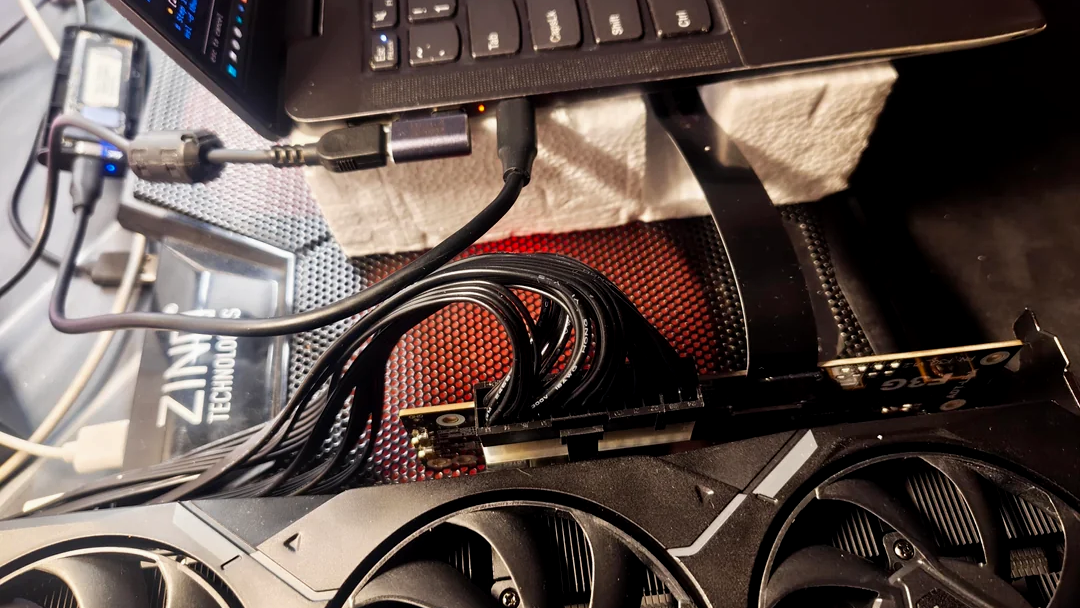
Enthusiast repurposes Lenovo Yoga laptop and AMD Radeon RX 7900 XT into M.2-powered desktop for local AI chatbots but hits DRAM bottleneck
 ↗
↗
A hobbyist project to run local LLMs on a modified Lenovo Yoga laptop with an external AMD Radeon RX 7900 XT via M.2 slot fails due to insufficient laptop DRAM
This experiment highlights the practical limits of repurposing consumer hardware for local AI workloads. Engineers testing similar setups should account for memory constraints, especially when using high-VRAM GPUs with limited system RAM. The failure underscores the importance of balanced hardware for LLM performance.
Written by elseif from the cluster below · every claim links back to a sourceThe three things worth knowing
The project used an M.2 slot and external PCIe cable to connect an AMD Radeon RX 7900 XT to a Lenovo Yoga laptop for local AI chatbots
Performance collapsed when the laptop’s DRAM was exhausted, forcing reliance on swap space and idling the GPU
The experiment ended with the hardware moved to a more suitable desktop system, abandoning the laptop-based approach
THE READ
What the cluster adds up to.
An enthusiast attempted to repurpose a Lenovo Yoga laptop into a desktop-like system for running local large language models (LLMs) by connecting an AMD Radeon RX 7900 XT via the laptop’s M.2 slot. The GPU was chosen for its 20 GB of VRAM, which is useful for LLM workloads, but the laptop’s limited DRAM became a critical bottleneck. The setup required booting from a USB SSD and initially worked for basic tasks, but the integrated display’s framebuffer consumed VRAM, reducing available memory for the models.
The project’s core issue emerged when running larger LLMs like Qwen 35B A3B and GLM-4.7 Flash with a 128K-token context window. The laptop’s DRAM was insufficient to handle the memory demands of the models, leading to excessive swapping and near-idle GPU performance. This mirrors a classic trade-off in AI workloads: balancing GPU memory, system RAM, and context window size. The experiment demonstrated that even high-VRAM GPUs cannot compensate for inadequate system memory in memory-intensive tasks.
The failure of the laptop-based setup underscores the importance of hardware balance for local AI workloads. While the M.2 slot provided a creative workaround for GPU connectivity, the laptop’s DRAM limitations made it unsuitable for sustained LLM operation. The project’s conclusion, migrating the GPU to a desktop system, highlights that consumer laptops, even when modified, are not ideal for high-memory AI tasks. Engineers evaluating similar setups should prioritize systems with sufficient RAM to avoid performance degradation.
Written by elseif from the cluster below · checked for specifics the sources never containedTHE CLUSTER