INFRA Signal 297
SiPearl begins delivering Rhea1 CPUs to Bull for Jupiter's CPU partition
 ↗
↗
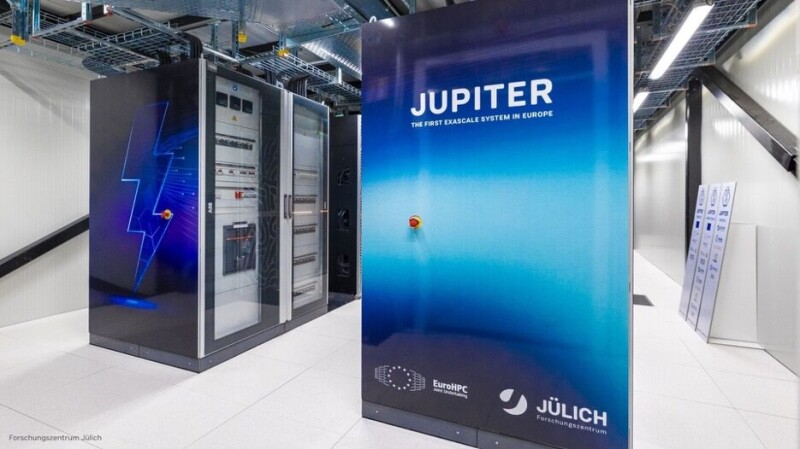
SiPearl has started delivering its Rhea1 Arm-based CPUs to Bull for integration into the Jupiter supercomputer's dedicated CPU partition.
This marks the first time Europe's leading exascale system incorporates domestic silicon, reducing reliance on US-made accelerators for specific HPC workloads. The Rhea1's high memory bandwidth addresses a gap left by GPU-centric designs, benefiting data-intensive scientific applications. It validates the EU's sovereign computing strategy by integrating local chip design into a top-tier national infrastructure.
Written by elseif from the cluster below · every claim links back to a sourceThe three things worth knowing
The Rhea1 is an 80-core Arm Neoverse V1 chip with 64 GB of HBM2e memory and 1.8 TB/s bandwidth, designed for HPC workloads not suited to GPUs.
Jupiter's CPU partition will comprise 1,300 nodes and 2,600 processors, estimated to deliver 5 petaFLOPS, operating alongside the existing Nvidia-powered booster.
The delivery represents a strategic shift for the EU, demonstrating the integration of domestic silicon into the continent's most powerful supercomputer.
THE READ
What the cluster adds up to.
Jupiter, the EU's first exascale supercomputer, currently relies on 24,000 Nvidia GH200 superchips for its booster section, which holds the European performance record. The new development involves SiPearl delivering its Rhea1 CPUs to Bull, the system builder, for a separate CPU-only partition. This partition is distinct from the GPU-heavy booster and is intended for workloads that do not benefit from accelerated computing.
The Rhea1 is an 80-core processor based on Arm's Neoverse V1 architecture, featuring 61 billion transistors. It includes four stacks of HBM2e memory totaling 64 GB, providing 1.8 TB/s of bandwidth, alongside four DDR5 channels. This high memory-to-compute ratio is specifically tailored for HPC and scientific applications that require efficient access to large datasets, a characteristic that previously favored systems like Japan's Fugaku.
While the Rhea1's Neoverse V1 core design is older than the V2 cores used in the Grace CPUs within Jupiter's booster, its inclusion is significant for digital sovereignty. The CPU partition will eventually span 1,300 nodes with 2,600 processors, estimated to produce 5 petaFLOPS. Although this output is modest compared to the exascale booster, it provides essential capacity for non-GPU workloads within the same system.
The delivery signals a broader trend in European HPC infrastructure, as SiPearl's Rhea2 chips are also slated for the Alice Recoque supercomputer. This move allows the EU to diversify its hardware supply chain, ensuring that critical scientific computing capabilities are not solely dependent on US semiconductor manufacturers. The integration of domestic silicon into a top-five global supercomputer serves as a proof of concept for the region's sovereign computing ambitions.
Written by elseif from the cluster below · checked for specifics the sources never containedTHE CLUSTER