AI Signal 512
LLMs lower barrier for user-created web app extensions
 ↗
↗
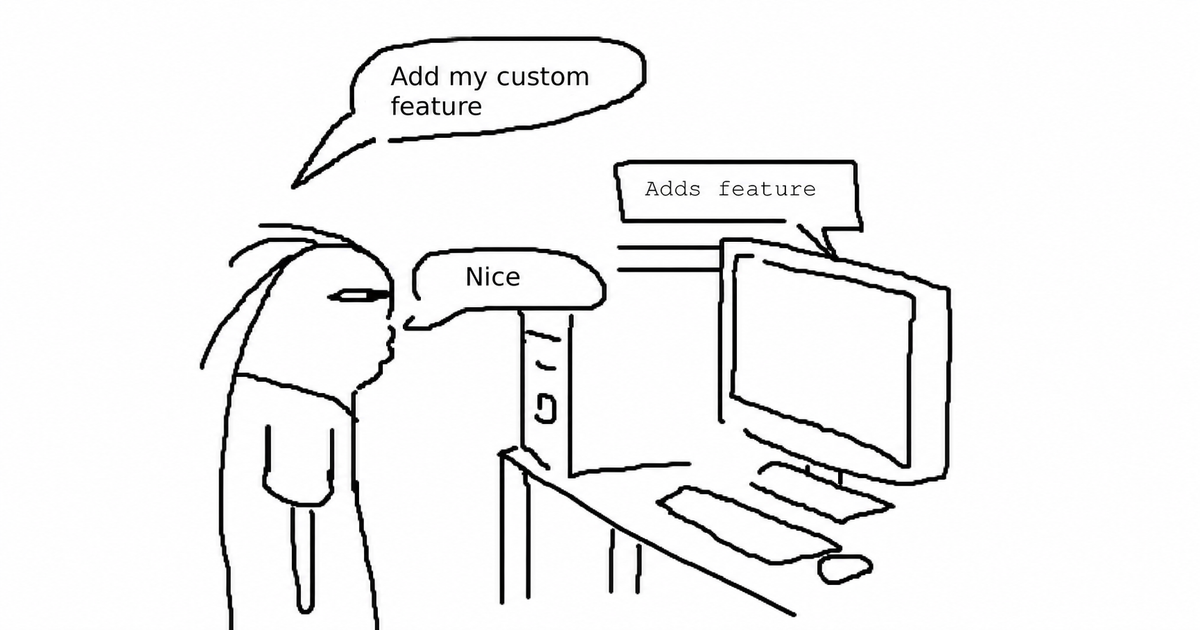
LLMs let users turn natural-language requests into runnable web app extensions, but sharing and deploying those extensions remains difficult without a dedicated cloud platform.
Engineers can address niche user needs without bloating the core product, because LLMs reduce the authoring cost of extensions. Modern sandbox primitives lower deployment cost and provide security, making it feasible to offer extensible cores on the web.
Written by elseif from the cluster below · every claim links back to a sourceThe three things worth knowing
LLMs make authoring extensions cheap enough for personal, one-off tools.
Deploying, securing, and sharing extensions is still complex; a cloud for small software could remove that friction.
Current extensible examples are local agents, IDEs, or game mods; the web needs similar sandbox-based hooks such as Dynamic Workers.
THE READ
What the cluster adds up to.
LLMs allow users to describe desired functionality in plain language and receive working code that can be attached to predefined extension points. This turns vague, long-tail requests into concrete features without requiring the user to write code manually. The core application stays unchanged while the extension handles the specific need.
Adopting this model requires engineers to design stable hooks, events, UI slots, and data interfaces, that extensions can safely call. The core must be versioned and documented so that extensions remain compatible over time. Engineers also need to integrate a sandbox runtime, such as Dynamic Workers, to isolate untrusted code. The primary cost is upfront work on the core and sandbox integration, not on building each extension.
Where the approach stops working is when the application lacks clear extension points or when the core changes frequently, breaking existing extensions. Sharing extensions also depends on a distribution mechanism; without a cloud service that handles authentication, versioning, and sandbox deployment, users must manage those steps manually. Additionally, the sandbox must trust the LLM-generated code; malicious prompts could still produce harmful behavior if safeguards are insufficient.
Compared with existing local extensibility, AI agents, IDE plug-ins, game mods, or CAD add-ons, the web has lacked a low-friction way to author and share such extensions. LLMs fill the authoring gap, while modern web sandbox primitives fill the deployment and security gap. Together they make it possible to treat the web as a platform for small, user-driven software.
Written by elseif from the cluster below · checked for specifics the sources never containedTHE CLUSTER