DATABASES Signal 142
Building interactive dashboards directly from a single Parquet file eliminates need for separate database
 ↗
↗
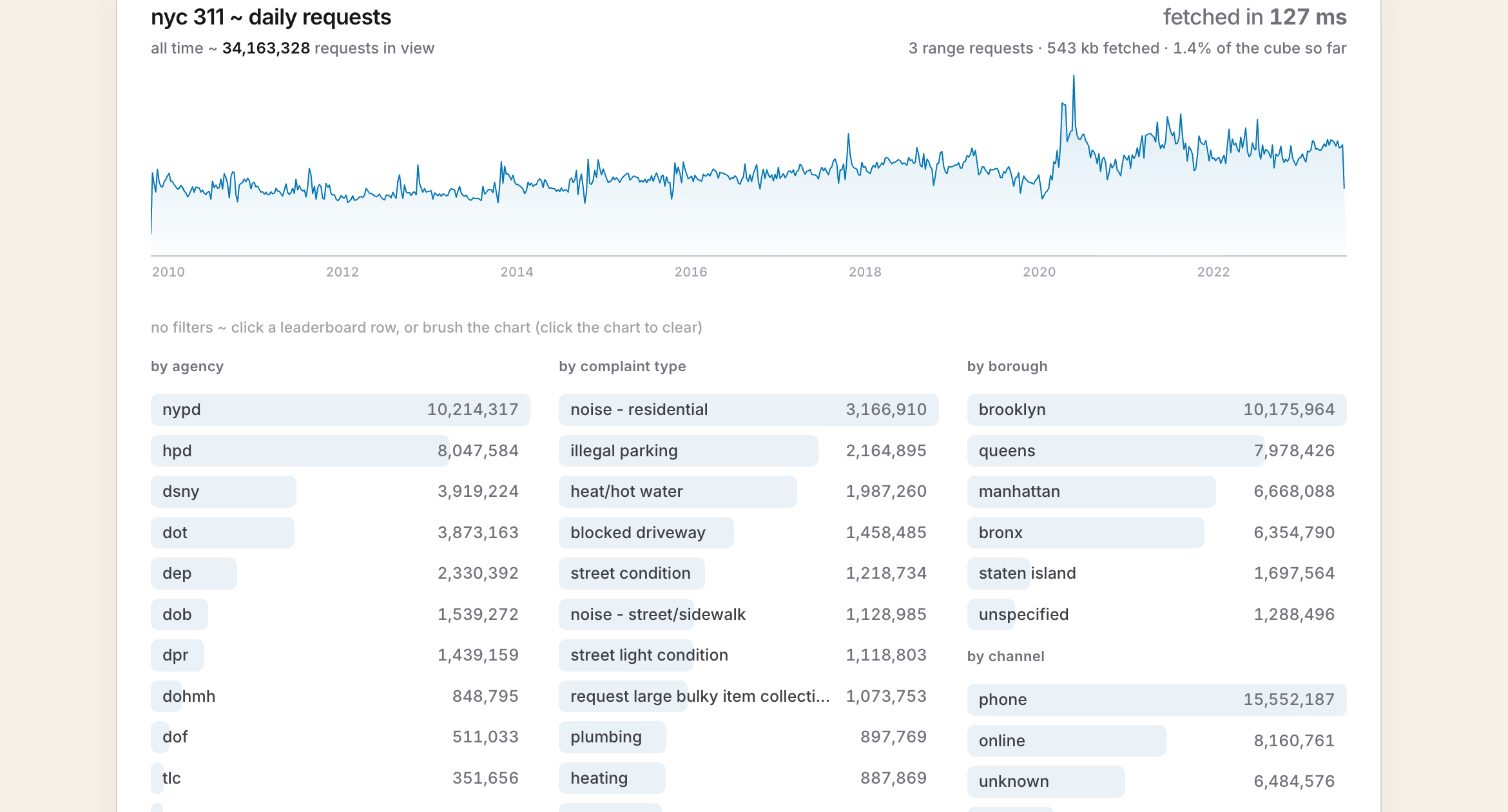
A drilldown dashboard is built by reading a pre-aggregated Parquet cube with Hyparquet in the browser, proxied via a Cloudflare Worker, removing the need for a separate database or query engine.
It shows that analytical dashboards can be served directly from immutable object storage using only client-side Parquet reads, reducing infrastructure overhead. This approach lowers cost and operational complexity for teams that already store data in services like Cloudflare R2.
Written by elseif from the cluster below · every claim links back to a sourceThe three things worth knowing
The dashboard uses a Parquet file containing pre-computed grouping sets for all needed aggregations.
Hyparquet reads byte ranges in the browser, guided by Parquet footers and sorted row groups to fetch only needed slices.
A Cloudflare Worker proxies and caches byte ranges to work around R2 rate limits while keeping the file immutable.
THE READ
What the cluster adds up to.
The demo shows a drilldown dashboard that reads directly from a single Parquet file stored in object storage. No traditional database or query engine is involved; the browser uses Hyparquet to issue range requests. A Cloudflare Worker proxies those requests and caches byte ranges at the edge. This shifts the analytical workload from backend services to the client and the edge layer.
Creating the cube requires a preprocessing step that computes all needed grouping sets and writes them into one Parquet file. The file must be sorted so that min/max values in each row group allow efficient pruning. Storage cost is limited to the size of the cube, which in the example is about 40 MB for 34 million rows. The only additional runtime cost is the edge worker that handles range requests and caching.
Because the dashboard relies on pre-computed aggregations, it can answer only the questions covered by the grouping sets in the file. Any ad-hoc filter or measure not present in the cube would require scanning more row groups or falling back to a full query engine. The method assumes the data is immutable; updates would necessitate rewriting the whole cube. Thus the approach is less suited for rapidly changing datasets or exploratory analytics.
Performance depends on the layout of row groups and the effectiveness of the edge cache; if the sorting is poor, each request may need to fetch many row groups, increasing latency and bandwidth. Very large cubes that exceed typical edge cache sizes could cause repeated fetches of the same data, diminishing the speed advantage. In such cases, a traditional backend with indexing might regain parity.
Written by elseif from the cluster below · checked for specifics the sources never containedTHE CLUSTER