TECH Signal 412
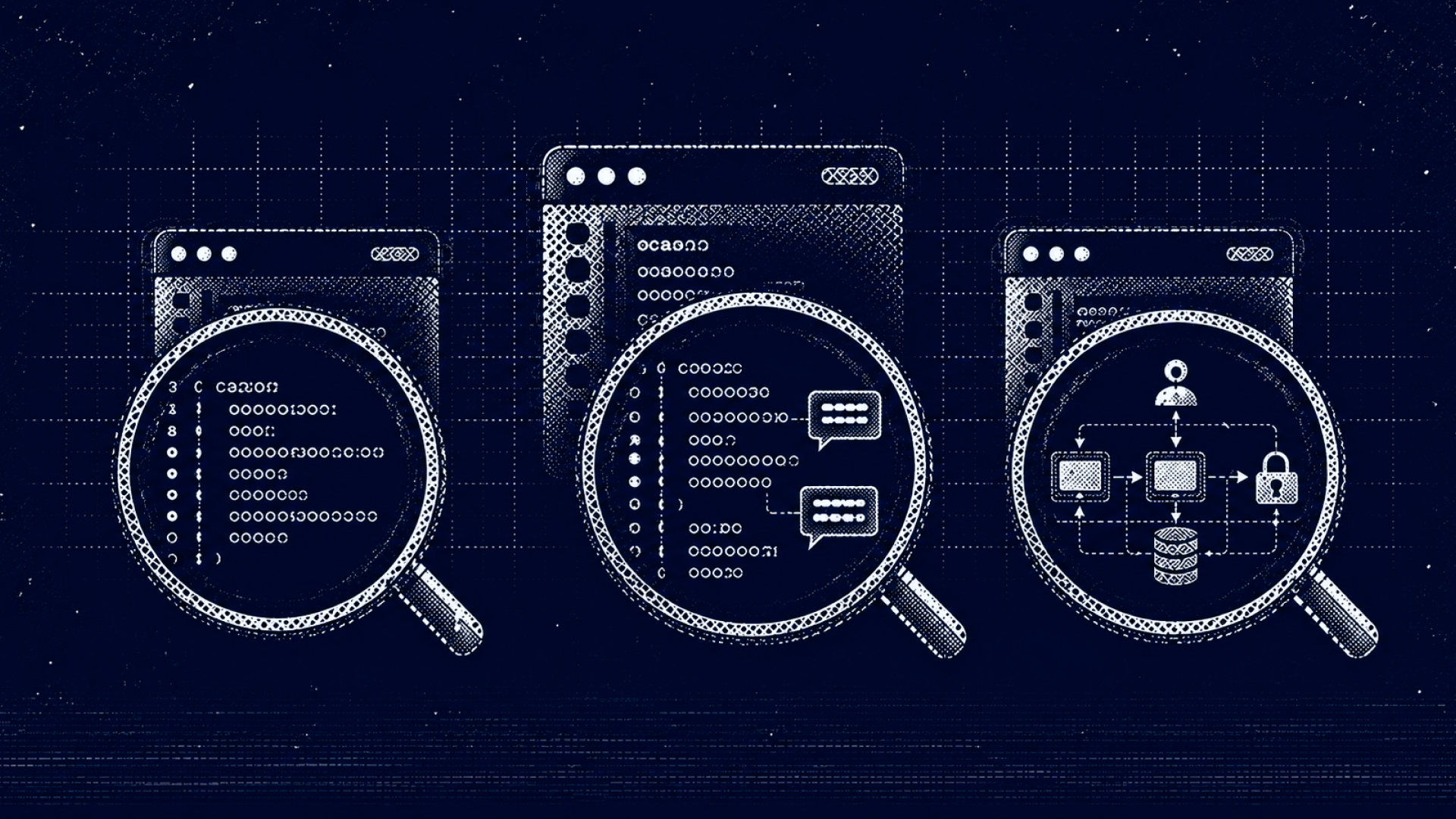
Four security testing approaches each target distinct vulnerability types across the software lifecycle
 ↗
↗
Engineers now have four complementary tools, SAST, Deep PR Review, AI Code Analysis, and AI Pentest, to catch vulnerabilities at specific stages of development.
Choosing the right tool for each development stage reduces noise and improves detection of logic flaws that pattern-based scanners miss. This layered approach also satisfies compliance needs by providing both automated checks and exploitable proof when required.
Written by elseif from the cluster below · every claim links back to a sourceThe three things worth knowing
SAST detects known code patterns deterministically and runs cheaply on every commit, pull request, and in the IDE.
Deep PR Review reasons about how a pull request interacts with the rest of the repository to catch early-signal flaws such as IDORs and broken access control.
AI Pentest validates findings by attempting to exploit a live running target, delivering concrete evidence for compliance.
THE READ
What the cluster adds up to.
The article identifies four distinct security testing methods that each focus on different types of vulnerabilities and operate at different points in the software lifecycle. SAST works as a deterministic pattern matcher that flags known issues without reasoning about data flow. Deep PR Review and AI Code Analysis both use reasoning to examine logic and intent, but they differ in scope, one looks at a single change, the other at the whole repository. AI Pentest adds a validation step by trying to exploit the findings on a running system.
SAST is inexpensive enough to gate every commit and can run continuously in CI/CD pipelines and IDEs, providing immediate feedback on known patterns. Its limitation is that it cannot follow untrusted data through multiple functions, so it often produces false positives on injections that are not actually reachable. Because it relies on a static rule set, it cannot detect flaws that depend on business logic or complex data transformations. Teams therefore need additional methods to catch those logic-based issues.
Deep PR Review runs on each pull request and reasons about how the introduced change interacts with shared libraries and services elsewhere in the repo, catching early-signal flaws such as IDORs and broken access control that SAST misses. AI Code Analysis applies the same reasoning across the entire repository, making it suitable for evaluating major refactors or hard-to-test components before a live target exists. Both methods require more computational effort than SAST but still run without needing a deployed application.
AI Pentest takes the reasoning of the previous two methods and tests it against a live, running system by attempting to exploit the identified issues, which yields concrete proof rather than an estimate. This validation step satisfies compliance requirements that demand demonstrable exploitability, but it also incurs the cost of maintaining a test environment and performing exploitation attempts. When no live target is available, AI Pentest cannot be run, leaving a gap that must be filled by the other three methods. Together, the four tools cover the full lifecycle: every commit, every meaningful change, and every release that needs proof.
Written by elseif from the cluster below · checked for specifics the sources never containedTHE CLUSTER