AI Signal 430
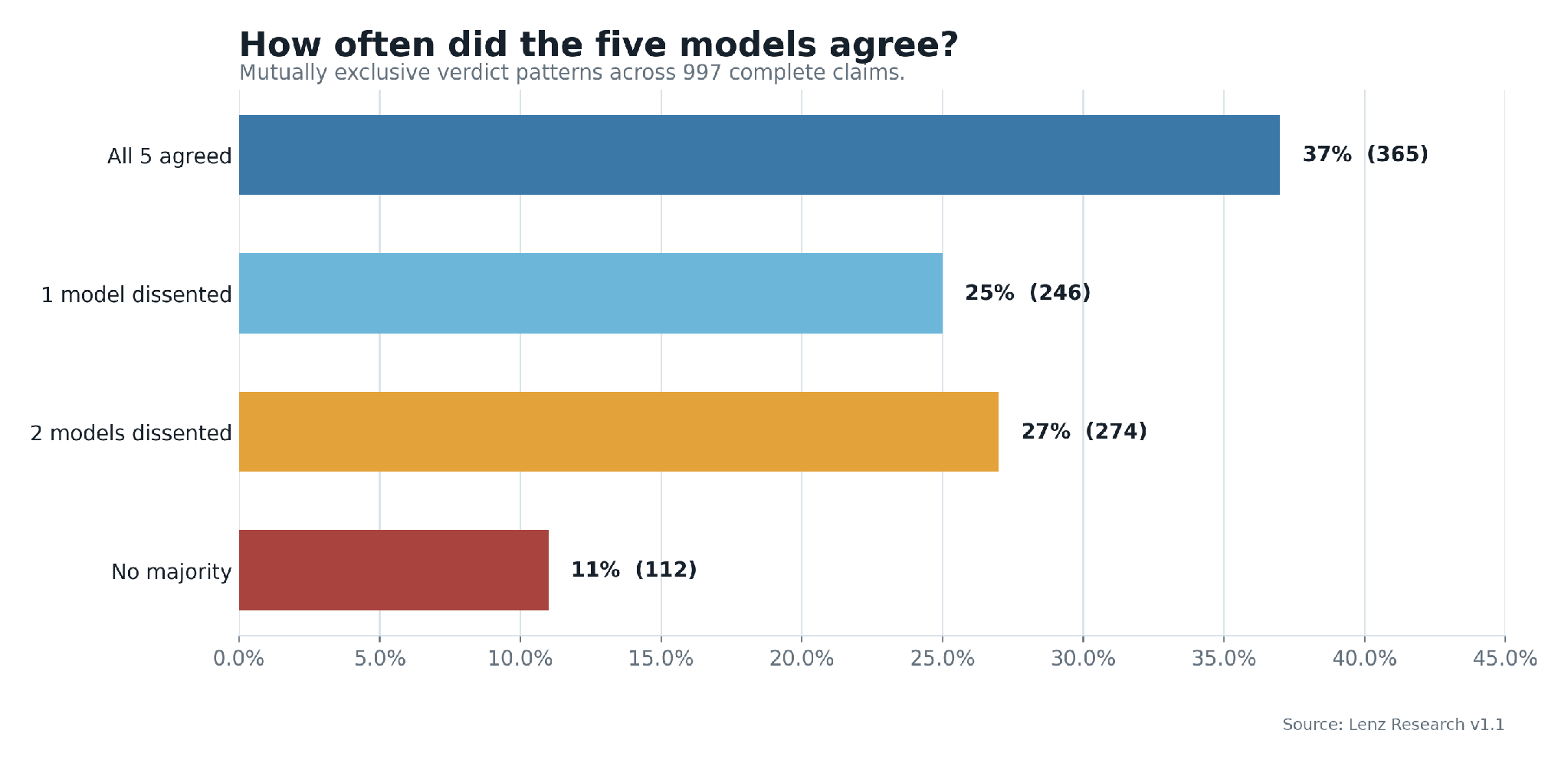
Five frontier LLMs fact-check 1,000 claims and disagree on 63%
 ↗
↗
Five frontier LLMs fact-checked 1,000 claims and disagreed on 63% of them.
The disagreement shows that even state-of-the-art models cannot reliably verify facts across the same set of claims. This undermines assumptions that benchmark performance translates to consistent factual accuracy, raising risks for applications that rely on automated fact-checking.
Written by elseif from the cluster below · every claim links back to a sourceThe three things worth knowing
The models checked the same 1,000 claims and disagreed on 63% of them.
All models reported high confidence despite significant disagreement.
Disagreement persisted even when models reported confidence of 10 on nearly all claims.
THE READ
What the cluster adds up to.
The study measured disagreement among five frontier LLMs on a shared set of 1,000 claims, finding that 63% of claims produced divergent verdicts.
Adopting any single model for fact-checking carries the cost of potentially incorrect conclusions, as high confidence does not guarantee consensus.
The findings stop short of claiming any model is more accurate than another, focusing instead on the unreliability of collective verdicts.
The methodology used near-duplicate removal and a five-point verdict scale, but relied on model self-reports without human validation.
Pairwise agreement varied widely, with Gemini and Sonar showing the lowest alignment, highlighting inconsistencies across model families.
Written by elseif from the cluster below · checked for specifics the sources never containedTHE CLUSTER