TECH Signal 345 2 feeds carried it
PDP-8 architecture walkthrough demonstrates front-panel programming and legacy storage methods
 ↗
↗
A detailed exploration of the PDP-8 minicomputer highlights its manual programming interface and pre-disk storage systems
For engineers working with embedded systems or retrocomputing, the PDP-8's design illustrates fundamental concepts in direct hardware interaction and early storage solutions. Understanding these legacy methods provides context for modern low-level programming and hardware control paradigms
Written by elseif from the cluster below · every claim links back to a sourceThe three things worth knowing
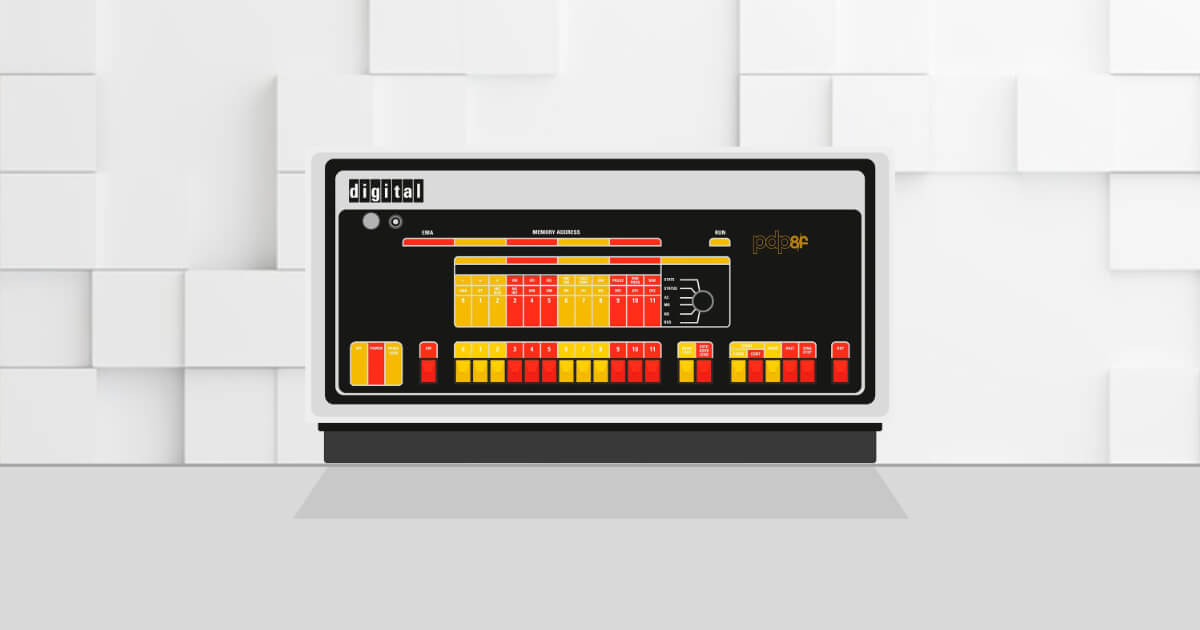
The PDP-8 used front-panel toggle switches for direct memory manipulation and bootstrap loading
Paper tape and DECtape provided sequential and semi-random access storage before disk drives became standard
The system's modular design combined core memory, tape drives, and disk cartridges in a single Omnibus backplane
THE READ
What the cluster adds up to.
The PDP-8 represents an era when programming required direct hardware interaction through front-panel controls. Engineers could observe and manipulate the program counter in real-time using amber lamps and toggle switches, a level of transparency rarely available in modern systems. This hands-on approach forced programmers to develop intimate understanding of memory addressing and CPU state management. The physical interface served as both diagnostic tool and programming environment, eliminating abstraction layers between software and hardware.
Storage solutions on the PDP-8 demonstrate the evolution from sequential to random-access media. Paper tape provided the most basic I/O method, requiring linear reading and writing of programs and data. DECtape introduced semi-random access capabilities, supporting block addressing and simultaneous read-write operations. The RK05 disk cartridges represented the next leap, offering true random access with capacities around 1.6MB per removable pack. Each storage tier addressed specific performance and cost tradeoffs in an era when memory and storage were expensive resources.
The system's modular architecture showcased how hardware components interconnected through the Omnibus backplane. Core memory, CPU, and peripheral controllers shared a common bus, allowing flexible configuration of system capabilities. This design philosophy influenced later minicomputer and microcomputer architectures, demonstrating how standardized interfaces could support diverse hardware combinations. The physical organization of components into color-coded cabinets also reflected deliberate system design for maintainability and operator understanding.
For contemporary engineers, the PDP-8 serves as a case study in hardware-software co-design. The visible state indicators and manual controls required programmers to consider timing, memory mapping, and device addressing at a fundamental level. Modern embedded systems often face similar constraints, though with different tradeoffs between abstraction and direct hardware control. The PDP-8's storage hierarchy also parallels modern storage systems, where different media types serve distinct roles in the memory hierarchy based on speed, capacity, and cost considerations.
Written by elseif from the cluster below · checked for specifics the sources never containedTHE CLUSTER