INFRA Signal 427
Fujitsu to sell 144-core Monaka Arm servers to rivals and clouds in November
 ↗
↗
Fujitsu is launching its custom Monaka Arm processors and three associated server models in November, targeting cloud operators, sovereign infrastructure buyers, and rival server manufacturers.
This introduces a new, high-core-count Arm option for datacenters, specifically pitched for inferencing workloads where Fujitsu claims double the output of rival CPUs. It also offers a Japan-manufactured sovereign alternative for European and domestic markets, potentially disrupting existing supply chains for high-performance inference hardware.
Written by elseif from the cluster below · every claim links back to a sourceThe three things worth knowing
The Monaka chip uses Broadcom 3D-chip stacking with four 2nm compute dies and four 5nm SRAM chiplets, supporting Armv9, DDR5, and PCIe 6.0.
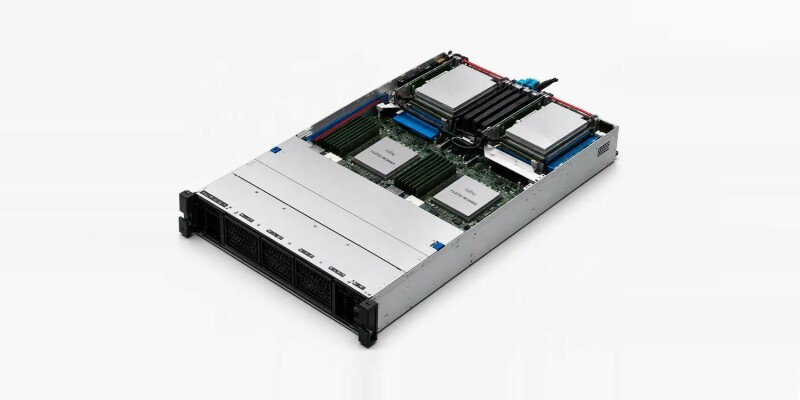
Fujitsu is selling the chip to third-party server makers, creating direct competition with its own three server models ranging from 1U air-cooled to 2U liquid-cooled HPC designs.
The company is positioning the Japan-manufactured servers as a sovereign solution for Europe and domestic markets, while highlighting suitability for hot air-cooled datacenters.
THE READ
What the cluster adds up to.
Fujitsu is moving its Monaka processor from a long-term roadmap item to a commercial product available in November. The chip diverges significantly from the Fugaku supercomputer silicon it was originally derived from, instead utilizing Broadcom’s 3D-chip stacking technology. It features four 2nm compute dies with 36 cores each, four 5nm SRAM chiplets, and a central I/O die supporting 12 channels of DDR5 and PCIe 6.0 connectivity.
The commercial strategy involves selling the raw processor to third-party server manufacturers, which places Fujitsu in direct competition with its own hardware. The company has designed three specific server models: a 1U unit supporting air or liquid cooling, a 2U air-cooled model, and a 2U liquid-cooled model intended for multi-node HPC and academic deployments. All configurations utilize the 144-core processor, with clock speeds varying between 2.1GHz and 2.9GHz depending on the thermal design.
The primary value proposition for cloud operators and AI-focused buyers is the claimed ability to handle double the inferencing output of rival CPUs. This performance claim, combined with the ability to operate in air-cooled environments up to 40C, addresses specific pain points in current datacenter infrastructure. The availability of a new source of inferencing power is particularly relevant given the ongoing fragility of silicon supply chains.
Fujitsu is also targeting the sovereign computing market by emphasizing that the servers are manufactured in Japan. This positioning is aimed at European customers and domestic users who prioritize local production and supply chain independence. However, the adoption by third-party server makers remains uncertain, as the industry has historically made only token efforts to deliver products hosting Arm chips despite years of touting their power efficiency.
Written by elseif from the cluster below · checked for specifics the sources never containedTHE CLUSTER