TECH Signal 486
New terminal-native coding agent Hax runs local LLMs with minimal resource use
 ↗
↗
Hax is a lightweight, C-based coding agent designed for terminal use with local LLMs and minimal dependencies
For engineers working in constrained environments or preferring terminal-based workflows, Hax offers a low-overhead alternative to heavier AI coding assistants. Its design prioritizes transparency and Unix-like composability, which may appeal to those who audit tool behavior or package software for distributions. The tool’s focus on local models and minimal resource usage could make it viable for edge or embedded scenarios where other agents are impractical.
Written by elseif from the cluster below · every claim links back to a sourceThe three things worth knowing
Hax is a single C binary with minimal dependencies, consuming only a few MB of memory
Supports multiple LLM providers including OpenAI-compatible APIs and local llama.cpp models without custom configuration
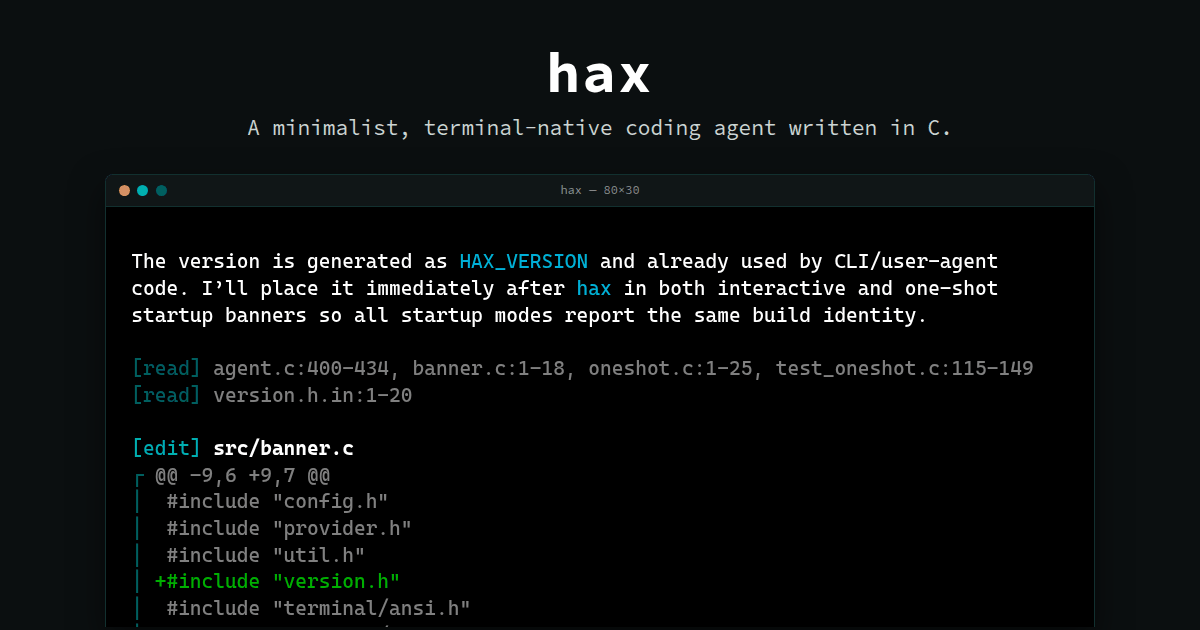
Designed for terminal-native use with streaming output, preserved scrollback, and inspectable transcripts
THE READ
What the cluster adds up to.
Hax presents a distinct approach to AI-assisted coding by prioritizing minimalism and terminal integration. Unlike many coding agents that rely on IDE plugins or web interfaces, Hax operates as a standalone binary with native terminal rendering. This design choice eliminates the overhead of graphical interfaces while preserving features like live output streaming and scrollback. The tool’s memory footprint, measured in single-digit megabytes, makes it particularly suitable for environments where resources are limited, such as CI/CD pipelines or embedded systems.
The tool’s architecture emphasizes transparency and auditability, addressing concerns about opaque AI interactions. Users can inspect full transcripts of model inputs and outputs, and optionally capture wire protocol traces. This level of visibility is rare in coding agents and may appeal to engineers who need to debug or document AI-assisted workflows. Hax also avoids common pitfalls of terminal applications, such as hijacking the terminal or disrupting existing workflows, by respecting native terminal behavior and preserving scrollback.
Hax’s provider-agnostic design allows it to work with a wide range of models, from local llama.cpp instances to cloud-based APIs like OpenAI and Anthropic. Auto-discovery of models and runtime capabilities eliminates the need for manual configuration in default setups, lowering the barrier to entry. However, the tool’s deliberate omissions, such as plugin systems or IDE panels, may limit its appeal to users who rely on those features. The documentation explicitly contrasts Hax’s philosophy with more feature-rich agents, positioning it as a tool for developers who value simplicity and control over extensibility.
Installation and usage reflect Hax’s minimalist ethos. The tool is distributed as a static binary for Linux and macOS, with straightforward build instructions for source compilation. Its command-line interface supports both interactive REPL sessions and one-shot prompts, with session persistence for continuity. While Windows support is limited to WSL, the tool’s cross-platform compatibility covers most Unix-like environments. The reliance on standard Unix tools like `fzf` for file completion ensures familiarity for terminal users, though it may introduce minor dependencies for some setups.
Written by elseif from the cluster below · checked for specifics the sources never containedTHE CLUSTER