TECH Signal 185
Higher Quality Small Synthetic Natural Language Text Generation for Interpretability Research
 ↗
↗
The post introduces a new small synthetic natural language dataset designed to improve interpretability research by addressing vocabulary size, word frequency, and error issues in existing datasets.
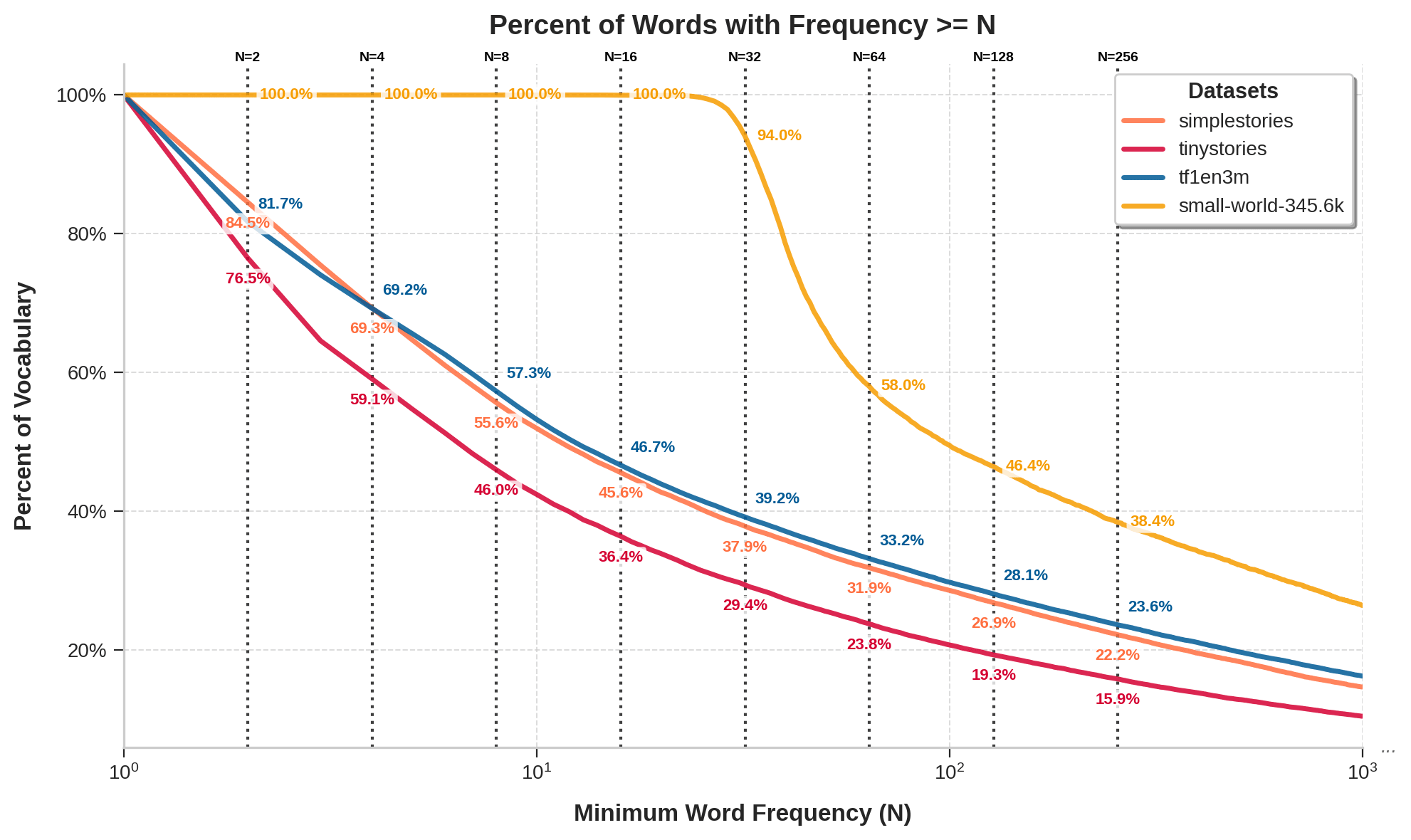
The new dataset provides a capped vocabulary where every word appears at least 16 times, reducing noise and enabling more reliable interpretability experiments. It can be generated locally on modest hardware, making it accessible for researchers without requiring large compute resources.
Written by elseif from the cluster below · every claim links back to a sourceThe three things worth knowing
The dataset uses a capped vocabulary of 8,973 words, ensuring all words occur at least 16 times to eliminate noise.
It is generated locally on an NVIDIA 5060 Ti (16GB) GPU at about 250 tokens per second, making it accessible for researchers.
The pipeline includes methods for sufficient word statistics and name disambiguation to improve dataset quality.
THE READ
What the cluster adds up to.
The post solves key problems in existing synthetic text datasets for interpretability research, specifically addressing vocabulary size, word frequency, and error issues.
Adopting this dataset requires researchers to generate it locally, which may involve technical setup and computational resources, though it is designed to run on modest hardware like an NVIDIA 5060 Ti.
The dataset stops working for applications that rely on larger vocabularies or different word frequency distributions, as it is specifically designed for small, capped vocabularies with sufficient word statistics.
The methods include capping new words after a set number of examples and using inverse-squared frequency weighting to ensure sufficient word occurrences, which directly addresses the noise problems in prior datasets.
The pipeline uses unsloth/gemma-4-26B-A4B-it-qat-GGUF for generation through a local llama-cpp server, providing an efficient and accessible way to produce the dataset.
Written by elseif from the cluster below · checked for specifics the sources never containedTHE CLUSTER