AI Signal 456
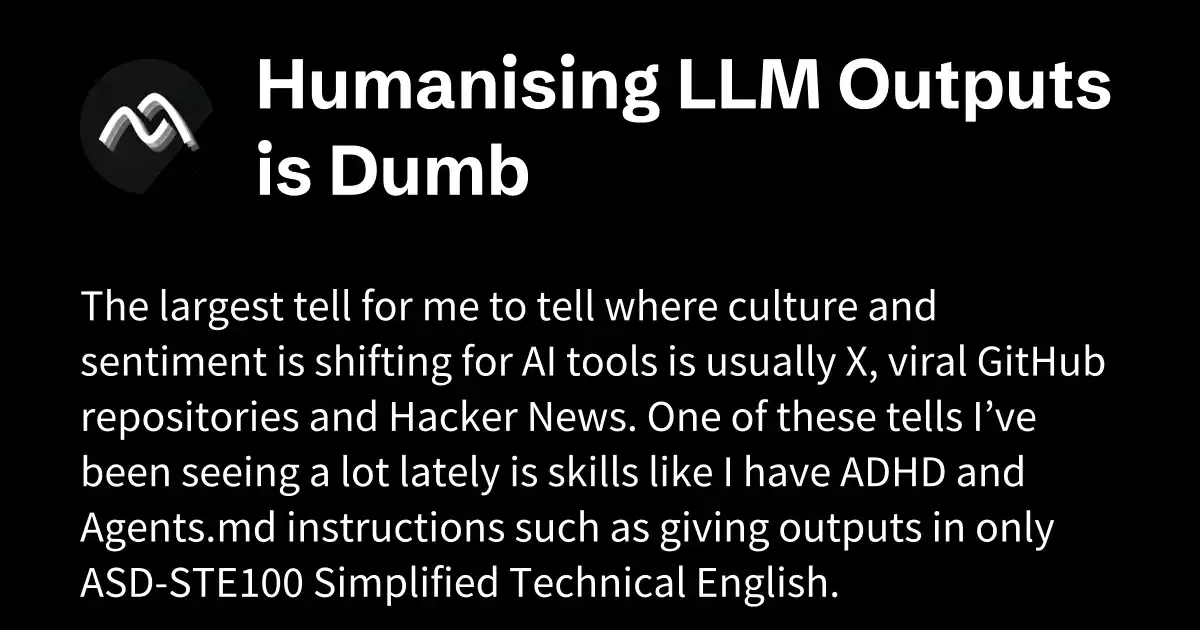
Humanising LLM Outputs Is Dumb
 ↗
↗
Engineering feedback suggests forcing LLMs to mimic human-readable styles during processing degrades output fidelity and obscures failures.
Teams building agentic workflows now face a trade-off: apply humanisation early and risk silent data loss, or defer it to the last step and preserve diagnostic detail. The choice affects debugging speed, inter-agent communication, and the reliability of automated decisions.
Written by elseif from the cluster below · every claim links back to a sourceThe three things worth knowing
Humanisation prompts compress LLM outputs in-process, discarding diagnostic detail before it can be logged or inspected.
Agents exchanging human-readable summaries compound information loss, hiding failures and uncertainty behind polite phrasing.
The pattern inverts established engineering practice, databases, compilers, and APIs all defer formatting until the final human boundary.
THE READ
What the cluster adds up to.
The event surfaces a tension between user experience and system integrity. LLMs are being instructed to adopt human-readable styles like ASD-STE100 or ADHD-friendly phrasing as part of their core task execution. This forces the model to compress its internal state into a lower-bandwidth format before completing the work. The compression is lossy, but the loss is invisible because the output remains coherent. Engineers accustomed to debugging raw logs or stack traces will find this opacity frustrating, especially when agents cascade summaries through multiple layers.
The cost of early humanisation is paid in debugging time and reliability. When an agent fails, it fails in ways that are useful to other machines, conflicting evidence, unresolved branches, or token-window exhaustion. Human-readable prose smooths these into vague phrases like 'a few considerations,' obscuring the actual problem. Teams adopting these prompts must either accept slower incident response or build parallel logging paths to capture the raw state, doubling their monitoring overhead.
The pattern contradicts decades of engineering practice. Databases store raw data and format it for dashboards only at display time. Compilers preserve intermediate representations for debugging, not readability. APIs exchange structured payloads, not friendly summaries. LLMs are being asked to do the opposite: format first, then work. This inversion makes sense for standalone chatbots but breaks down in agentic systems where outputs become inputs for other agents. The fix, deferring humanisation to the final step, requires tooling that doesn’t yet exist at scale.
The viral adoption of these prompts is a symptom, not a solution. Users are patching a missing layer in the stack: a renderer that can take precise, machine-facing state and compress it into warm, concise human output on demand. The durable version of 'talk to me like I have ADHD' is a post-processor, not an operating instruction. Until that layer is built, teams will keep applying humanisation early, trading fidelity for convenience. The feedback loop is clear: the prompts are a bug report for the tooling.
Written by elseif from the cluster below · checked for specifics the sources never containedTHE CLUSTER