DATABASES Signal 423
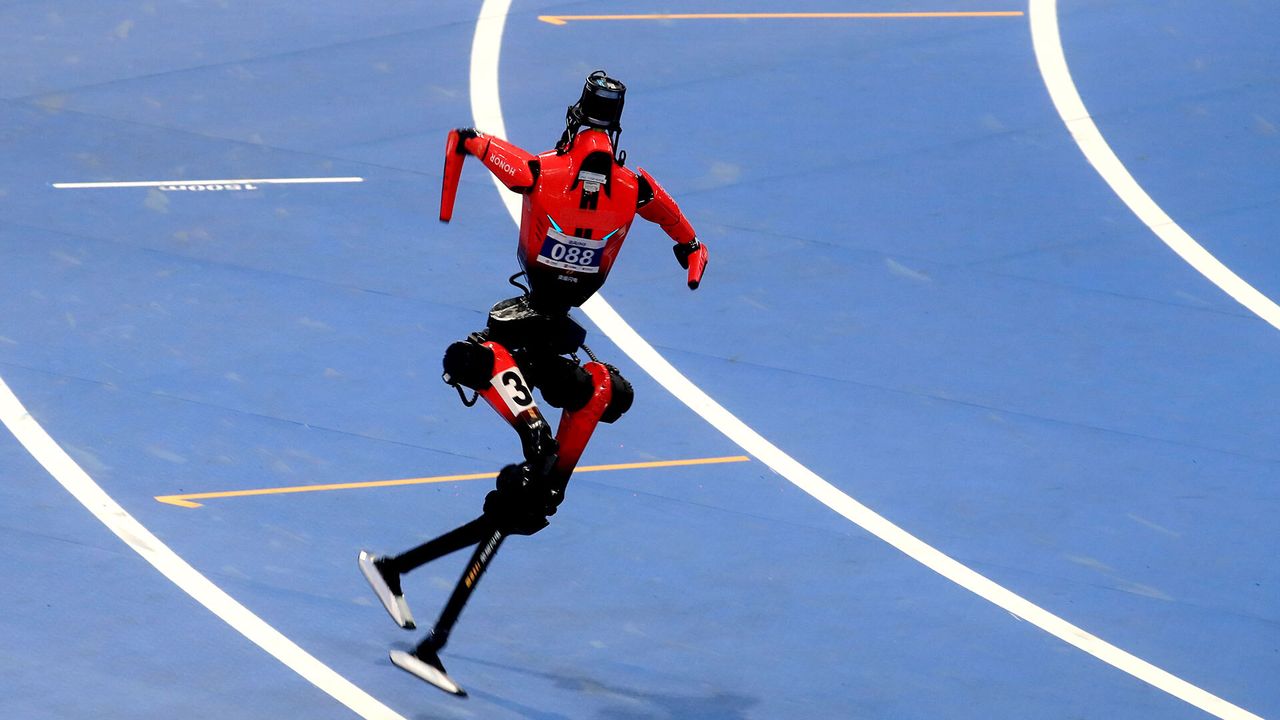
Humanoid robots reportedly break Usain Bolt's 100m record with 9.39-second sprint before crashing
 ↗
↗
Two Chinese humanoid robots at the World Humanoid Robot Games achieved sub-9.58-second 100-meter dash times, surpassing the human world record set in 2009.
This event demonstrates rapid advancements in bipedal robotics, particularly in speed and autonomy. However, the robots' inability to decelerate or stop gracefully highlights critical limitations in real-world applicability, where controlled motion is essential for safety and functionality.
Written by elseif from the cluster below · every claim links back to a sourceThe three things worth knowing
Tiangong Ultra logged a 9.39-second 100m dash, 0.19 seconds faster than Usain Bolt's 2009 record.
The robots achieved speeds of 23.8 mph but crashed into foam pads after crossing the finish line.
The event showcases progress in humanoid robotics but underscores challenges in dynamic stability and control.
THE READ
What the cluster adds up to.
The reported performance of the Tiangong Ultra and Honor Lightning robots marks a significant milestone in humanoid robotics. Achieving a 9.39-second 100-meter dash, faster than the fastest human, demonstrates improvements in actuator response, balance algorithms, and power efficiency. For engineers, this suggests that bipedal locomotion is becoming more viable for high-speed applications, though the context remains tightly controlled. The robots' speed was likely optimized for a straight-line sprint, a scenario far simpler than real-world environments where obstacles, uneven terrain, and dynamic interactions are common.
Despite the record-breaking times, the robots' inability to decelerate or stop without crashing reveals a critical gap in their design. The foam pads used to cushion their impact underscore the lack of robust braking or stabilization mechanisms. For practical deployment, such as in industrial or service roles, robots must handle transitions between motion states, starting, stopping, and turning, without losing control. The current limitation suggests that while speed has advanced, the underlying control systems may still rely on simplistic or pre-programmed behaviors rather than adaptive, real-time decision-making.
The event's broader implications for robotics engineering are mixed. On one hand, the rapid improvement, from 21.5 seconds last year to 9.39 seconds this year, shows that iterative development in hardware and software can yield dramatic results. On the other, the robots' performance is narrowly scoped to a single task in a controlled setting. The contrast with human runners, who can adjust their gait, anticipate obstacles, and recover from perturbations, highlights how far humanoid robots still have to go. For engineers, this serves as a reminder that speed alone is not a proxy for capability; robustness, adaptability, and safety are equally critical metrics.
The geopolitical context also matters. The robots' development and the event's location suggest a focus on advancing domestic robotics capabilities, but the FCC's ban on foreign-made robots in the U.S. could limit their adoption elsewhere. For engineers working on global projects, this introduces an additional layer of complexity, as hardware and software may need to comply with regional regulations or face restricted markets. The event, while impressive, is as much a showcase of technical progress as it is a reflection of the fragmented landscape in which robotics innovation occurs.
Written by elseif from the cluster below · checked for specifics the sources never containedTHE CLUSTER