AI Signal 427
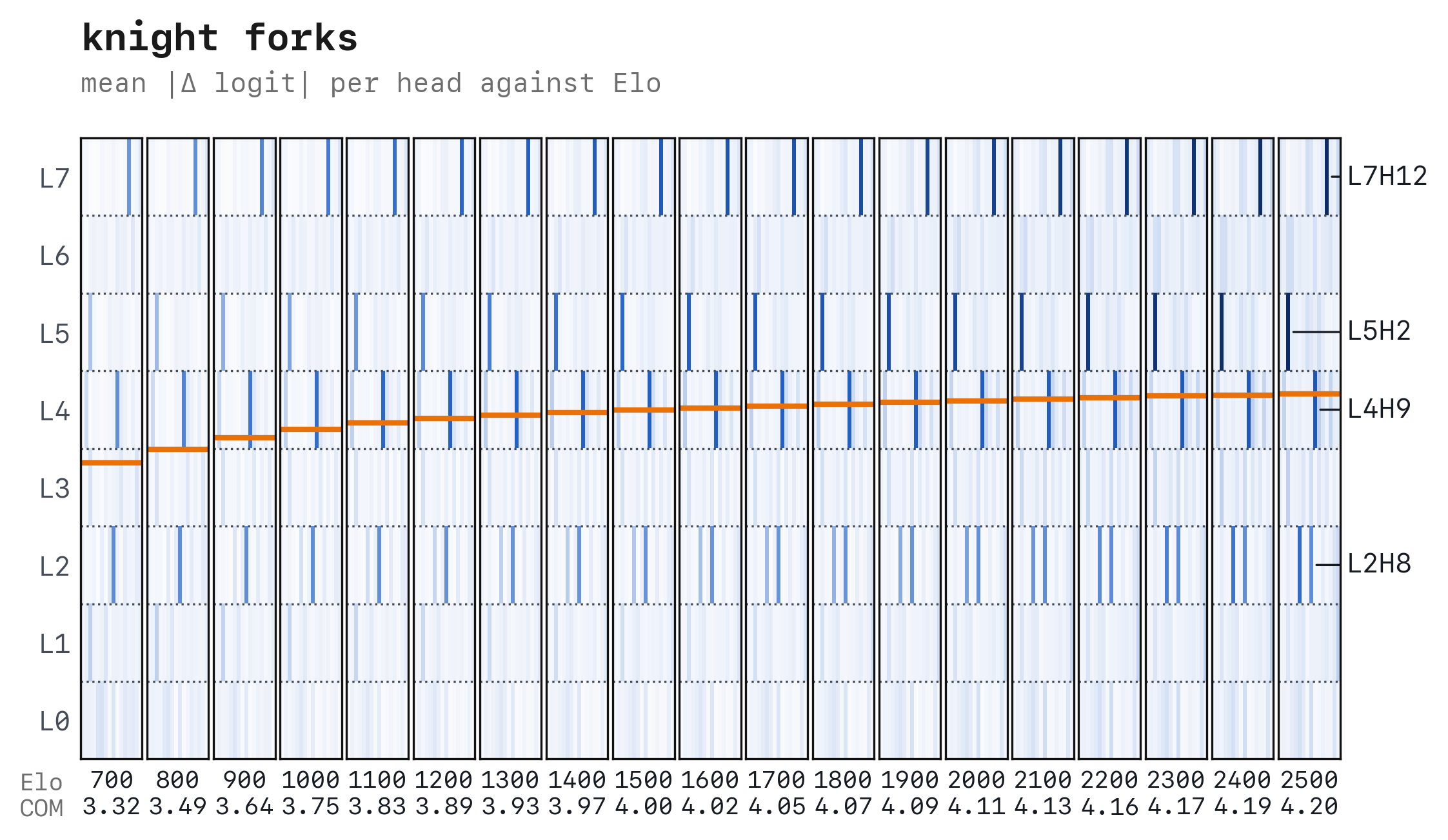
Increasing Skill Level Recruits Deeper Attention Layers in a Frozen Chess Transformer
 ↗
↗
Paper: Increasing Skill Level Recruits Deeper Attention Layers in a Frozen Chess Transformer TL;DR: Maia-3 is a transformer-based chess model that takes Elo as an input to the pre-trained network, so you can vary the skill the network is conditioned on.
This research illustrates how varying skill levels in AI chess can affect the depth of attention mechanisms in a transformer model. Understanding this relationship can inform the design of AI systems that adapt to different levels of complexity in tasks. It also provides insight into the functioning of neural networks in specialized applications, which can enhance their interpretability and efficiency.
Written by elseif from the cluster below · every claim links back to a sourceThe three things worth knowing
Maia-3, a chess-specific transformer model, adjusts its behavior based on Elo ratings to simulate different skill levels.
The study reveals that higher skill levels lead to deeper computations within the model's attention layers.
Deeper layers are recruited for specific tactical computations, indicating a shift in how the model processes information as skill increases.
THE READ
What the cluster adds up to.
The Maia-3 chess model utilizes a transformer architecture that adapts its processing depth based on the Elo rating input, which ranges from 700 to 2500. This capability allows it to simulate varying levels of chess expertise without altering its underlying weights, providing a flexible framework for analyzing chess strategies. It highlights the model's adaptability to different skill levels.
In practical terms, this means that as the Elo input increases, the model engages deeper layers of its architecture to compute moves. This depth migration is significant, as it suggests that advanced tactics, particularly complex maneuvers like knight forks, are processed more thoroughly in the model's architecture. Understanding this can help engineers develop more nuanced AI systems that respond differently based on task complexity.
However, the model's performance might plateau or become less effective outside the specified Elo range. If the Elo rating exceeds the model's training limits, it may not generalize well to those higher skill levels. This limitation is crucial for engineers considering the deployment of such models in real-world applications, as it delineates the bounds of the model's reliability.
Written by elseif from the cluster below · checked for specifics the sources never containedTHE CLUSTER