OBSERVABILITY Signal 447
Instacart Builds Blueberry, an AI-Powered Assistant to Help On-Call Engineers Investigate Incidents
 ↗
↗
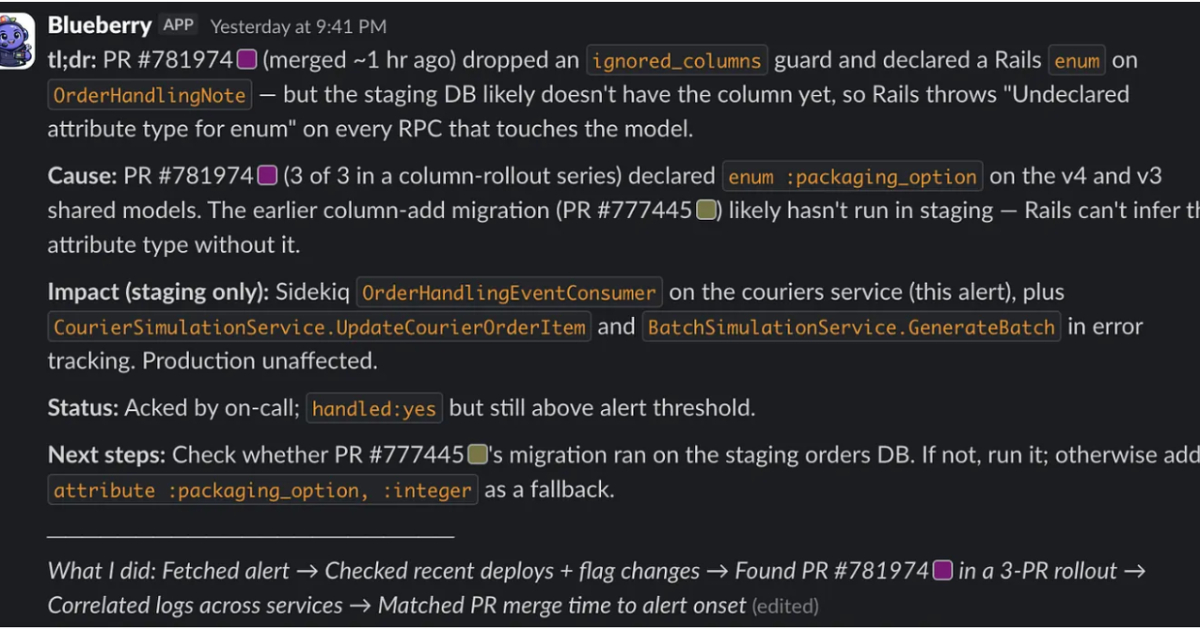
Instacart released Blueberry, an AI-driven assistant that surfaces context and root-cause hypotheses for on-call engineers directly inside Slack incident threads.
By automating the early data-gathering steps of incident response, Blueberry reduces the time engineers spend searching for logs, ownership, and deployment history, allowing faster diagnosis. The system leverages fourteen years of internal incident records to improve hypothesis accuracy from the mid-60% range to the high-90% range, indicating a measurable boost in diagnostic quality. Engineers still retain final decision authority, so the tool augments rather than replaces human judgment.
Written by elseif from the cluster below · every claim links back to a sourceThe three things worth knowing
Blueberry launches about ten parallel AI subagents per alert and returns a grounded hypothesis within roughly three minutes.
The assistant pulls from internal sources such as service ownership, deployment metadata, logs, metrics, and a long-standing incident knowledge base.
Integration is limited to Slack-based workflows; the tool does not execute remediation actions automatically.
THE READ
What the cluster adds up to.
Instacart built Blueberry to address the bottleneck where on-call engineers spend the initial minutes of an incident manually assembling context. The platform stitches together multiple AI agents with internal operational data, delivering a concise hypothesis directly into the Slack thread where the alert originated. This shift moves the starting point of an investigation from an empty slate to a pre-populated set of logs, deployments, and related incidents. The architecture relies on a tool-aware harness that keeps investigation state and queries internal catalogs, rather than depending solely on generic language models. By grounding each subagent’s output in concrete data sources, the system achieves a reported diagnostic accuracy improvement to the high-90% range. The design also includes a feedback loop where engineers can review and refine the AI’s suggestions, reinforcing the knowledge base over time. Operationally, adopting Blueberry requires integrating the AI agents with Slack, exposing internal data pipelines (logs, metrics, deployment records), and maintaining the incident history repository. Teams must also implement the side-mounted catalog and persistence mechanisms
Written by elseif from the cluster below · checked for specifics the sources never containedTHE CLUSTER