PLATFORMS Signal 612 2 feeds carried it
Introducing Agent Plugins
 ↗
↗
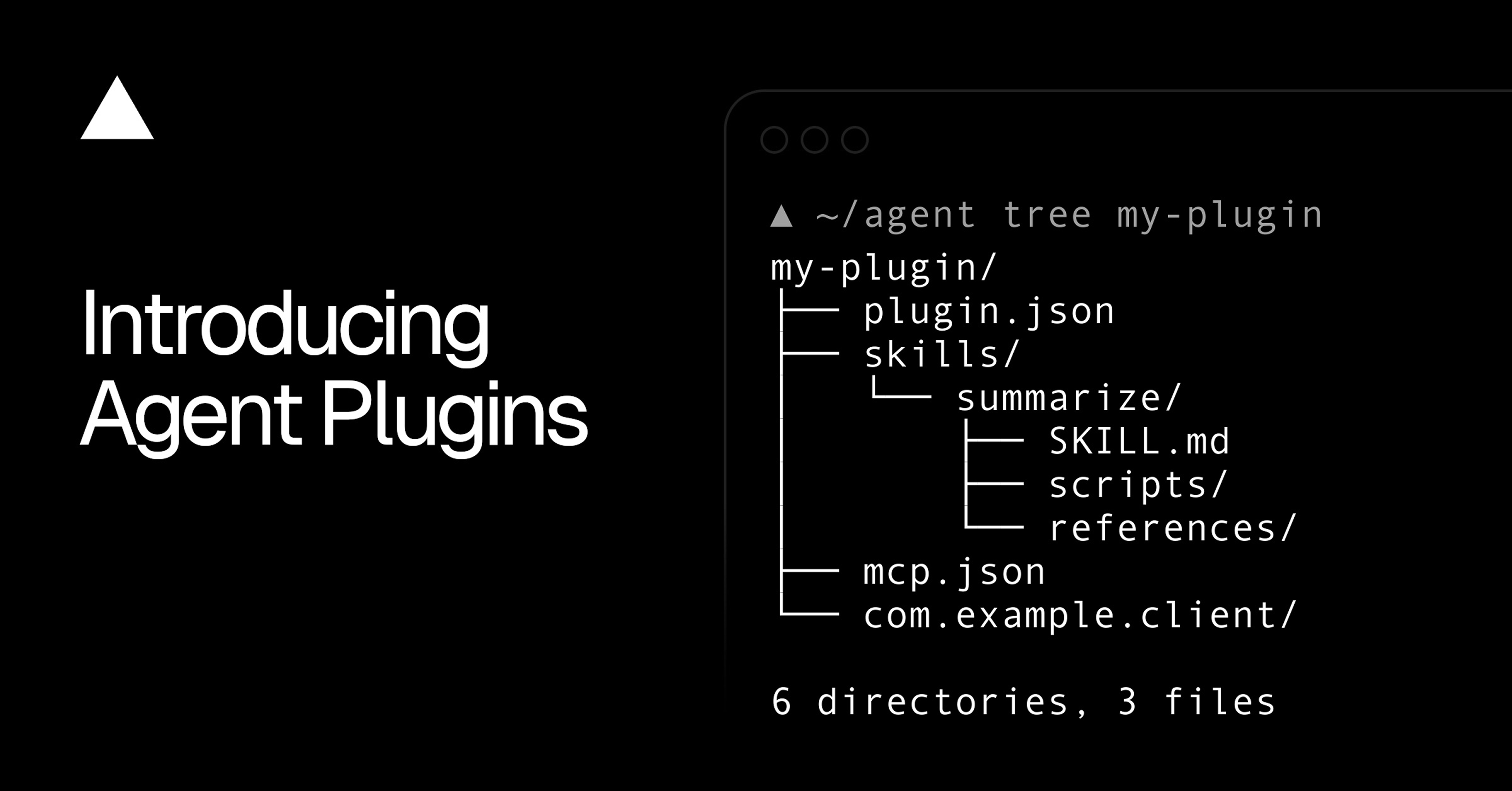
Agent Plugins 1.0.0 defines a vendor-neutral directory layout and minimal JSON manifest for bundling AI Agent Skills and MCP servers into a single portable plugin.
By giving all compatible clients a predictable structure, extension authors no longer need to maintain separate packages for each platform, cutting duplication effort. Client developers gain a small, deterministic contract for discovery and validation while retaining freedom over installation, distribution, policy, and UI. The specification is backed by multiple cloud and AI vendors, reducing the risk of a single-vendor lock-in.
Written by elseif from the cluster below · every claim links back to a sourceThe three things worth knowing
A plugin is a directory containing a plugin.json manifest and fixed subfolders for skills and MCP configuration.
Clients may support either Skills, MCP servers, or both, and validation of each component is independent.
Namespaced extensions let individual clients add proprietary data without breaking the shared format.
THE READ
What the cluster adds up to.
The announcement introduces a standardized packaging format for AI agent extensions, replacing the ad-hoc methods that each client previously required. The core of the change is a simple directory with a plugin.json file that declares the spec version and name, plus optional subfolders for reusable Skills and MCP server definitions. This reduces the overhead for authors who previously had to tailor metadata and discovery paths for each target platform.
Implementing the spec on a client side mainly involves adding logic to locate plugin.json at the root, read the minimal fields, and then scan the known subfolders for supported component types. The cost is limited to parsing a small JSON schema and performing independent validation of each component, without imposing any particular distribution or policy mechanism. Clients that do not adopt the spec will continue to use their existing packaging conventions and will simply ignore directories that lack the expected manifest.
The format deliberately stops at the boundary of discovery and loading; it does not prescribe how plugins are installed, how policies are enforced, or how user interfaces present them. Consequently, any client-specific features, such as custom authentication, versioning, or UI flows, must be handled through the namespaced extension mechanism, which remains outside the portable contract. This ensures that the shared format remains lightweight while allowing each platform to innovate independently.
The feeds frame the release differently: Vercel emphasizes the versioned release, while Google highlights the ability to package both skills and tools together. This contrast underscores the dual focus of the spec, providing a concrete, versioned artifact for developers and a broader capability for bundling diverse agent functionalities. The multi-vendor backing, including AWS, Microsoft, OpenAI, and others, signals industry consensus rather than a single company’s roadmap.
For engineers building or operating AI-enabled services, the immediate impact is a reduction in packaging complexity and a clearer path to cross-platform reuse. Adoption requires modest changes to plugin loading pipelines, and the specification’s open governance means future extensions can be incorporated without breaking existing implementations. However, any client that relies on proprietary metadata not covered by the core schema must continue to manage those details through its own extension namespace.
Written by elseif from the cluster below · checked for specifics the sources never containedTHE CLUSTER