TECH Signal 431
I've gone from writing about SD-WAN to depending on it
 ↗
↗
A remote-worker couple combined DSL, 5G, and Starlink with a Ubiquiti SD-WAN gateway to keep their home network reliable after moving to a rural location.
Using SD-WAN to aggregate consumer broadband links can turn intermittent, low-bandwidth services into a usable connection for SaaS-driven work. Engineers can achieve automatic failover and traffic steering without buying expensive MPLS circuits, but they must still accept the performance ceiling of the underlying ISPs.
Written by elseif from the cluster below · every claim links back to a sourceThe three things worth knowing
Multi-WAN failover and load-balancing were implemented with a Ubiquiti UniFi Dream Machine SE, which required no additional license.
Policy-based routing directs SaaS traffic over the fastest available link while keeping internal traffic on the preferred path.
The solution mitigates frequent drops from 5G and Starlink but cannot overcome the inherent bandwidth limits or outages of those services.
THE READ
What the cluster adds up to.
The household moved from a suburban fiber connection to a mountain setting where the only wired option was DSL offering roughly 20 Mbps down and 1.5 Mbps up. To compensate they added a 5G home internet service that delivered near-gigabit download speeds but only 30-40 Mbps uplink, and a Starlink subscription promising 100-400 Mbps down with about 30 Mbps up. Both wireless links suffered occasional outages, with about a dozen disconnections over two months, many occurring during work hours.
Managing these connections manually would have required separate SSIDs and firewall rules for each network, leading to channel interference and no seamless handover for voice or video calls. The lack of automatic routing meant that a dropped link could interrupt ongoing sessions, forcing users to reconnect or switch networks manually. This approach also failed to provide a unified policy for directing traffic based on application needs.
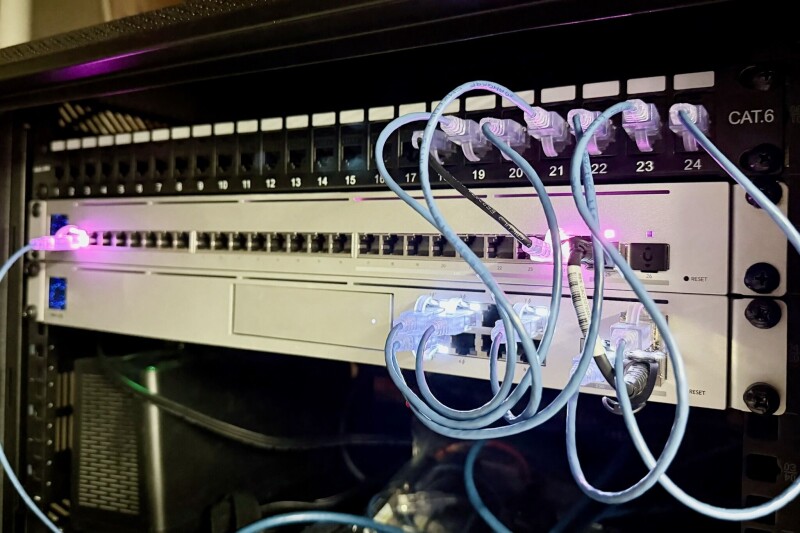
The couple deployed a Ubiquiti UniFi Dream Machine SE, which already supports multi-WAN failover, load-balancing, and policy-based routing. By configuring the device to treat the 5G and Starlink links as redundant paths, the gateway can automatically shift traffic when one link degrades, while still allowing specific traffic, such as SaaS applications, to prefer the higher-capacity link. Because the device does not require a paid license for these features, the hardware cost was essentially the only expense.
With SD-WAN in place, the home network experiences fewer visible interruptions, as the gateway can reroute traffic within seconds of a link failure, preserving call quality and session continuity. However, the overall throughput remains bounded by the slower uplink of the consumer services, and any prolonged ISP outage still results in loss of connectivity. Engineers should therefore view this as a reliability enhancer rather than a bandwidth booster.
Adopting this setup mainly involves the time to configure the gateway and define routing policies; no additional subscription or licensing fees are needed. The solution works well for typical remote-work workloads but may not satisfy high-performance or low-latency requirements that enterprise MPLS or dedicated fiber would provide. Consequently, while SD-WAN can extend the usefulness of patchy broadband, it does not eliminate the need for a robust primary connection where critical.
Written by elseif from the cluster below · checked for specifics the sources never containedTHE CLUSTER