DATABASES Signal 142
Keenable SELECT reportedly lets engineers query live web data using SQL with semantic operators
 ↗
↗
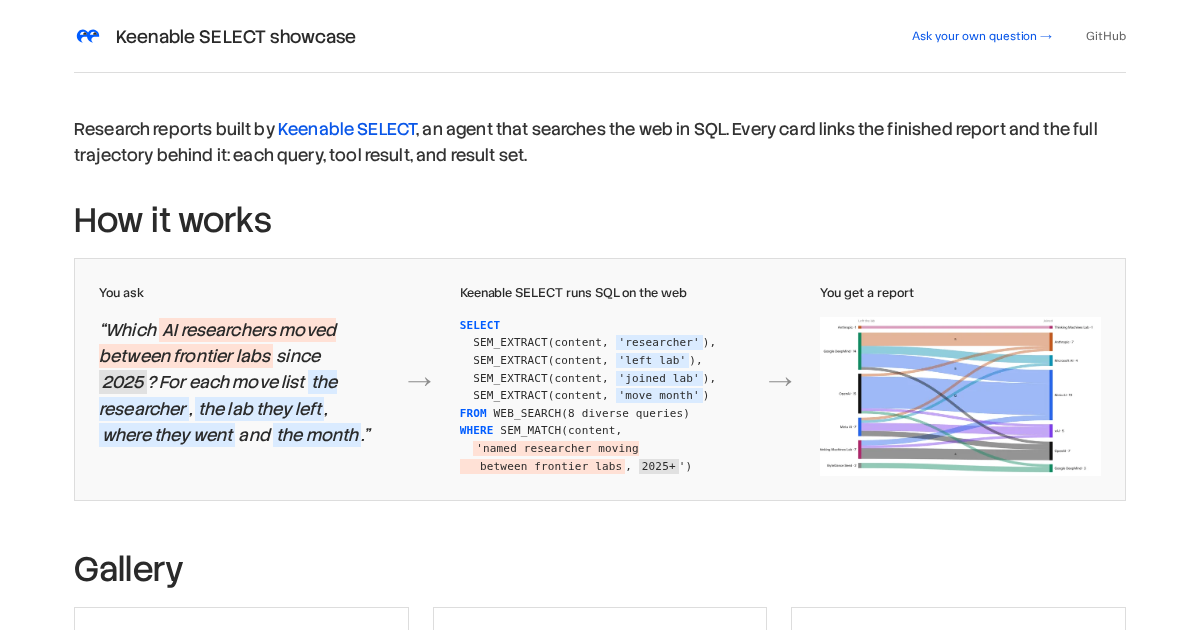
Keenable SELECT introduces a DuckDB-based agent that translates SQL queries into web searches, semantic extraction, and structured reports without manual page scraping.
This shifts the cost of web research from post-processing unstructured data to filtering and extracting within the query itself. For engineers, it replaces ad-hoc scraping scripts with a declarative interface, but its accuracy depends on the underlying LLM’s semantic operators. If the operators misinterpret content, the query results may be silently incorrect.
Written by elseif from the cluster below · every claim links back to a sourceThe three things worth knowing
SQL queries now include semantic operators like `SEM_EXTRACT` and `WEB_SEARCH` to fetch and process live web data directly.
The system runs exact SQL filters first, reducing LLM calls to only the rows that pass the WHERE clause.
Each query result is saved as a reusable result set, and later queries can reference it by ID for iterative analysis.
THE READ
What the cluster adds up to.
Keenable SELECT bridges SQL and web data by embedding semantic operators directly into DuckDB queries. Engineers can write a single `SELECT` statement that searches the web, filters results, and extracts structured fields, tasks that previously required separate scraping, parsing, and LLM calls. The system offloads the heavy lifting to the query engine, which runs exact filters before invoking LLM-based operators like `SEM_EXTRACT`. This design minimizes LLM costs by limiting semantic processing to rows that already match the SQL conditions.
The trade-off is dependency on the accuracy of semantic operators. `SEM_EXTRACT` and `SEM_MATCH` rely on an LLM to interpret unstructured text, which can introduce errors if the model misreads context or fails to extract the intended field. For example, a query for 'researcher moves between labs' might miss a lab name if the source page phrases it ambiguously. The system mitigates this by exposing the full query trajectory, allowing engineers to audit each step, but it doesn’t eliminate the risk of silent failures in the extraction process.
For iterative research, the system saves every query result as a reusable result set with an ID. Later queries can reference these IDs, enabling engineers to build on prior work without re-running expensive web searches. This is useful for refining reports or combining datasets, but it also means the system’s utility depends on the quality of the initial query. Poorly designed `WHERE` clauses or semantic filters can propagate errors through subsequent queries, making the audit trail critical for debugging.
The approach contrasts with traditional web scraping, where engineers write custom scripts to fetch pages, parse content, and structure data. Keenable SELECT replaces this pipeline with a declarative SQL interface, but it doesn’t eliminate the need for domain-specific tuning. Queries must still account for variations in how web content is phrased, and the system’s performance hinges on the diversity of the initial `WEB_SEARCH` queries. If the search terms are too narrow, the results may miss relevant pages entirely.
Written by elseif from the cluster below · checked for specifics the sources never containedTHE CLUSTER