TECH Signal 341
Koopman Theory provides a mathematical framework for understanding moral evolution
 ↗
↗
The constructivist view links natural selection to moral values through Koopman Theory's mathematical form.
This theoretical approach could reshape how we understand the evolution of morality, bridging biology and ethics. By employing mathematical models, it may offer clearer insights into moral reasoning and decision-making processes. This could potentially lead to more effective moral frameworks that adapt over time as society evolves.
Written by elseif from the cluster below · every claim links back to a sourceThe three things worth knowing
Koopman Theory expresses the influence of natural selection on moral views mathematically.
The framework suggests that moral systems evolve alongside biological constraints.
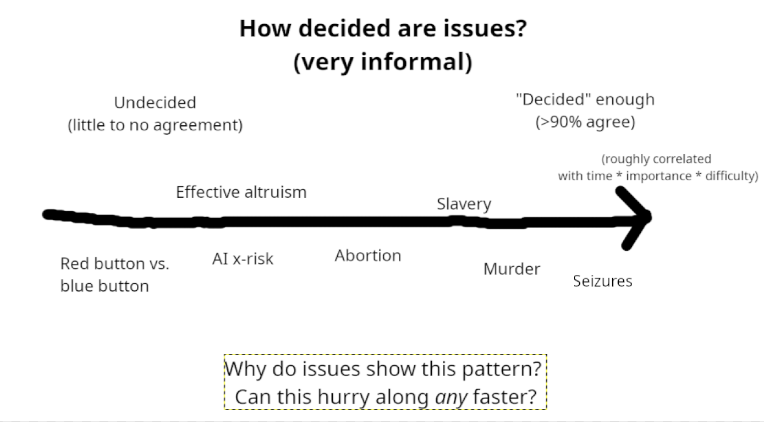
Understanding moral evolution may speed up societal consensus on ethical issues.
THE READ
What the cluster adds up to.
The application of Koopman Theory to metaethics introduces a quantitative approach to understanding how moral values evolve through natural selection. By using the linear Koopman operator, the theory posits that moral systems can be modeled and predicted based on their evolutionary history, offering a novel perspective on ethics.
This mathematical framework emphasizes the role of evolutionary pressures in shaping moral concepts, suggesting that moral reasoning may be fundamentally linked to the same biological constraints that govern physical existence. This connection could lead to more robust ethical theories that align closely with human behavioral patterns.
However, while the theory provides a structured way to analyze moral evolution, its practical implementation in real-world ethical discussions may be limited. The complexities of human values and societal norms might not always fit neatly into mathematical models, potentially oversimplifying the nuanced nature of moral reasoning.
Moreover, this theory raises questions about the implications of using mathematical constructs in moral philosophy. If moral systems are seen as evolutionary adaptations, this may challenge traditional views of morality as absolute or universal, leading to debates on moral relativism versus objectivism in ethical discussions.
In conclusion, while the Koopman Theory offers intriguing insights into the relationship between evolution and morality, its utility in guiding ethical decision-making will depend on how well it can be integrated with existing moral frameworks and the extent to which it can accommodate the complexities of human values.
Written by elseif from the cluster below · checked for specifics the sources never containedTHE CLUSTER