OBSERVABILITY Signal 152
LG Display replaces OLED metal masks with photolithography for 1.6x brightness and 2.4x lifespan
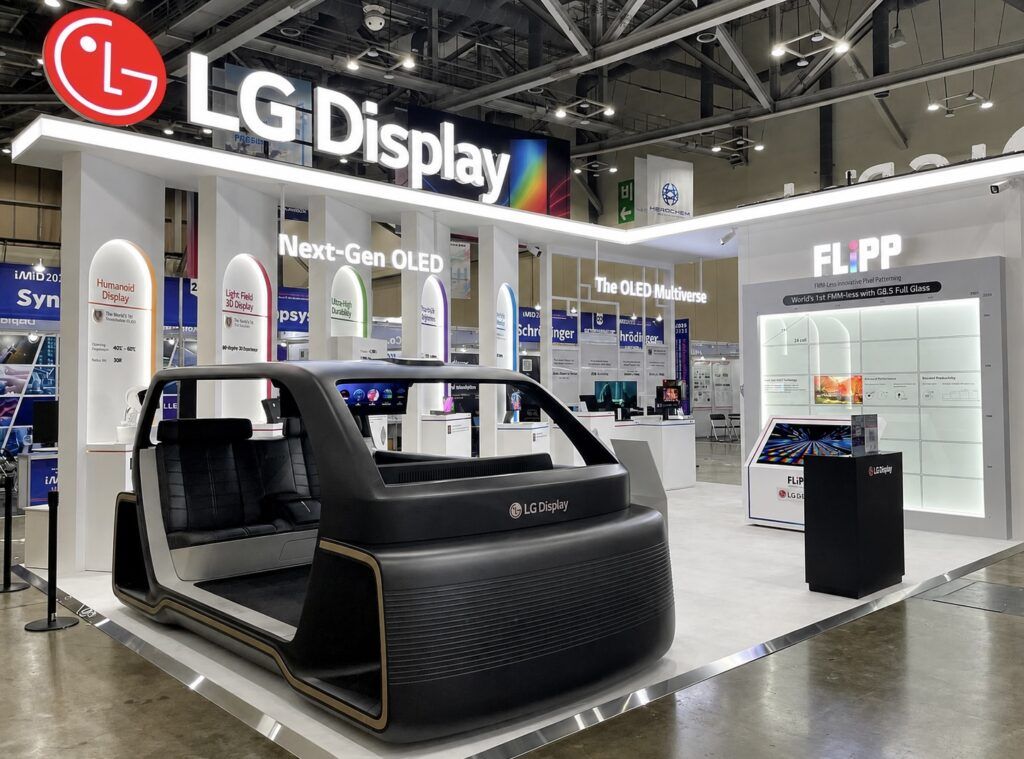 ↗
↗
LG Display’s FLiPP technique uses semiconductor-style photolithography to pattern OLED subpixels without fine metal masks, cutting material waste and boosting panel performance.
Photolithography removes the physical limits of metal masks, enabling higher-resolution, larger-format OLED panels at lower cost. The 13 % power saving and 2.4× lifespan extension directly improve the economics of OLED adoption in laptops, monitors, and TVs.
Written by elseif from the cluster below · every claim links back to a sourceThe three things worth knowing
FLiPP eliminates fine metal masks, increasing subpixel aperture ratio by 55 % and reducing material waste by 64 %.
Panels gain 1.6× brightness and 2.4× lifespan while drawing 13 % less power.
LG plans $2.15 billion investment to commercialise FLiPP by late 2027, starting with laptops and monitors.
THE READ
What the cluster adds up to.
Fine metal masks have been the bottleneck in OLED manufacturing: heavy, prone to sag, and limited to small motherglass sizes. FLiPP replaces them with photolithography, the same process used in semiconductor fabrication. A uniform layer of organic material is deposited, then a photoresist is applied and selectively hardened with UV light through a photomask. Unhardened material is washed away, leaving the RGB subpixels in place. The cycle repeats for each colour, producing a complete OLED stack without the geometric constraints of a metal stencil.
The immediate consequence is a 55 % increase in aperture ratio, which directly translates to 1.6× higher brightness and 2.4× longer panel lifespan. Because the pixels are closer together and the panel does not need to be driven as hard, power consumption drops by 13 %. Material utilisation jumps from 30 % to 64 %, cutting per-panel cost. LG has already demonstrated the technique on an 8.5-Gen motherglass (2 200 mm × 2 500 mm), a size that would have required cutting and rejoining with metal masks.
FLiPP is not the first maskless OLED process, Japan Display’s eLEAP and Visionox’s variant predate it, but it is the first positioned for mass production. LG’s $2.15 billion investment targets late 2027 for commercial output, initially for laptops and monitors. The technique is resolution-agnostic and scalable from 1 inch to 100 inches, removing the need for custom masks for each new panel design. This flexibility accelerates iteration and lowers the barrier to entry for high-resolution OLED in new form factors.
While FLiPP is compatible with any OLED stack, LG is focusing on RGB OLED, where red, green, and blue subpixels are deposited directly. This contrasts with WOLED and QD-OLED, which use white or blue emitters plus colour filters. Direct RGB deposition improves colour volume and gamut, addressing traditional OLED weaknesses in saturation and brightness. The combination of FLiPP and RGB OLED could therefore shift the competitive balance in premium displays, particularly in applications where colour accuracy and power efficiency are critical.
Written by elseif from the cluster below · checked for specifics the sources never containedTHE CLUSTER