PLATFORMS Signal 51
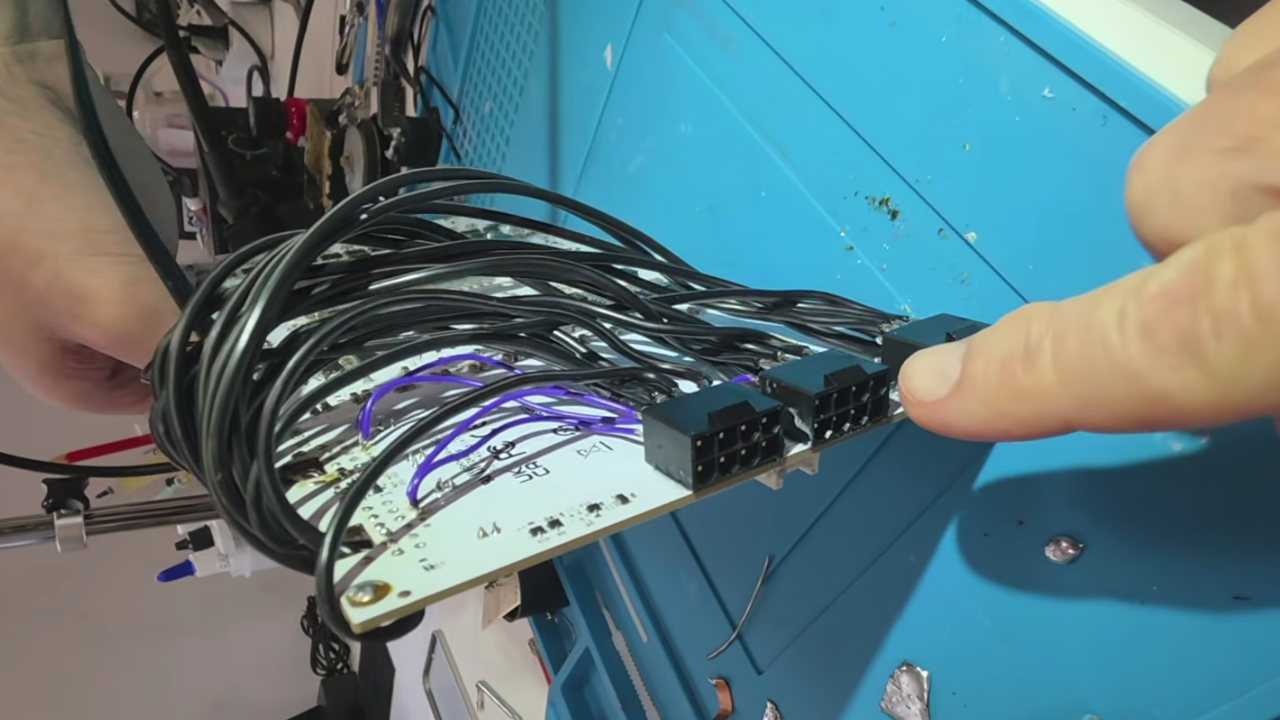
Modded RTX 5090 replaces 16-pin power with triple 8-pin connectors drawing up to 900W at 3,400 MHz
 ↗
↗
A hardware mod demonstrates that traditional 8-pin PCIe connectors can sustain extreme power loads for high-end GPUs without relying on the newer 12V-2x6 design.
This experiment challenges assumptions about power delivery limitations in modern GPUs and highlights potential reliability trade-offs in connector design. For engineers, it raises questions about whether legacy power standards can still meet the demands of next-generation hardware without compromising stability.
Written by elseif from the cluster below · every claim links back to a sourceThe three things worth knowing
The modded RTX 5090 achieved 900W power draw and 3,400 MHz clock speeds using three 8-pin connectors instead of the standard 16-pin.
Each 8-pin connector handled over 120A during testing, far exceeding its official 150W rating.
The experiment suggests older power connectors may still be viable for high-end GPUs despite industry shifts toward newer designs.
THE READ
What the cluster adds up to.
The mod demonstrates that 8-pin PCIe connectors, despite their official 150W rating, can sustain power loads far beyond spec when properly implemented. This was achieved by soldering heavy-gauge cables directly to the PCB’s power regulators and rewiring sense pins to bypass built-in power limits. The result, a 900W draw at 3,400 MHz, shows that the physical connector itself is not the bottleneck, but rather how it interfaces with the card’s power delivery system. For engineers, this underscores the importance of trace design and cable gauge in high-power applications, not just the connector type.
While the mod proves technical feasibility, it also reveals practical trade-offs. The use of three 8-pin connectors occupies more physical space than a single 16-pin, which could complicate case design and cable management. Additionally, the experiment relied on liquid cooling to manage thermals, a requirement that may not scale to consumer builds. The lack of software or BIOS modifications suggests the card’s firmware still expects a 16-pin interface, meaning real-world adoption would require either hardware workarounds or vendor support. This limits the mod’s immediate applicability but opens a discussion about power delivery flexibility.
The experiment arrives amid ongoing concerns about 16-pin connector reliability, particularly melting issues in high-performance GPUs. By showing that 8-pin connectors can handle extreme loads without failure, the mod challenges the necessity of the newer 12V-2x6 standard for high-end cards. However, the 8-pin’s lower pin count may still pose risks under sustained high-current conditions, such as increased resistance or heat buildup in cables. For engineers, this highlights a tension between backward compatibility and forward-looking standards, whether to optimize for proven designs or invest in newer, potentially more robust solutions.
The mod’s success with fewer connectors (e.g., two or even one 8-pin) further complicates the narrative. While clock speeds remained high, the reduced power draw suggests diminishing returns in performance per watt. This raises questions about whether the 16-pin’s higher power ceiling is truly necessary for most use cases, or if it primarily serves as a safeguard against extreme overclocking. For system builders, the experiment implies that power delivery could be modular, with users choosing between connector types based on their specific needs, though this would require industry coordination to standardize.
Written by elseif from the cluster below · checked for specifics the sources never containedTHE CLUSTER