TECH Signal 490
Open-source NanoGPT speedrun benchmark ranks model efficiency in code generation tasks
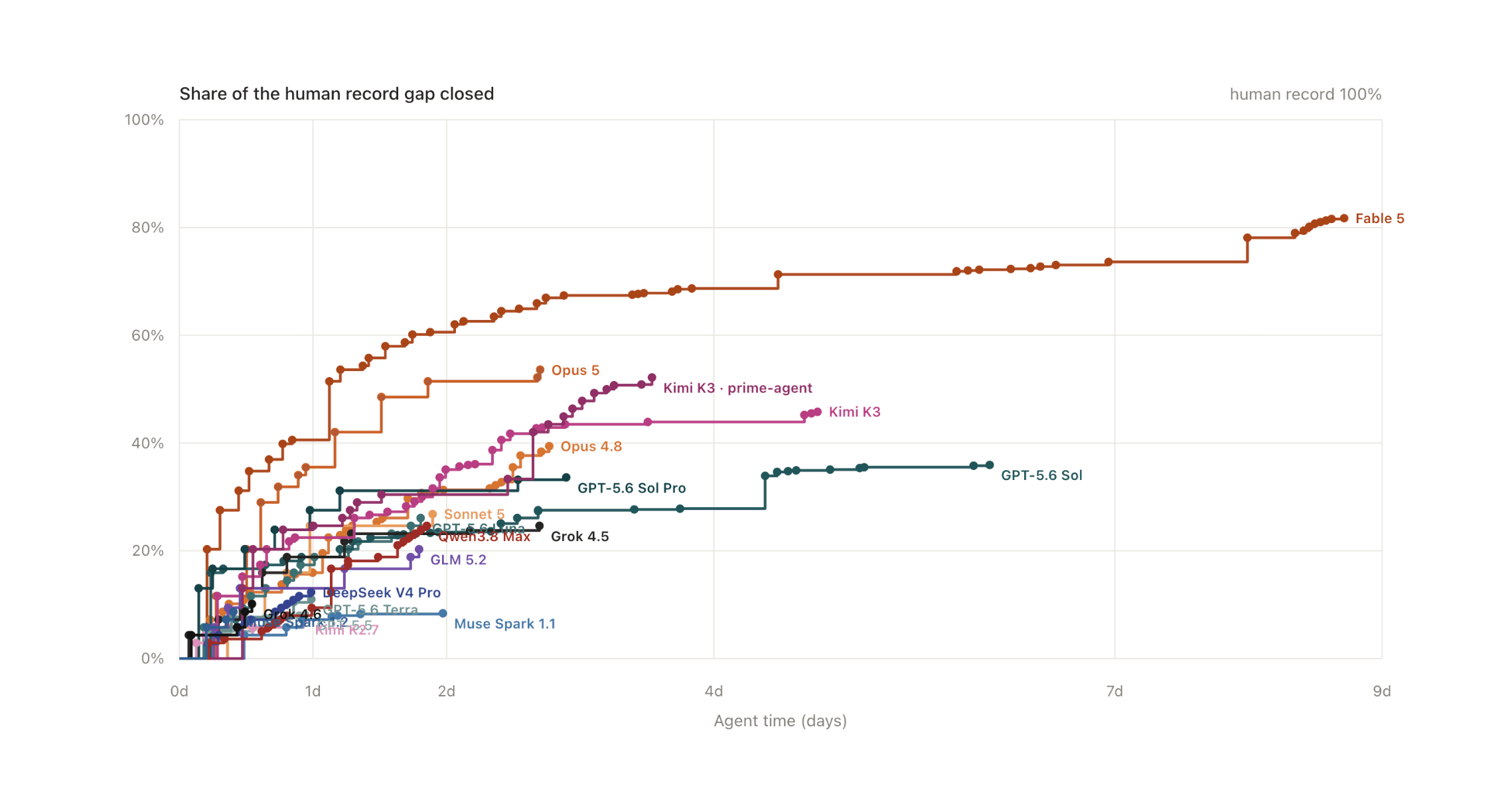 ↗
↗
A public leaderboard compares how quickly and accurately language models complete a constrained coding challenge.
Engineers tuning or selecting models for code-generation workloads now have a reproducible, apples-to-apples metric. The data shows that small efficiency gains compound over many inference calls, which directly impacts cloud costs and latency. No single model dominates across all dimensions, so trade-offs between speed, accuracy, and cost remain necessary.
Written by elseif from the cluster below · every claim links back to a sourceThe three things worth knowing
The benchmark measures both token throughput and correctness on a fixed coding problem.
Top models close 80 % of the gap between a human baseline and a naive upper bound.
Open traces let engineers inspect tool calls, subagents, and scratchpad usage for each run.
THE READ
What the cluster adds up to.
The NanoGPT speedrun is a public, time-bounded coding challenge that forces language models to generate working code under a fixed token budget. Each model is scored on two axes: the number of tokens emitted per second and the correctness of the final output. The leaderboard ranks models by how much of the gap between a human baseline and a naive upper bound they close within 24 hours of wall-clock time.
The data reveals that no single model wins on every metric. Fable 5 leads in gap-closed percentage but emits fewer tokens per second than some competitors. Conversely, models that push higher token rates often sacrifice correctness, leaving more of the gap open. Engineers must therefore decide whether their use case prioritises raw throughput, accuracy, or a balance of both.
Open traces are provided for every run, exposing the internal tool calls, subagent invocations, and scratchpad contents. This transparency lets engineers debug why a model succeeded or failed on a particular subtask. It also highlights that models with similar final scores can arrive at them through very different internal strategies, which may affect maintainability or cost in production.
The benchmark is deliberately constrained: models run on identical hardware, use the same prompt, and face the same token budget. This removes variability from infrastructure or prompt engineering, isolating the model’s intrinsic efficiency. However, it also means the results may not generalise to longer or more complex coding tasks where memory usage or context window size becomes the bottleneck.
Written by elseif from the cluster below · checked for specifics the sources never containedTHE CLUSTER